100,000,000+ Carts Filled Globally

Categories
Vape-Jet

101: What Can You Fill with a Vape-Jet?

Discover the Versatility of the Vape-Jet Filling Machine

Whether you are new to our products, or you have been a loyal follower of our brand since day one, you may find yourself surprised by the versatility of our filling machines. We’ve put countless hours into research and development to design a machine that can handle a wide range of oils and hardware styles. In fact, our machines can now save configurations for over 1,000 different devices, making it easier than ever to switch between hardware. But our dedication doesn’t stop there. Our team continuously strives to improve our products and adapt to the ever-evolving landscape of the industry. 

In this article, we’ll dive deeper into the unique functionalities and capabilities of our fully automatic filling machine. We’ll cover everything from the various oil types it can handle to the myriad of hardware styles it can accommodate. We hope to provide a comprehensive understanding of the machine’s workings and capabilities, making it easier for you to decide if our solution is the right fit for you. 
Vape-Jet
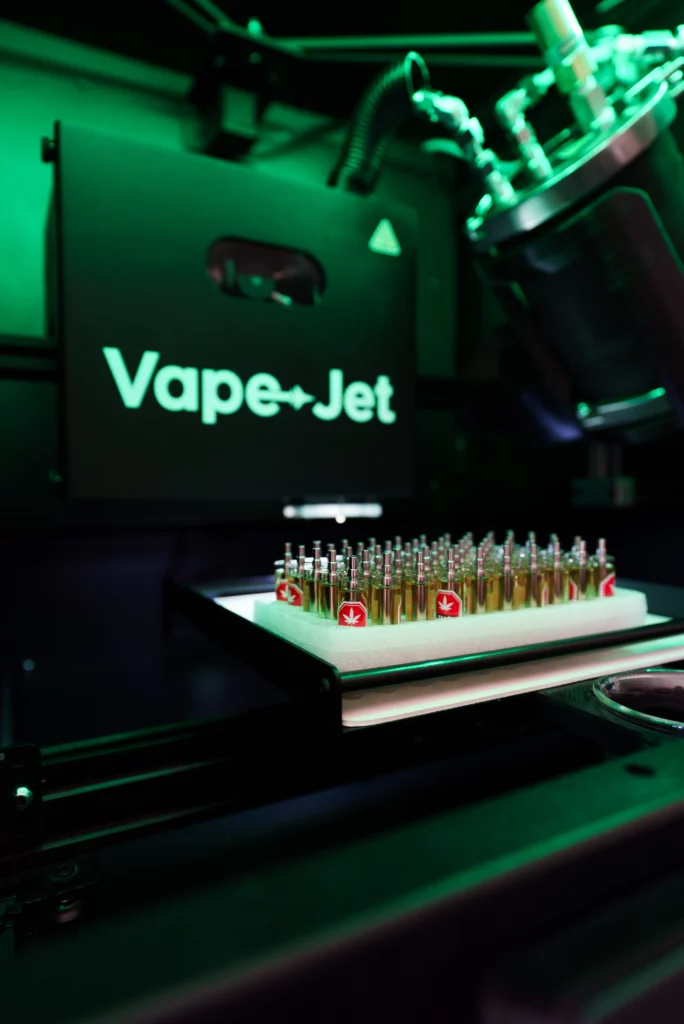
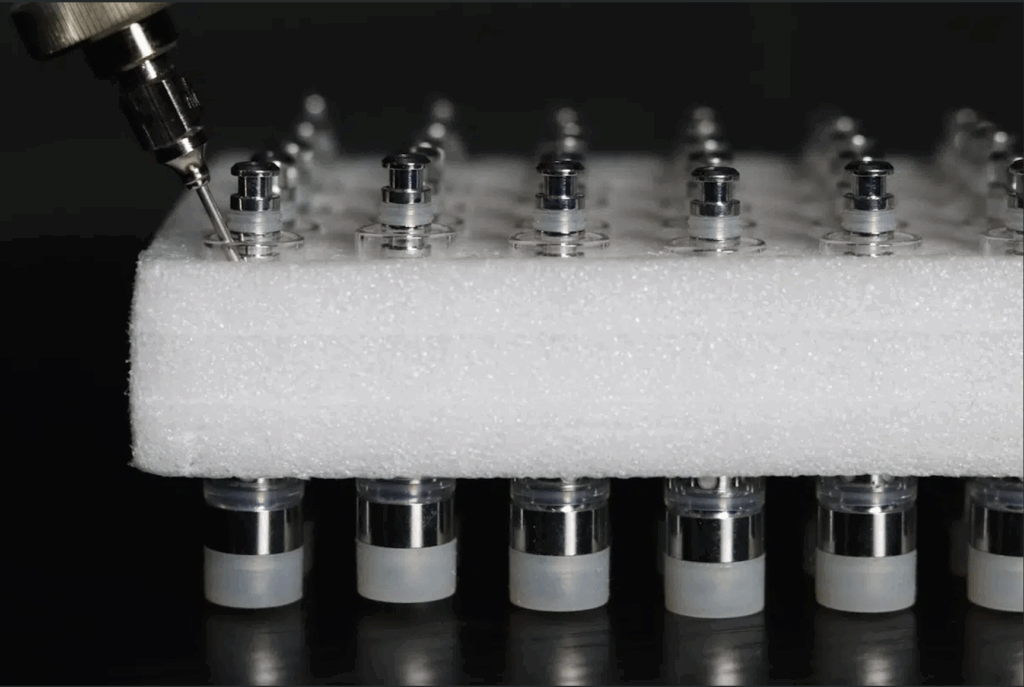
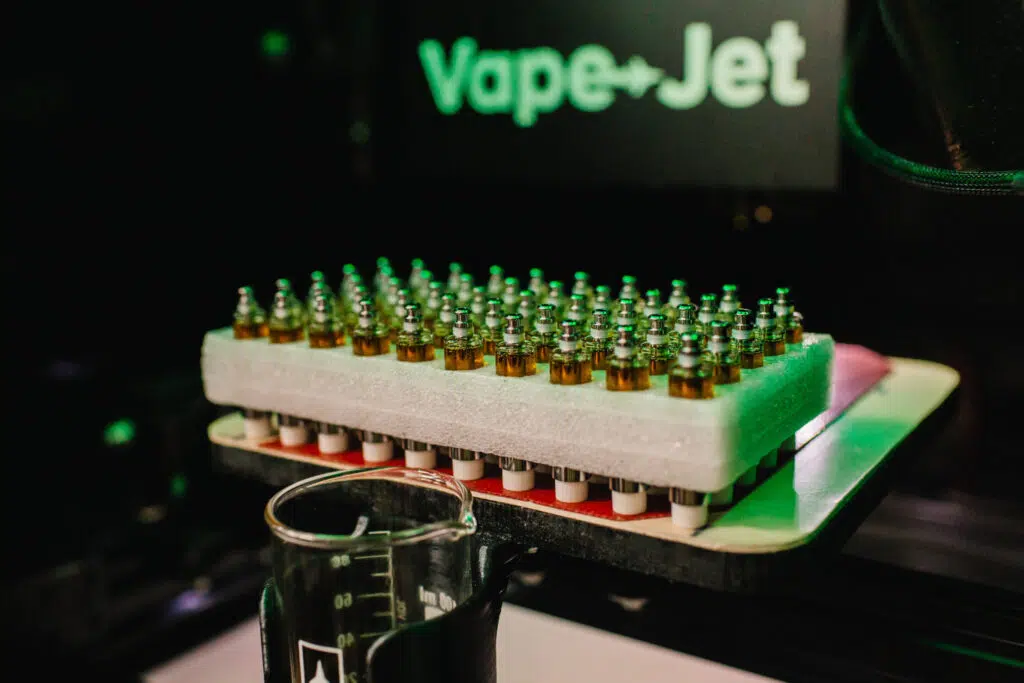
Precision filled 510 vape cartridges.

Explore Vape-Jet’s Oil Handling Capabilities 

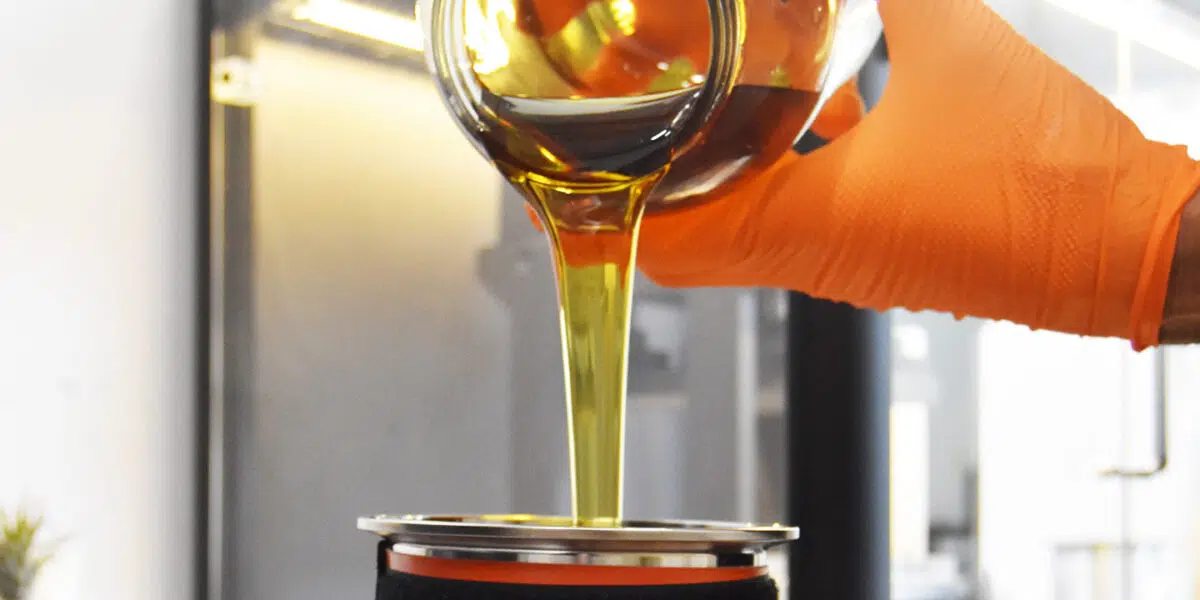
The Vape-Jet’s pharmaceutical-grade syringe pump is designed to handle an extensive range of oil viscosities and formulations. How do we achieve this? With the help of closed-loop feedback motors for the syringe pump, our software has the ability to detect any stalling caused by particularly thick fluids. Instead of halting, the system internally slows down, applies more torque, and finishes the dispense accurately each time. 

Our system integrates nitrogen assistance to push the oil through the fluid path, eliminating the need for it to be pulled through by the pump. This function allows the machine to operate at the lowest possible temperatures across the three independent heating zones located at the reservoir, pump chamber, and needle. 

By keeping heat to a minimum during the filling process, your oil is shielded from oxidation, degradation, and contamination. The outcome? A more authentic, flavorful vaping experience that remains true to the original oil formulation. 

The types of oil that our Vape-Jet fully automatic filling machine can handle include, but are not limited to: 

  • Delta 9 THC Distillate (Botanical terpenes, Cannabis-derived terpenes, or Sauce) 
  • Live Resin (Liquid Diamonds and Sauce, BHO, Liquid Shatter) 
  • Rosin (Solventless Hash Oil) 
  • CO2 Extract 
  • Delta 8 THC Distillate (Botanical or Hemp-derived terpenes) 
  • CRD (Crystal Resistant Distillate) 
  • Minor Cannabinoids (HHC, THCv, THC-O, CBN) 
  • Full-Extract Cannabis Oil (RSO) 
  • Tincture 

We have developed a detailed recommended settings guide to help Vape-Jet operators identify the optimal parameters for filling different oil viscosities. If you ever find yourself in need of assistance, our support team is always standing by to guide you through the process of configuring your machine for a new type of oil. 
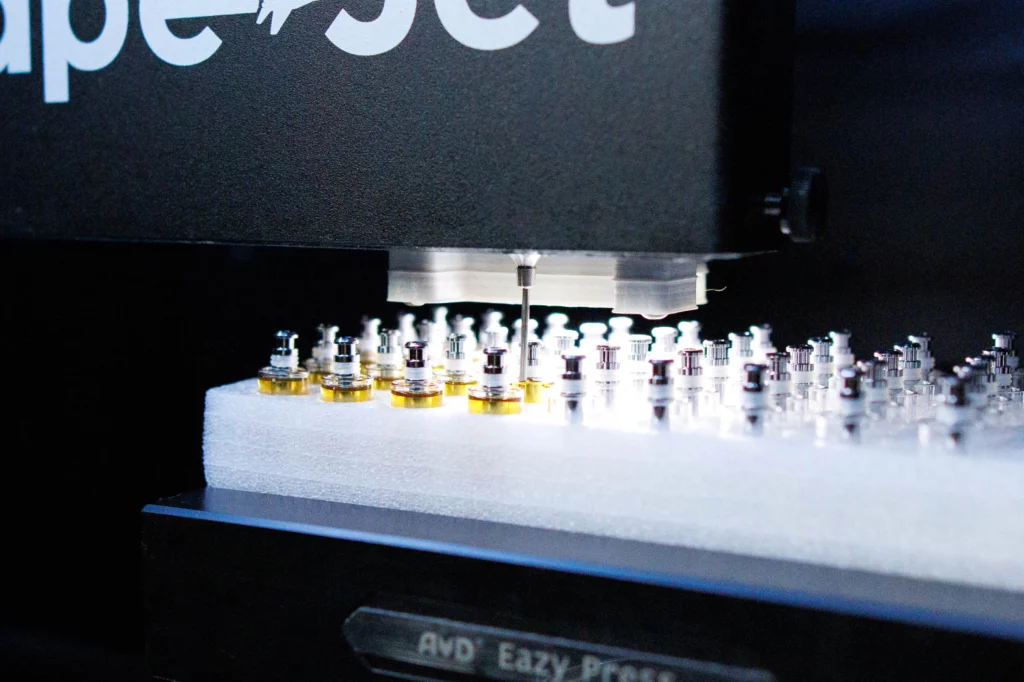
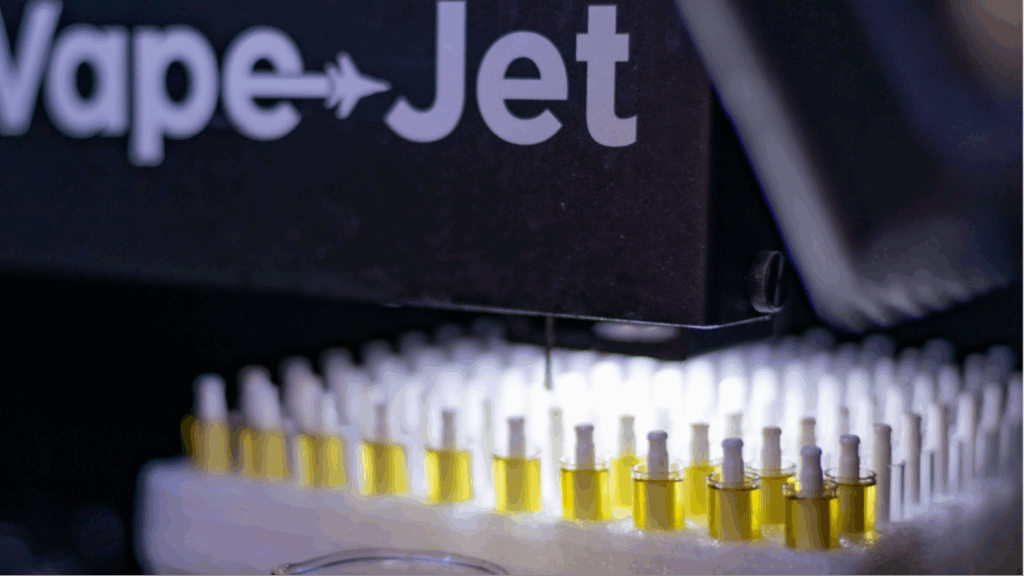
Vape-Jet fully automatic oil filling machine filling AVD Eazy-Press cartridges.

Redefine Adaptability with Vape-Jet’s Hardware Solutions 

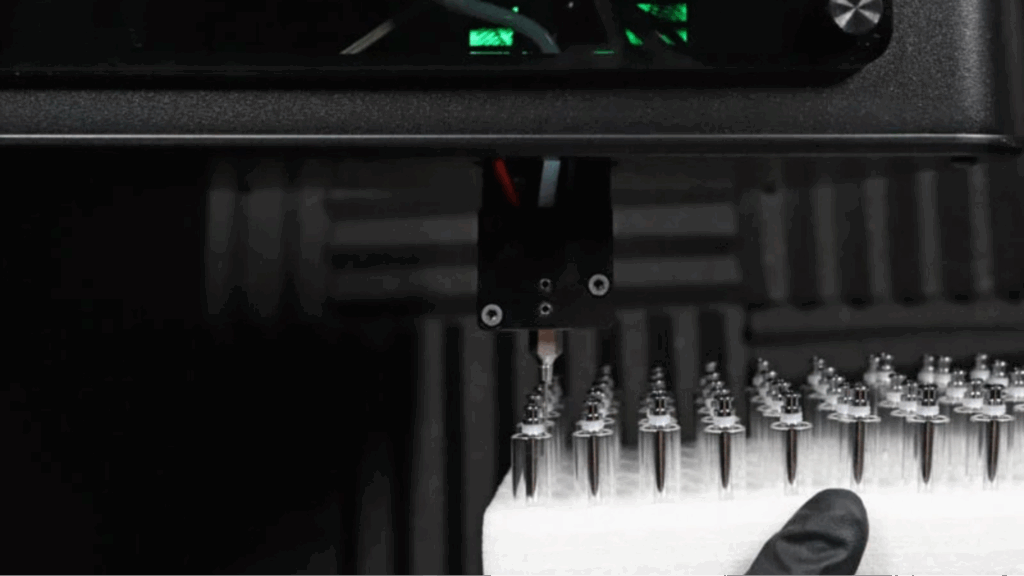
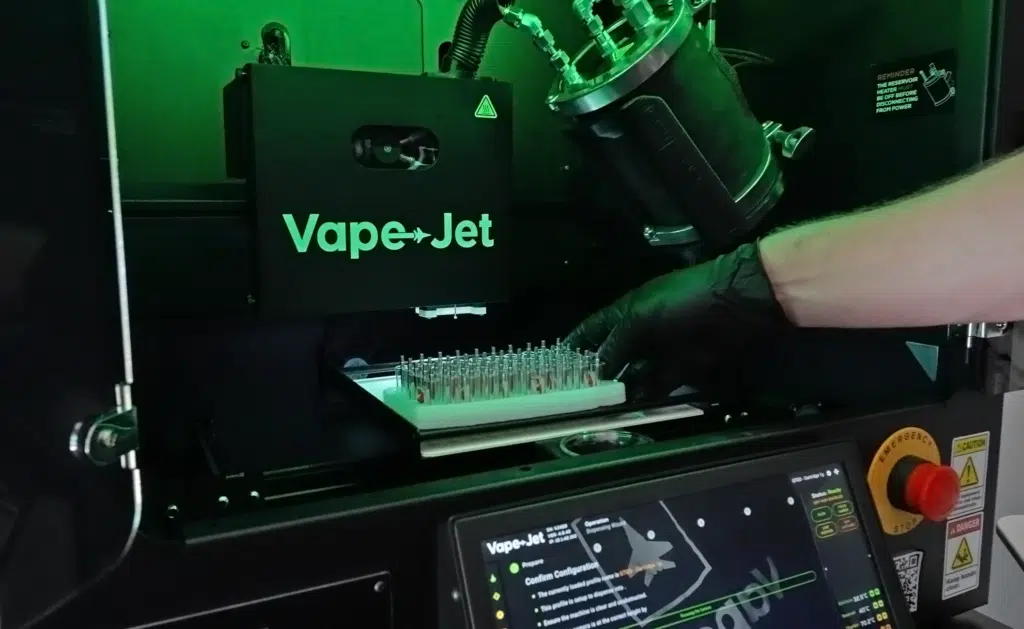
Our Vape-Jet fully automatic filling machine features an automated machine vision system. This advanced technology analyzes the hardware, aligns the needle over the ideal filling position, and fills each piece of hardware with unparalleled accuracy and repeatability, to within ±0.25%. 

This system relies on a software-based machine vision algorithm that uses the shape of the hardware and operator-provided information to accurately insert the needle into the specified opening. (Ex. The widest point between the center post and the outer wall of a circular cartridge, inside one or both of the oil tank openings of a double-sided pod, the center of a bottle or capsule) Thanks to the machine vision system and adjustable camera and needle heights, the Vape-Jet can be configured to fill a wide array of products of varying sizes and shapes without the need for physical retooling or additional alignment jigs. 

Types of hardware that our Vape-Jet fully automatic filling machine can accommodate include:  

  • Vape Cartridges  
  • Vape All-in-One Devices (Disposables) 
  • Vape Pod Systems 
  • Syringes 
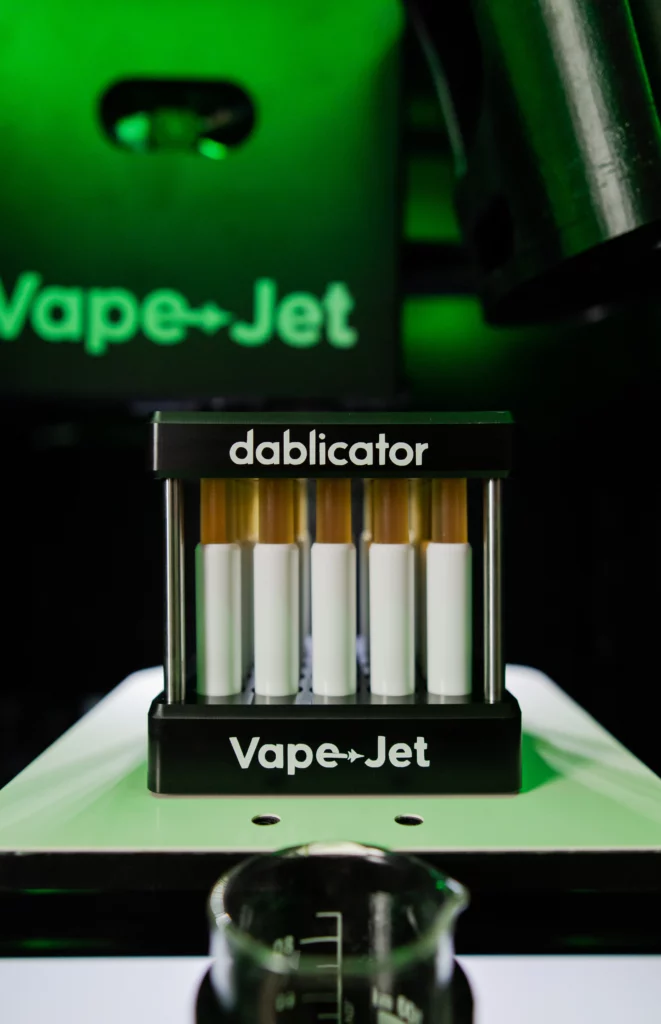
  • Dablicator Oil Applicators* 
  • Capsules 
  • Sauce Jars 
  • Tincture Bottles 
  • Pre-Roll Infusion (details below) 

With our third-party calibrated and certified pumping mechanism, we can swiftly and accurately fill any volume from 0.001ml to 5.0ml into your chosen hardware. Most cartridges and all-in-one devices come in trays of 50-100 from the manufacturer that can be placed directly onto the filling platform, eliminating the need for manual transfer and saving hundreds of touch points per tray. 
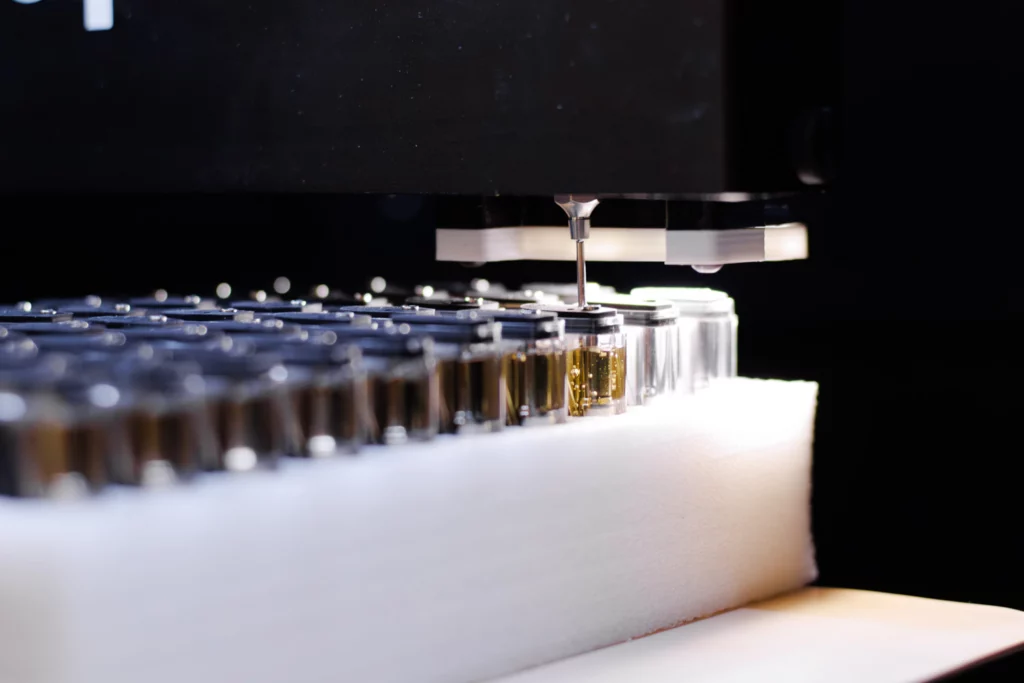
Vape-Jet fully automatic filling machine filling iKrusher all-in-one hardware.
Filled Dablicator oil applicator pens.
Filled Greentank 510 cartridges.

The Fuel Injector, Vape Jet’s Joint Infusion Solution 

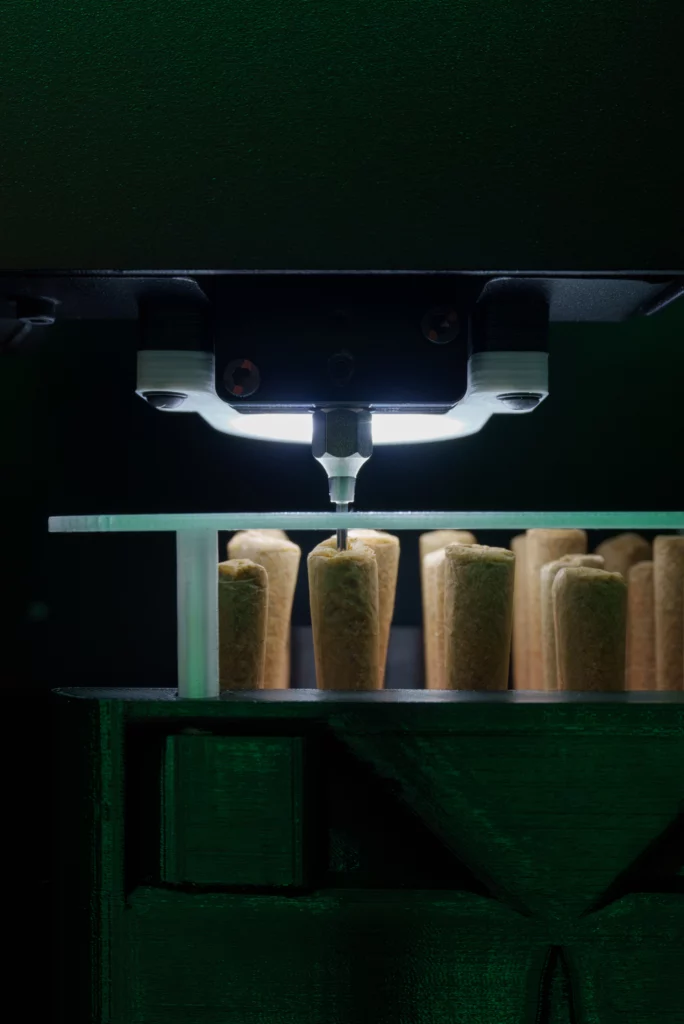
Exciting developments are always underway at Vape-Jet. Meet the Fuel Injector, our pre-roll alignment device. This innovative solution utilizes custom 3D printed components and a food-grade silicone jig to secure 24 pre-packed and twisted cones in place. The standard Vape-Jet needle is swapped out for a sharp stainless-steel needle which pierces and injects oil into each joint using the same machine vision technology deployed during cartridge filling. During the dispense, the needle retracts to evenly distribute oil throughout, leaving a precise line of oil down the center. This newest addition to our line of Vape-Jet accessories delivers on our goal to offer the most adaptable and robust filling solution available.

The Fuel Injector is now fully available and out of the research and development stage! Be sure to stay tuned to our blog and sign up for our monthly Re:Fill newsletter to be the first to know when new products drop.
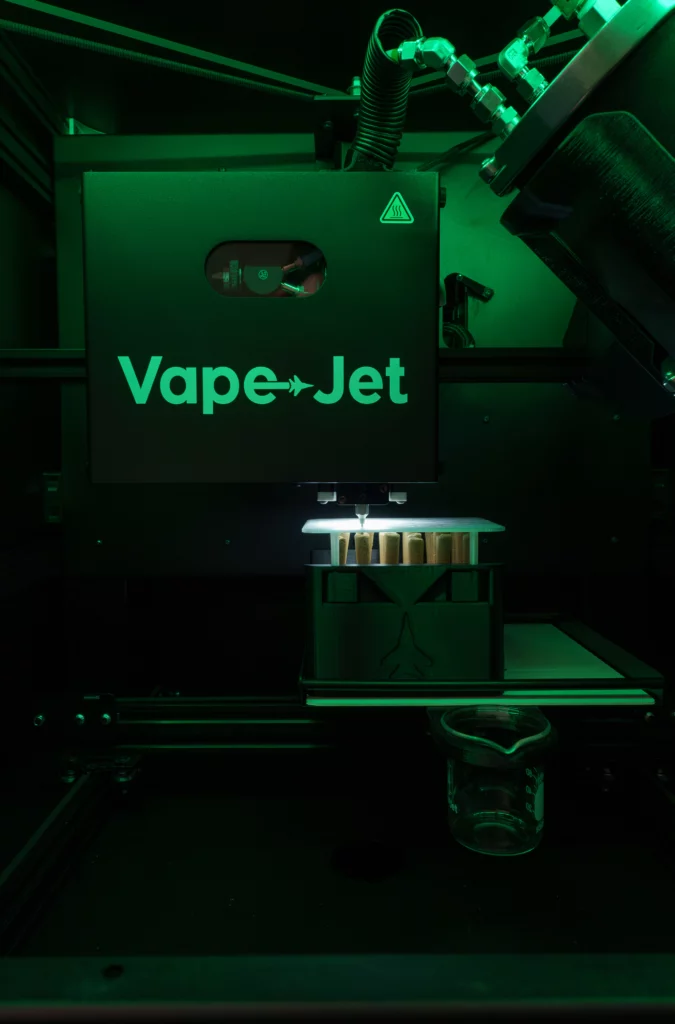
The Fuel Injector in a Vape-Jet filling machine.
Vape-Jet injecting oil into a pre-roll.

Confirm Your Hardware Compatibility 

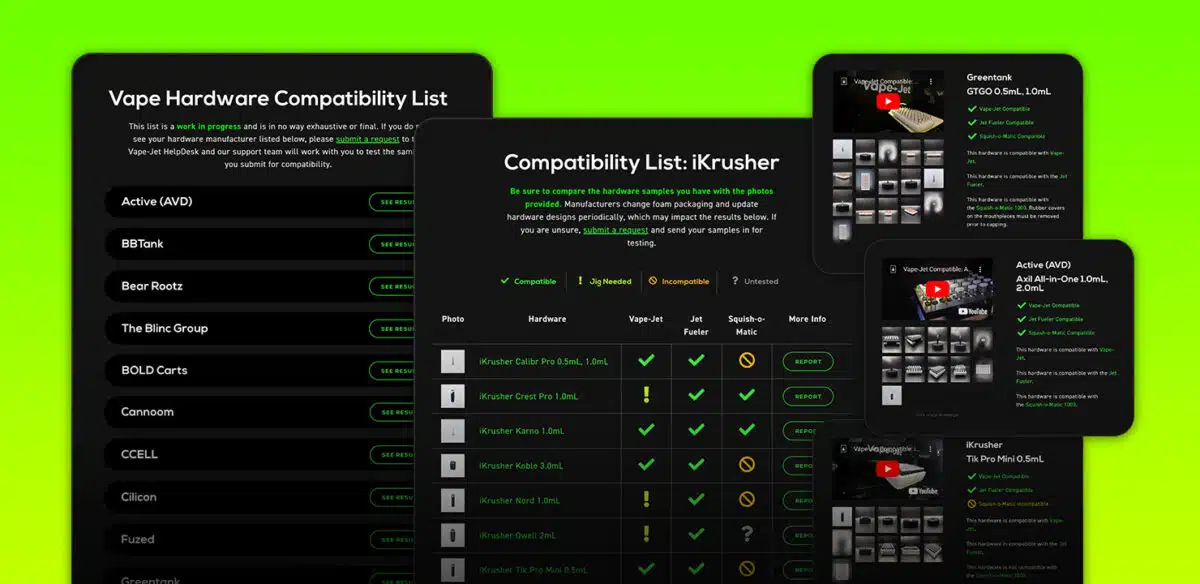
Want to know if your hardware is compatible with ours? With over 1,000 device profiles supported, there is a great chance we already work with your favorite hardware! Our support team offers complimentary testing to ensure our machines can accommodate your products. Simply open a ticket at the Vape-Jet HelpDesk, send a full tray to the specified address, and we’ll send back a detailed report. If an occlusion jig is needed, our engineers can design, fabricate and validate one in house for your specific hardware. 

*Requires Dablicator alignment jig for filling, available to purchase directly from Vape-Jet (Current Vape-Jet customers save $90) 

Embrace the Future of Vape Cartridge Production 

As the industry continues to evolve, consumer habits change, and new vape products are developed, we assure you that our team will keep pace with these changes. Our software-based platform and unique ability to actively deploy updates to our machines in the field ensure our fully automatic fleet will continue to adapt and innovate. 

If your operation isn’t quite ready to invest in a fully automated system, we provide an upgrade path from our semi-automatic filling machine. By purchasing a Jet Fueler now, we offer a discount on a Vape-Jet machine when your business is ready to scale. The best part is that you get to keep your Jet Fueler unit and expand your fleet for ultimate filling flexibility. 
Have Questions? We’ve Got the Answers 

Curious to find out if your hardware is compatible with ours? Submit a ticket to our HelpDesk for complimentary testing. 

Interested in hearing from customers who are actively using our machines? Browse our blog. 

Want to learn more about our filling solutions and their features and benefits? Reach out to our sales team. 

Don’t forget to sign up for our monthly Re:Fill newsletter to get early access to company updates, product releases, and other exciting announcements. Follow us on the essentials, too: Facebook, Instagram, LinkedIn, Twitter, and YouTube

Think Automation is a Thing of the Future? 

This article was developed by an AI copywriter. The future is now, so join the revolution or risk getting stuck in the past. If you’re ready to integrate automation into your workflow reach out to our crew with your questions to see what Vape-Jet automation solutions can do for you.

Categories
General Jet-Fueler Vape-Jet

How the Global CO₂ Shortage Affects Cannabis Oil Extraction

Industry Insight

For cannabis oil producers, the importance of CO2 cannot be understated. As the primary solvent in one of the most popular cannabis oil extraction methods in the industry today, the recent CO2 shortage has profound implications for oil production processes. With so much volatility in the market, let’s take some time to think about this CO2 dilemma and propose some solutions so oil producers can keep meeting customer demand while maintaining the same high-quality products consumers deserve. 

How did this CO2 Shortage Begin? 

As with any global shift in market availability, the reasons for the current CO2 situation are varied. Perhaps most significantly, the Russian invasion of Ukraine has created extensive oil and natural gas supply interruptions in Europe, leading to volatile petrochemical and agricultural markets which directly affect fertilizer production, of which food grade CO2 is a byproduct.  

This market uncertainty, tied to lack of supply, has already affected other industries close to cannabis. In the brewing industry, for instance, the impact of the CO2 shortage is already playing out, leading to increased input costs which have numerous upstream and downstream workflow ramifications.  

The Significance of CO2 for Vape Cartridge Producers

The benefits of using CO2 for cannabis oil extraction are well-documented, but it’s worth revisiting just how vital CO2 is for vape cartridge production.  

As the most common solvent for Supercritical Fluid Extraction (SFE), CO2 earns its place because of multiple factors: 

  1. It is one of the safest non-polar solvents 
  2. It is more dependable during SFE for preserving the compounds found in cannabis 
  3. It can pull various cannabinoids from the plant through fractioning 

When Will the Cannabis Oil Extraction Industry Feel the Shortage?

[CO2 demand] from the cannabis industry, for cannabinoid and terpene extraction, [has] been growing quickly, and not enough new capacity is coming online to compensate.” – Craig Bettenhausen, “US faces COshortage” 

The worlds of cannabis production and retail are accustomed to fluctuating markets. Most post-legalization markets, for example, overinvest in production capacity leading to wholesale cost reductions. Dealing with lower prices isn’t new, and it usually leads to consolidation and restructuring until the supply and demand for cannabis come back into alignment. How is this CO2 shortage different, and how is it similar? 

Well, although it can be difficult to predict when and how certain industries will react to a decreased CO2 supply, there are some reasonable expectations of when we will start seeing the shortage affect the cannabis industry. 

The first people to feel the CO2 supply shortage will be grow and cannabis oil extraction facilities, especially when natural gas and oil consumption spike in winter (Butane Hash Oil extractors will likely feel this pain as well). Accordingly, all cannabis flower, extract, and distillate will probably see cost increases throughout the year., which will squeeze profit margins on vape cartridges. 

Of course, this spike in the price of natural gas during wintertime will undoubtedly be exacerbated by increased gas exports to Europe from North America. As energy costs inflate due to decreased supply and increased demand, input costs for cannabis cultivation, extraction, and refinement will rise, ultimately yielding lower margins on cannabis products across the board and increasingly small returns. 

In short, with high electricity costs, high CO2 costs, and high butane costs, every step in the cannabis product chain will be affected.  

So, What’s the Solution?

Wholesale and retail marijuana prices continue to fall in most states, with production often outpacing consumption… The glut of cannabis products and brands have retailers in many states increasingly discounting their merchandise in hopes of shrinking bulging inventories and boosting sales amid growing competition.” – Andrew Long, “Midyear State Cannabis Sales a Mixed Bag Across the United States

With such clear indicators of pesky inflation and increased input costs on the horizon, we ought to think of some solutions. After all, we shouldn’t just read this information and run to the closest bar. It’s what we do with the information going forward and how we use it to stay ahead of the curve and prepare for the uncertainty that matters. 

So, what can you do? 

Solution 01: Invest in Automation

As input costs rise due to CO2 and other raw materials—and oversupply issues continue for the cannabis industry—prices will continue falling, ultimately squeezing out many operators with high costs and low returns. In other words, cost reduction is key, and reducing labor costs with automation may be the only way to compete.  

Luckily, this solution is our specialty. At Vape-Jet, we manufacture the most advanced fully-automated (Vape–Jet) and semi-automated (Jet Fueler) vape cartridge-filling systems on the market. In fact, we’ve discussed how vape cartridge automation is one of the most proactive, crucial investments you can make in your cartridge filling process quite a bit. 

Not only do our vape cartridge-filling machines fill your cartridges faster, more accurately, and help you overcome cartridge hardware challenges, our team also provides unmatched after-sales support to keep your operation running. That means higher productivity, decreased labor input, and satisfied customers. 

Vape-Jet 4.0 | The Most Advanced Fully-Automatic Vape Cartridge Filling Machine - Click to Learn More
Jet Fueler 2.0 The Most Advanced Semi-Automatic Vape Cartridge Filling Machine - Click to Learn More
Solution 02: Plan for a New Pricing Strategy

As Krista Raymer writes in her article, “to combat price compression, cannabis retailers can use psychology and consumer behavior tendencies to guide them toward certain products or shopping patterns. One important tactic to do this is through the lens of price perception.”  

Krista lists three strategies cannabis companies can use to stay ahead: ‘visualization of pricing,’ ‘in-store signage,’ and ‘insignificant numbers.’ Read detailed descriptions of these strategies in “Dispensary Pricing Strategy: How to Combat Price Compression.” 

Solution 03: Solventless Cannabis Oil Extraction

As we discussed earlier, CO2 is a dependable solvent for Supercritical Fluid Extraction (SFE). But what if you moved your workflow away from solvents? Well, it is safe to assume that solventless processes will see a significant boost if solvents inflate high enough. If you want to learn more about this cannabis oil extraction method and how it affects production, product quality, and operation costs, start with this article—“Extracting the Bottom Line.” 

And That’s Where We Come In

As we watch the CO2 shortage impact other industries around us, cannabis businesses should start preparing for the necessary strategies (cultivation, production, sales, etc.) to combat the inevitable results of price increases in our industry. Automation is one of the most straightforward ways to set your business up for success now and especially when uncertainty starts affecting the markets on which we depend. 

Reach out to the Vape-Jet team today, and let’s optimize your operation now and secure your workflow for the long haul. 

While you’re at it, don’t forget to sign up for our monthly Re:Fill newsletter to get early access to company updates, product releases, and other exciting announcements. Follow us on the essentials, too: Facebook, Instagram, and LinkedIn.  

Interested in our new partner program? Learn more here. 

Categories
Vape-Jet

Distillate Gun Vs Cart Filling Machine: Key Differences, Costs & Scaling Insights

Manual vs Automated Filling: A Crucial Production Choice

When it comes to scaling your vape cart operation or entering the vape cartridge space, every operator faces a crossroads: should I automate my workflow or continue using manual labor to fill each device or cart?

It’s only natural, at this intersection, to start wondering about the differences between distillate guns vs. cart-filling machines. While distillate guns are the preferred choice for emerging brands or beginners, automated vape cartridge filling equipment is the inevitable choice as volume grows. 

So, whether you’re just exploring new workflows or thinking about adding high-volume cart filling to your operations, this is the guide for you. Here, we’ll dive deep into all the pros and cons of manual vs automated cart filling to help you decide which is right for you. 

What Is a Distillate Gun?

To start, let’s cover the definitions and basics of both devices. A distillate gun is exactly what it sounds like. It’s a handheld “gun”- type device with a heated syringe-like filling tool that fills vape carts or all-in-one devices when its trigger is activated.

This method is entirely manual, so it’s best for smaller labs looking to add vape carts or all-in-one devices to their product SKUs, or for early-stage brands without the volume or capital to purchase fully automated equipment. 

In general, depending on the operator, distillate guns can fill 300-1,000 units per day. However, this can often come at a cost. Not only can operators become fatigued quickly from repetitive strain, negatively affecting morale, but fatigue can also lead to inconsistent fill volumes. 

Another factor that affects filling with distillate guns is the need to maintain temperature stability manually. Without advanced equipment to heat the extract material for you, you’ll be responsible for heating it yourself, increasing the risk of high product loss from drips, stringing, and reloads. 

Obviously, with the manual labor required to operate a distillate gun, this method has higher labor costs, which should be considered as part of the overall cost during initial conversations about which method to choose.

What Is a Cart Filling Machine?

For automated distillate filling, operators turn to vape cartridge filling equipment to alleviate labor costs and to increase daily output. These high-volume cart-filling solutions can produce 2,000- 100,000+ units per day, depending on the exact type you select. 

Beyond throughput, one of the most notable benefits of vape manufacturing automation is its ability to maintain stable temperatures. Most advanced equipment features advanced temperature controls, allowing you to fill with distillate and other thicker materials. 

No matter the type of extract you’re using, vape cartridge filling equipment is also more accurate, with fills typically within ±1–2% per fill for tight tolerances. They’re also designed to minimize drip, helping reduce waste overall. 

For maximum efficiency, it’s best to seek out equipment that offers repeatable, SOP-driven performance or configuration profiles within its interface. This allows you to seamlessly switch between SKUs, including various extracts or fill sizes. 

All in all, automated solutions reduce operator labor to a supervisory role only, alleviating your team from manual labor and increasing consistency and quality. Machines like Vape-Jet also offer add-ons that integrate with cappers to automate your workflows further. 

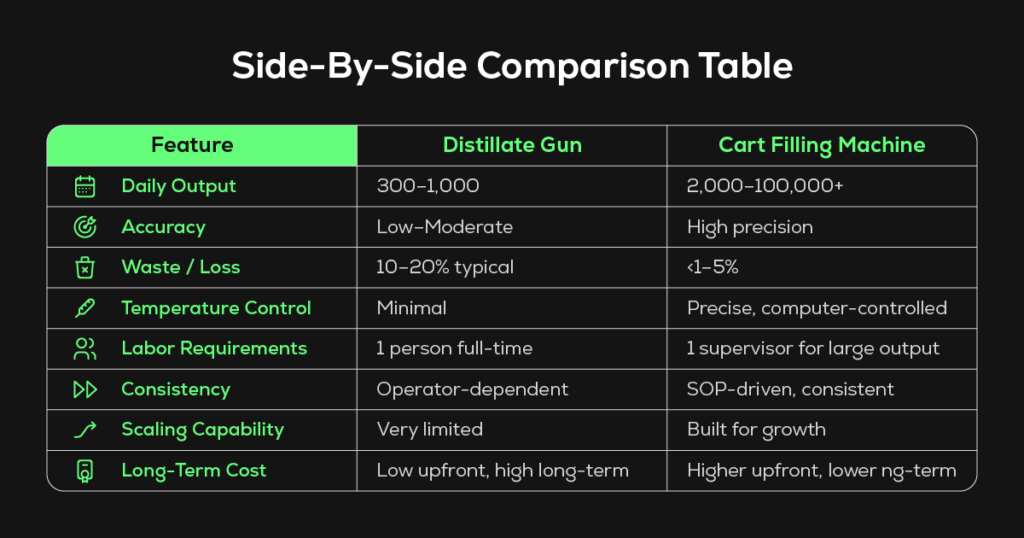
Side-By-Side Comparison Table

When deciding on a distillate gun vs a cart-filling machine for your operation, there’s nothing like a side-by-side comparison table to help. To summarize the main differences you need to know for scaling, take a look at the comparison of the major factors below.

Key Factors to Consider When Choosing

So, how do you know which is right for your operation when considering manual vs automated cart filling? There are a few key factors you’ll want to review and consider when making the decision, including: 

  • Batch size & daily output goals: Even if you’re starting small, if you plan to expand, or if retailer demand for higher output, you’ll want to consider long-term profitability. While distillate guns may suffice today, as output increases, you’ll need to consider automated solutions for optimal efficiency. 
  • Compliance & QA consistency requirements: If accuracy is a concern for compliance and quality assurance, automated solutions are also the way to go, as they are much more accurate fill-wise and less prone to human error. 
  • Budget vs long-term ROI: Manual tools may be cheaper upfront, but automated systems often deliver more substantial long-term ROI by reducing waste, labor hours, and rework. The more volume you run, the faster automation pays for itself.
  • Oil type (distillate, live resin, rosin, HTE blends): If you plan to expand into more viscous materials, such as live resin or rosin, you’ll want to consider selecting automated equipment with temperature controls and support. 

Lastly, consider your labor availability. If you’re running a lean operation with minimum staff, the need for hands-free operation will be greater than those that have the team size to support the bandwidth of manual filling. 

If labor costs are an ongoing concern for you, it’s definitely wise to consider automated solutions. Manual workflows require consistent staffing and skill to maintain quality, and quality can decline toward the end of shifts due to operator strain. 

Cost Comparison: True ROI of Automation

As we already mentioned, it’s not just the initial cost you’ll want to consider when deciding between distillate guns vs cart-filling machines. You’ll also want to consider long-term profitability and the ROI of automation in the long run. 

With that said, distillate guns are far less expensive up-front than vape manufacturing automation equipment. But they do produce higher levels of waste and require more labor, which drives up costs overall. 

Automation, on the other hand, reduces waste and manpower to just one or two operators while filling more carts or devices per hour. Since scaling requires efficiency and consistent product quality, operators have no problem justifying the cart-filling machine cost when seeing the value they’ll get in return. 

To summarize, even though vape cartridge filling equipment costs more initially, it provides long-term savings with: 

  • Labor reduction
  • Higher throughput
  • Reduced oil waste
  • Fewer failed QA checks and less rework

When a Distillate Gun Might Still Make Sense

Of course, high-volume cart filling equipment isn’t for everyone. A distillate gun is sufficient for micro-batch production or for facilities and labs conducting R&D. They’re also well-suited for those who want to start small or have a lower budget. 

With a trustworthy team and the proper protocols in place, distillate guns can fill small-batch orders with accuracy, allowing operators to scale to larger equipment later as profits and capital build over time. 

When a Cart Filling Machine Is the Superior Choice

If you’re already producing small- to mid-sized volumes and seeking to scale to the next level, it’s wise to consider a cart-filling machine. But keep in mind, not all vape cartridge filling equipment can be treated equally. 

When searching for the superior choice, there are a few features that’ll support the streamlining of workflows and help improve product quality, including: 

  • Data-driven precision
  • Pharmaceutical-grade engineering
  • Cleanroom compatibility
  • Reduced human error
  • Future scalability
  • Support + software updates

Why Choose Vape-Jet Machines Over Generic Automation

There’s a good reason the top vape cart brands choose Vape-Jet for their automated vape cartridge-filling equipment. The Vape-Jet is designed to address the industry and manufacturing challenges we’ve discussed here today. 

The company’s fleet of equipment is designed and manufactured in the USA, and hand-made using American-made parts. It offers every facility the complete training and ongoing support that come with its equipment, with customized SOP guidance for a smooth onboarding. 

As for equipment features, the Vape-Jet delivers efficiency, quality, and accuracy through machine-vision alignment, pharmaceutical-grade pumps, and a nitrogen-pressurized fluid path that protects the integrity of the precious materials used in its filling processes. 

To further assist the vape filling process, Vape-Jet’s clean-in-place procedures allow seamless SKU switchovers, closed-loop temperature control to maintain optimal temperatures for various viscosities, and a repeatability rate of ±0.25% with the lowest transfer loss on the market.

Finally, the manufacturers of Vape-Jet are constantly working to improve the Vape-Jet based on direct customer feedback. They routinely add new features, can customize and modify the machines to your workflows, and continually apply software updates to improve processes. 

Final Takeaway

As you’ve learned here today, when deciding between distillate guns vs cart-filling machines, there’s a time for distillate guns, and there’s a time for vape cartridge-filling equipment. For operators, it’s all about defining your facility’s long-term goals and overall product demand. 

While distillate guns are sufficient for small-batch, entry-level needs, vape manufacturing automation is essential once volume and consistency matter. When it is time to get serious about scaling, there’s one high-volume cart-filling machine to consider over the rest: Vape-Jet. 

Ready to Upgrade Your Filling Line? Get a Demo or Quote from Vape-Jet.

Categories
Vape-Jet

Filling Disposable Vapes vs 510 Cartridges: What’s Different, What’s the Same

From the first 510 cartridge to today’s eclectic collection of disposable vapes, the world of vaporizing has come a long way since its emergence on the scene. As one of the most beloved ways to consume for novice and experienced consumers alike, it’s no wonder the product category has evolved to prioritize convenience and quality. 

Of course, the way in which operators are filling those carts or all-in-one devices has also evolved. Long gone are the days when manual hand-filling is the norm, and today, more and more operations are turning to advanced technology and manufacturing to streamline their workflows and processes. 

Looking to expand your SKUs or improve your throughput, accuracy, or product integrity – no matter which product you’re filling?  This is the guide for you! Keep reading as we cover all the similarities and differences of filling a disposable vape vs. cartridges, and all the latest innovations that can help you do both the most efficiently. 

Understanding Filling Disposable Vapes And 510 Cartridges

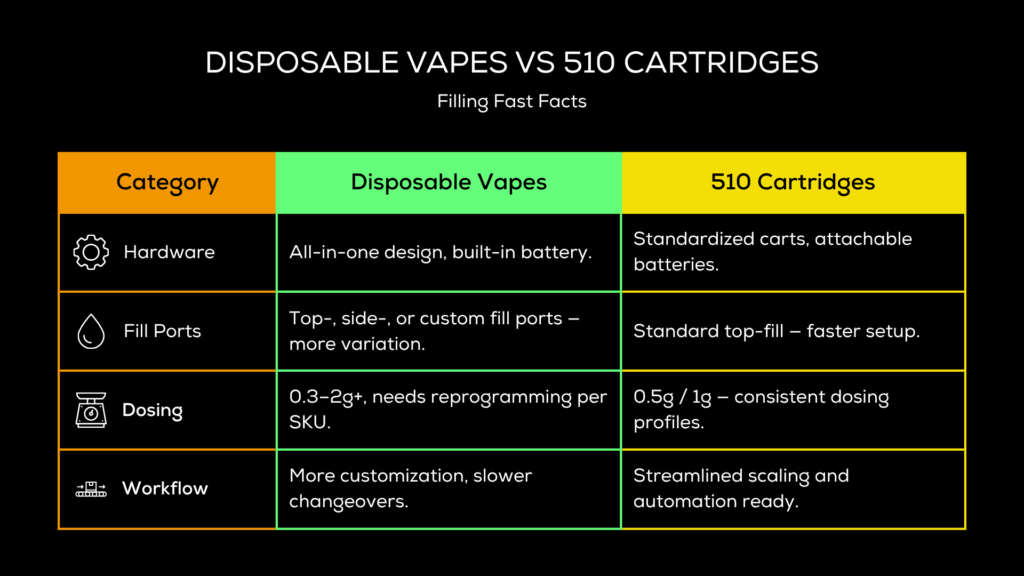
First, let’s get a general understanding of how disposable all-in-one devices differ from 510 cartridges, to understand the filling process for each better. It all starts with the hardware construction of each. Disposable devices come equipped with integrated batteries, hence their all-in-one nature, and reservoirs with a mouthpiece for airflow and use. Inside the reservoir is a wick that heats the material. 

Unlike 510 cartridges, disposable all-in-one devices don’t require manual attachment to batteries to power their use. Instead, 510 carts have a standardized threading to attach to the consumer’s battery, and are then capped with a mouthpiece as a seal. They, too, contain an inner core, or wick, that heats the oil to vaporize, for the consumer to inhale. 

One thing that is similar for both is that they can both be filled with various extract types. Both 510 and disposables can contain oils with different viscosities, such as distillate (the most liquid), to live resin, and live rosin (the most viscous). But the construction of each piece of hardware varies, causing differences in the space you have to fill, and the method in which you can do so, accurately and cleanly, to avoid waste. 

All in all, when learning how to fill a 510 cartridge, or exploring how do you fill a disposable vape in-house, it all comes down to the hardware you choose, and the equipment or tools you’ll need to do so, the most efficiently and effectively. To dive deeper, let’s explore fill head types and compatibility with disposable and 510 cartridge fillers, next.  

Fill Head Types and Compatibility

So, how do the fill head types differ when filling disposable vapes vs. 510 cartridges? Let’s consider their designs to understand the process better. For cartridges, you’ll typically be working with top-fill designs and press-on cap styles. However, as we’ve mentioned, there’s no standard disposable device, making each one unique. 

This means disposables may require top-fill designs, side-fills, or even proprietary fill port styles. This requires specific nozzle control, or geometry, to place the filler nozzle into the device just right to fill precisely. As for the similarities, both demand clean insertion and can benefit from nitrogen-assisted flow for the utmost preservation of the oil’s integrity, and precision filing, for protection against leaks. 

For differences, as you can likely tell, disposables are less forgiving, as mismatched fill heads can damage seals or create leaks, while 510s are standardized and generally more compatible. The advantage of investing in equipment, like Vape-Jet, means your operation can benefit from machine vision alignment that enables seamless transitions between disposables and 510s, minimizing downtime.

Dosing Adjustments and Precision

In the legal cannabis industry, it doesn’t matter exactly how you fill a 510 cartridge or disposable all-in-one device, but it does matter that you maintain accurate dosing for compliance, consumer trust, and margin protection. The dosing adjustments for both devices vary; however, cartridges tend to be more universal compared to modern-day disposables. 

Today, 510 carts usually have standardized fill volumes of 0.5g or 1g. While disposables vary more widely in reservoir sizes (0.3g–2g+), requiring reprogrammed dosing profiles. The precision of fill not only comes down to the volume, but also depends heavily on the viscosity management (read more about fill weight vs. volume here!). 

Equipment with a pharmaceutical pump and software-based guided calibration procedures is the most helpful for increasing precision filling, regardless of the device type. For instance, the Vape-Jet 4.0 allows operators to consistently hit desired fill volume with a repeatability rate of ±0.25% and the lowest transfer loss on the market, avoiding costly overfills. 

Workflow Considerations for Production

The key to scaling when filling disposable vapes vs 510 cartridges is to implement a workflow that allows the optimal production of both. For the majority of producers, this means investing in or upgrading the type of vape cart filler they’re using internally. The more efficient your fills get, the more products you can produce, and the higher the profits. 

Of course, it’s crucial also to consider the end-consumer. Just because you can fill more 510 cartridges or disposable vapes, that doesn’t mean you’re doing so optimally. If the fill clogs the device, it can affect the way in which the device draws, affecting customer loyalty and retention. If overfilling is common, you can waste product, which can negatively impact your bottom line. And so on, and so on. 

So, to finish our comprehensive guide to disposable vape vs. cartridge filling, here are the top workflow consideration differences and similarities to think of when implementing workflow improvements for each: 

  1. Changeovers: 510s cartridges allow for quick changes due to the standardization of size. On the flip side, disposables come in a variety of proprietary hardware types, which adds a level of complexity for manual fills. To combat this, leading operations implement technology or equipment that allows for saved machine profiles and potentially different handling steps, if filling with different viscosities, etc. 
  2. Scalability: Thanks to the 510s universal capability, they are often filled in larger volume batches. Disposables, however, usually run across multiple SKU variations, which include different types of oil fills, capacities (up to 3g!), and various designs for exclusive drops. This means that having workflows that can easily adjust to variants is key. 
  3. Quality assurance data: As mentioned previously, both workflows must consider compliance when it comes to filling and quality assurance, too. Traceability is required via METRC for all products, so having a workflow that integrates it into the process is crucial for avoiding costly fines and violations. For quality purposes, data that tracks good batches and not-so-ideal batches is a helpful tool for improving processes to meet consumer preferences and demand better.
  4. Labor efficiency: Your workflow is only as good as its efficiency. When implementing automation for filling either 510 or disposable vapes, you can not only reduce training gaps or downtime across workflows, but also human errors that can affect profit margins. 

In the end, these considerations, and ultimate efficiency and quality, are what drive operators to invest in innovative equipment, like the fully automatic Vape-Jet 4.0 for filling disposable vapes vs 510 cartridges. If you’re looking to level up your facility’s operations, whether filling 510 cartridges or disposable all-in-one devices, look no further than our fleet of equipment. 

Learn more about Vape-Jet now to fuel your workflows for optimal production. 

Categories
Vape-Jet

1-866-FUEL-420: Ground Crew on Standby

At Vape-Jet, we pride ourselves on empowering our customers to be in control of their production and automation. They’re the pilots, with hands on the controls, and eyes on the horizon, pushing the limits of precision filling for improved throughput and profit margins. 

Our mission on the ground? To be the crew that keeps your operations flying higher, faster, and smoother with exemplary support. That’s why we couldn’t be more thrilled to announce a new direct line to mission control: introducing 1-866-FUEL-420, where support is just one call away. 

Your Ground Crew, On Standby

In the cannabis industry, avoiding downtime is especially crucial to meet retailer demands and build valuable relationships. That’s why Vape-Jet is proud to make access to its world-class support team of engineers that much more seamless. 

In addition to our speedy help desk and ticket system, you can now reach “mission control” directly by calling 1-866-FUEL-420. Here, you’re not reaching a generic help desk. You’ll be speaking directly with cannabis technology experts who have intrinsic knowledge. 

Our new support line gives every Vape-Jet operator direct access to the engineers, automation specialists, and extraction chemists who design and optimize the same machines you rely on every day. 

They understand each pressure curve, nitrogen pulse, and temperature delta that affects day-to-day operations, rather than giving generic responses or putting you on hold, which delays production even further. 

From oil behavior to process control, it’s our mission at Vape-Jet to keep your production in the green. This is a direct output of the Vape-Jet Turbine, our operating system for performance and customer obsession. 

Pilot in the Cockpit

The Pilot in the Cockpit principle defines how we see our users: you command the mission, and we make sure the systems behind you never fail. Our Ground Crew is part of that same Turbine, spinning continuously to maintain your uptime and precision.

Every Vape-Jet interface, every data feed, and every diagnostic tool is designed to empower the operator. You’re in command of your facility’s unique operations. But even the best pilots rely on their ground crew to optimize the flight and to achieve the utmost success in the mission. 


That’s where our support engineers, available at 1-866-FUEL-420 come into the equation. They 

operate like flight controllers, monitoring telemetry, diagnosing issues, and providing actionable fixes to keep you on schedule. 

Whether it’s a viscosity adjustment, a software sync, or a process calibration, we’re here to ensure a smooth flight from takeoff to touchdown, keeping your workflows running smoothly and quality products moving out the door quickly (allowing profits to flow back, just as fast!).  

Fueling Your Flow

Of course, adding 1-866-FUEL-420 to Vape-Jet’s already robust support system is more than a number, it’s a commitment. It sets Vape-Jet apart from traditional equipment on the market today, offering a direct uplink to people who actually built your system, test your updates, and understand the flow path of your operation down to the micron. 

At Vape-Jet, our success isn’t measured in closed tickets. It’s measured in consistent fills, minimized downtime, and ensuring operators can focus on the mission. Rest assured, day in, and day out, your dedicated ground crew is on standby to help fuel your flow!

Today, Vape-Jet machines are responsible for filling over 96 million carts and counting. All backed by innovation, dedication, and a commitment to support vape brands across the US, and globally for seamless operations, that help operators scale. 

Cleared for Takeoff: Your Mission, Our Support, One Number

Uptime, process control, and optimal performance are crucial to every facility’s ability to keep up with retailer demands, improve product quality, and retain customer loyalty. At Vape-Jet, we ensure your workflow is mission-ready, despite any obstacles that may get in the way. 
If they do? Operators are standing by at 1-866-FUEL-420 to get your flight back on track, with ease. Not a Vape-Jet customer yet? Explore how our fleet of equipment is designed to boost productivity, with unmatched support from our direct line, and beyond.

Categories
Vape-Jet

Vape-Jet Named One of Oregon’s Fastest-Growing Private Companies

Vape-Jet is proud to announce our ranking on the Portland Business Journal’s Fastest Growing Private Companies in 2025. Alongside Oregon’s best, Vape-Jet’s fastest-growing company accolade highlights the team’s commitment to making an industry impact as a cannabis automation leader. 

Why it Matters  

Being honored as one of the fastest-growing companies is more than just a milestone celebrating Vape-Jet’s rapid growth. It’s a testament to the team’s relentless dedication to supporting innovation for real-world industry impact.  

Over the years, the Vape-Jet team has worked tirelessly to build technology that supports the 

seamless operation of extraction companies globally. In 2025, the company is nearing its 96,000,000,000 cart-filling milestone, with an interactive tracker available on its website. 

Vape-Jet remains committed to keeping the manufacturing, assembly, support, and fabrication exclusively in Portland, with local partners. For the area’s business community, the award signifies that cannabis technology drives legitimate, scalable economic growth in the state. 

Behind the Recognition 

Landing at #40 on the list of 100 of the area’s fastest-growing companies recognizes this momentum. From Oregon to Michigan, the US, and globally, the award solidifies the trust and credibility that the team has garnered across the cannabis industry.  

Day to day, the team builds upon its customer-first reputation, ensuring operators stay productive through every production cycle by: 

  • Expanding nationwide with installations across top multi-state operators and craft producers.
  • Supporting next-generation automation technology that integrates precision dosing, SKU flexibility, and product preservation.
  • Continually innovating to meet the unique demands of the industry and its operators, and providing world-class support. 

Altogether, the achievement represents a collective effort by Vape-Jet’s passionate team of engineers, innovators, and partners dedicated to advancing automation in cannabis manufacturing. 

What’s Ahead

Of course, Vape-Jet’s fastest-growing company accolade is only the beginning. A part of our active deployment and commitment to innovation means we’re constantly evolving to continue our scaling efforts —internally and for our fleet of customers! Stay tuned for all the latest Vape-Jet news by subscribing to our newsletter, and click below for more about our story. 

Learn more about Vape-Jet’s story.

Before we go, a big thanks to our team, partners, and customers for helping us achieve this recognition. Our team is forever grateful for the trust and partnerships that fuel our growth and help us land on the list of Portland Business Journal’s Fastest Growing Private Companies in 2025. Onward and upward! 

Read the full article on the 114 fastest-growing companies in Oregon. 

Categories
Vape-Jet

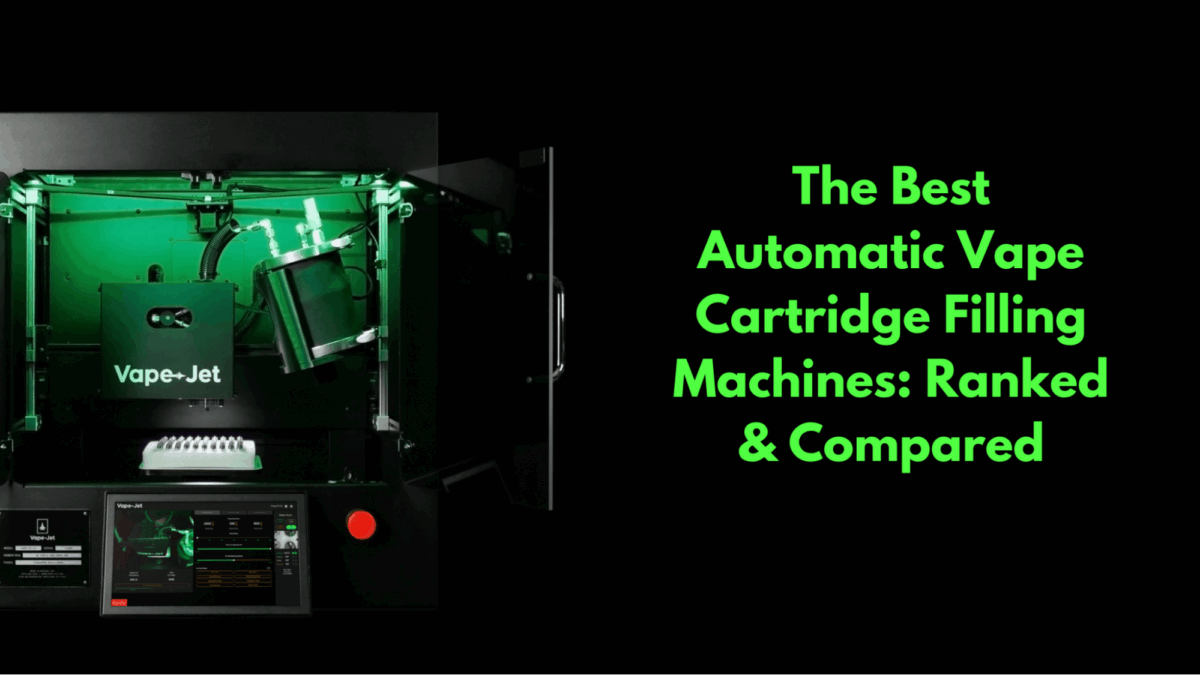
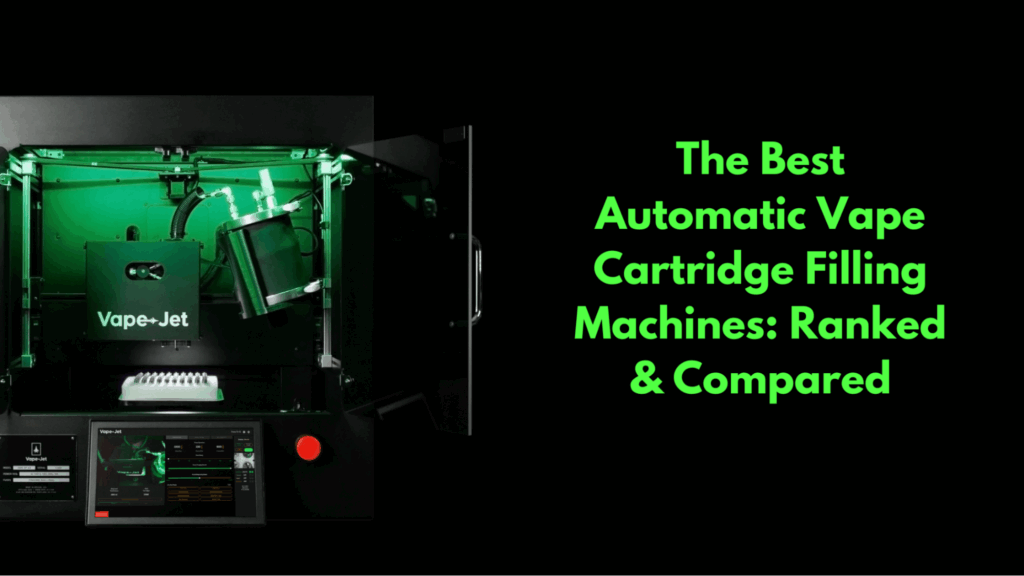
The Best Automatic Vape Cartridge Filling Machines: Ranked & Compared

If you know, you know…filling carts manually is a costly endeavor. Not only is it labor-intensive ($$!), it’s also prone to waste and errors. Of course, there is a solution. In fact, these drivers of rising costs and dwindling profit margins are to thank for the rise in demand for vape cart filling machines. 

Operators across the US are automating the process with cannabis filling machines, which are providing an immediate positive impact. From accurately filled cartridges, done so consistently, to machines that help preserve terpenes for quality, the best cart-filling machines are a game-changer for facilities seeking to scale. 

As one of the fastest growing product categories…vape cartridges, and all-in-one devices aren’t going anywhere, anytime soon. Meaning, automation to gain a competitive advantage. That’s where this guide comes in handy. Here, we’ll dive deep into the top four best vape cartridge filling machines on the market today. 

Wondering which of the best cart-filling machines would work best for your unique workflow and operation, from craft to high-volume and multi-SKUs? We’ve got you covered. Keep reading as we rank and compare these machines on real-world criteria affecting everyday operations: accuracy, speed, cleaning capabilities, compliance, and ROI. 

How We Evaluated These Machines

To start, how exactly did we evaluate the machines? Not every piece of equipment can be treated equally, so here’s what went into our rankings and comparison. 

  1. Functionality: The functionality of machines is crucial to the success of automation. We evaluated based on throughput (carts/hour), dosing precision, cleanability, and software features.
  2. Material handling: In the ever-evolving world of cannabis extracts, it’s wise to consider the equipment’s ability to handle various materials, such as distillates, live resin, and rosin.
  3. Operator feedback: A machine can have all the bells and whistles, but if they don’t translate to real-world applications, they might not be worth it. That’s where the weight of operator feedback, of how the machines work in real lab environments, helps. 
  4. Costs to consider: Not just the upfront cost or investment, but also labor savings, cost of maintenance, and the financial risks of downtime. 

Automatic Vape Cartridge Filling Machines Compared

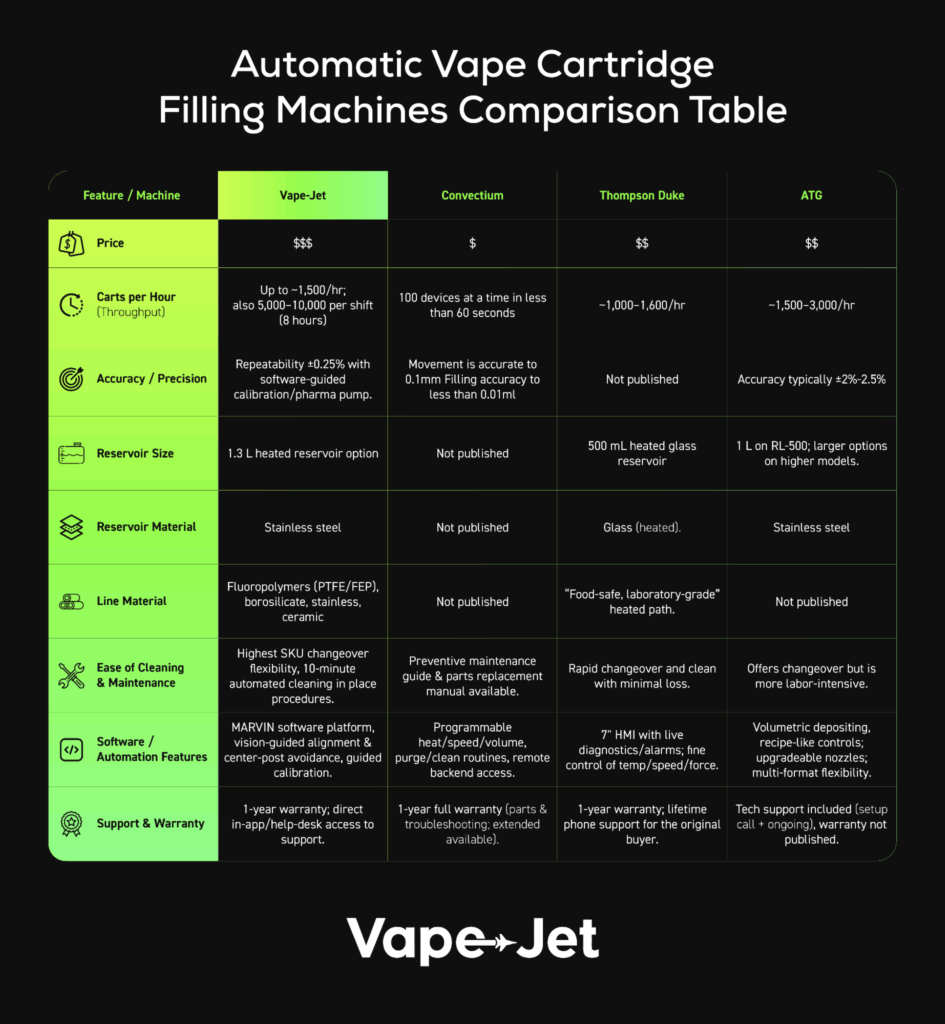
With so many vape cart filling machines, and so little time, we put in the work to review and compare each of the most popular machines, using the most beneficial benchmarks. Before we dive into the detailed reviews of each cartridge-filling equipment, let’s introduce the top four machines: Vape-Jet, Convectium, Thompson Duke, and ATG. We’ll discuss the types of operations they’re best suited for and their most notable features. 

Vape-Jet Vape Cart Filling Machine

The Vape-Jet vape cart filling machine is one of the top choices for its exceptional accuracy, extraordinary efficiency, and the quality manufacturing of the equipment itself. Using sanitary materials, such as stainless steel, and nitrogen-assisted fluid paths, operators can protect their precious oils while increasing efficiency with strong software and automation features. 

Due to its higher upfront cost, many consider the Vape-Jet cartridge filling equipment, the cream of the crop, making it best suited for operators serious about scaling and brand reputation.

Convectium Filling Machine

On the other hand, if you’re running lower-quality distillate and prioritize speed over quality, the Convectium filling machine might be a consideration. This piece of equipment offers a high-speed throughput, which is efficient for large standardized batches (not various SKUs) for a streamlined tray-based workflow.

Due to its lack of flexibility, it’s not ideal for brands with various SKUs or those looking to expand exponentially. At the same time, its higher temperature during operation can also be harmful to delicate oils, degrading natural terpenes. 

Thompson Duke Filling Machine

The Thompson Duke filling machine is another highly regarded and respected option that offers facilities, trusted and durable engineering. Its claim to fame is that GMP-ready models are readily accessible and available for upgrading quickly, with broad hardware compatibility for operations looking to scale to a variety of SKUs. 

However, the transition to other SKUs isn’t as “cannabis-friendly”, with more labor-intensive steps to go from filling 510-carts to disposable hardware, or handling various materials. It’s also less software-driven than newer systems, losing out on valuable traceability data and insights. 

ATG Filling Machine

Another lower-cost option that’s optimal for operations scaling from semi-automatic workflows to fully automated workflows is the ATG filling machine. This is another high-volume machine that prioritizes quantity over quality, making it ideal for distillate carts and lower-quality extract material. 

One of its major drawbacks is that it’s not explicitly designed for the cannabis industry and offers a broader accuracy rate. Even more, it takes more time for cleaning and changeovers, making it more difficult to scale with various SKUs. 

Summary Comparison Table

Nothing helps a decision more than pros and cons, and a comparison table with the top features for facilities to consider. So, here’s a quick side-by-side look at each of the best vape cartridge filling machines to help decide which is right for you.
Detailed Reviews of Each Machine

Now that you have a good idea of which machine you might be leaning towards, let’s get into our complete and more detailed reviews of each of these cannabis filling machines. 

Vape-Jet 

Vape-Jet is a USA-based team committed to bringing the most innovative automation technology to niche markets and underserved processes – like cannabis and vape cart filling. Its fleet of equipment includes the fully automatic vape cart filling machine, the Vape-Jet and a semi-automatic vape cartridge filling machine, the Jet Fueler. 

Made specifically for cannabis, the manufacturers of Vape-Jet have a deep understanding of the nuances and challenges of the industry, like quality and throughput, both of which are imperative to higher retail prices, and scaling exponentially. This commitment is evident in the equipment’s design, which features materials designed to preserve and protect extracts, along with AI-powered automation for maximum efficiency. 

With its advanced accuracy and repeatability rate of consistent fills, it offers operators the most advanced features available in an automated cannabis filling machine today, including its clean-in-place procedures, which take just 10 minutes and X ml of alcohol to perform, reducing downtime between SKUs. It also lets you skip the loading jig, minimizing the steps to start filling. 

To reflect on any weaknesses, the more innovative and effective a piece of equipment = the more it’ll cost, meaning it has a higher up-front cost than most machines. However, its operators can see a quick ROI in return, and savings in labor, thanks to only needing one operator to run. 

Convectium 710 Shark 

The Convectium filling machine, named the 710 Shark, is an automatic vape cart filling that relies on a tray fill approach and is built primarily for speed (no matter its compromises). It delivers there, with the capability to fill up to 100 devices at one time, in under 60 seconds. While the standardized system is well-suited for high-volume runs, it comes with a few compromises. 

If you want repeatable and programmable routines that keep the line moving while on one single SKU, the 710 Shark could be for you. But changeovers are less flexible than other machines, which can be difficult for operations that offer various SKUs. This means it’s best suited for distillate producers, with standard 510-threaded or disposable hardware, especially when the upstream prep and downstream capping routines are dialed in. 

Of course, something so high-speed can burn at higher temperatures, meaning operations will be limited on the type of terp-rich or solventless extracts they produce. Another disadvantage is the loading of the tray, which adds extra touch points and time to the operation as a whole, as well as additional employees to support the process. 

Thompson Duke 

One recognizable name in the manufacturing world that also makes our list of the best vape cartridge filling machines is none other than Thompson Duke. This long-standing company now offers an entire portfolio of equipment that’s specifically built for the volumetric dosing of cartridges, pods, jars, and syringes. The collection includes the ACF automatic filler line and the larger IZR platform, both designed to prioritize repeatability and SKU flexibility. 

Designed for operations that prioritize consistency and broad device compatibility, Thompson Duke emphasizes reliable mechanics and straightforward controls over flashy features. Teams running standardized programs appreciate its predictable fills, sturdy build, and established service network that supports training, spares, and uptime.

As for weaknesses, the Thompson Duke equipment is less software and vision-centric than more advanced AI models, like Vape-Jet. Plus, its heated-reservoir changeovers will add time to workflows when producing multiple SKUs or changing input extracts frequently. To run solventless material, or material that’s more terpene-rich, you’ll also need to fine-tune the prep to achieve the best results, adding time to the process overall. 

ATG Pharma

Finally, the last cannabis filling machine to review is the ATG filling machine. ATG Pharma is a manufacturer that specializes in filling and packaging equipment, like vape carts, but also creams, balms, lotions, bottles, etc. Their fully automatic system, the RoboCAP, prides itself on prioritizing flexibility between various SKUs, making it ideal for operations that produce more than just 510 carts. 

For teams that need one platform to run multiple product lines, RoboCAP’s recipe-driven controls and modular tooling make day-to-day operations feel familiar across cartridges, bottles, and topicals. It also offers an approachable path to scaling (from semi-automated setups to full automation) while aligning capital spend with growing demand.

As for its disadvantages, that same multi-format flexibility can lengthen changeovers and increase cleaning/calibration time between SKUs. The equipment’s accuracy tolerances are broader than ultra-precision, cannabis-specific fillers, and low-temperature, terp-preserving workflows may require extra tuning and disciplined SOPs to hit ideal results.

Material & Accuracy: What Many Overlook

When considering automation and upgrading your facility’s workflows, you may be overwhelmed by the initial costs, thinking, “Where can I save?”. However, when you consider how certain features can impact your brand’s future and long-term customer loyalty, you might think differently about which factors to skimp on – those being material handling and accuracy. 

Stainless steel reservoirs and PTFE lines are essential to preserving the natural integrity of the material you’ll be filling carts with, and protecting it from contamination. If a safe, trustworthy, quality, and tasty product is what you’re seeking, then you’ll want to avoid equipment that has aluminum or silicone parts, which can degrade terpenes (the taste centers!) and cause leaching. 

Not only do sanitary materials support a quality end-product when it comes to terpene and flavor integrity, but they also support compliance, keeping your material free of harmful contaminants. Even more critical to compliance and consumer satisfaction is dosing precision. While state regulations vary on the margin of error that’s acceptable for dosage, it’s something you don’t want to worry about, if necessary. 

Beyond that, a quick search on Reddit shows that consumers are highly concerned about underfilled carts, and overfill inaccuracies can compound over time, making a cumulative impact. What may seem like a small amount here and there can equal an immense cost of waste over thousands of carts, all of which are overfilled. 

Cost and ROI in Practice

Again, like we mentioned earlier, it’s not just the upfront price you should consider when factoring in the cost of the machine you choose. You’ll also want to consider the ROI you’ll get in return, as long-term savings, including: 

  • Less waste
  • Labor reduction
  • Higher retail cost/profit margins

By increasing your precision and accuracy in fills, you’ll minimize the amount of oil loss per cart and boost margins overall. Beyond, by upgrading your equipment, you can also better preserve its natural integrity, which can, in turn, command a higher retail price. Moreover, reliable machines (with reliable support!) can cut downtime costs, too. 

Altogether, treat the upgrade as an investment in your brand’s future growth, as choosing the right system (and paying extra for the features that matter!) will pay itself back, faster than you may imagine. 

Choosing the Right Machine for Your Operation

Lastly, to finish our complete guide to the best cart-filling machines, it’s crucial to weigh the options, features, and capabilities, alongside your operation’s unique demands. First, and foremost, where are you in your business? Are you a craft operation or a high-throughput enterprise? Do you fill with low-quality distillate or terp-rich solventless extracts? 

These answers will determine whether you should prioritize material quality or output (despite accuracy), while you can consider other factors, such as compliance, cleanability, space, and price from there. Another crucial factor that’ll make a long-lasting effect over future workflows is the type of support the brand offers, too. 

In the end, a machine is only as good as the training, warranty, and type of support that’s available when you need it the most (like meeting retailer’s drop dates, or keeping up with demand and avoiding downtime). When choosing the right machine for your operation, ask for references you can speak to directly, or at the very least, peruse reviews and testimonials. 

Vape-Jet Compared: Why It’s the Smart Choice for Scaling and Compliance

All in all, while it’s always best to receive a second opinion or do your research, it’s not hard to see who’s manufacturing the best vape cartridge filling machine. Vape-Jet is the leading choice of leading extract companies across the globe. From its industry-leading accuracy to premium materials, it’s designed for terpene-rich, high-value extracts for brands seeking to gain consumer trust and retention. 

Adding to optimal profit margins is the Vape-Jet’s clean-in-place procedures, minimal downtime, and fast SKU changeovers, supporting the efficient operations of leading vape companies. The Vape-Jet’s advanced software and data reporting tools make it compliance-ready with traceability features, and allow you to make future-proof decisions with valuable insights. 

At Vape-Jet, our machines are specifically made for the cannabis industry, with a dedicated cannabis-focused support team that understands the unique challenges of the industry. Ready to propel your business to all new heights? Look no further than the Vape-Jet fleet of equipment, from the fully automatic Vape-Jet to the Jet Fueler, a semi-automatic vape cartridge filling machine. 

Get in touch with our sales team to learn more now or to schedule a demo. 

Categories
Vape-Jet

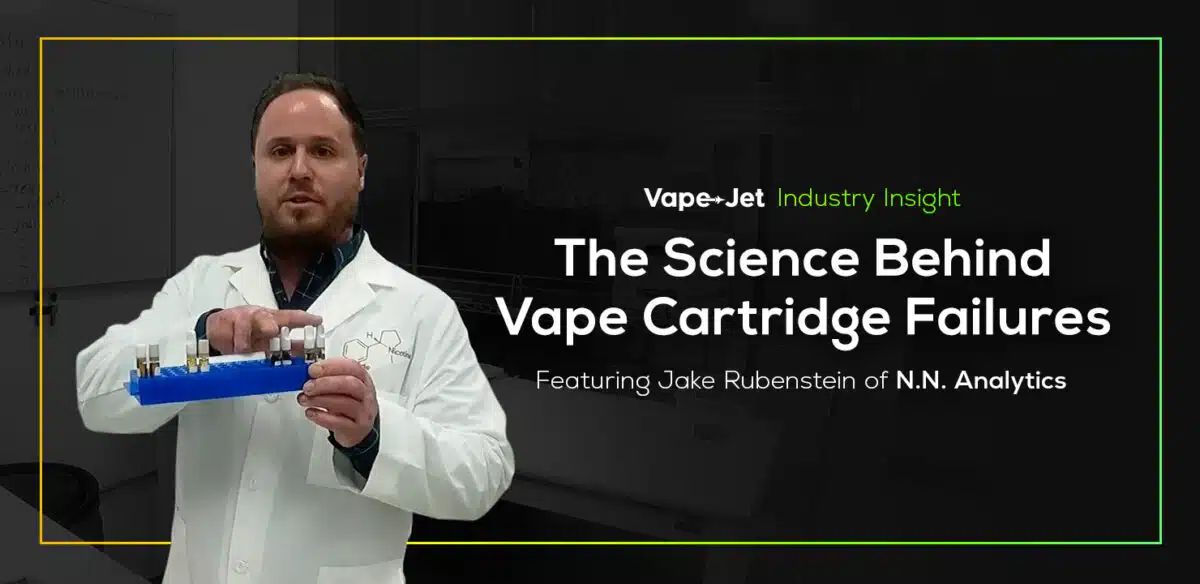
The Science Behind Vape Cartridge Failures: What Causes Carts to Leak & How to Fix a Leaking Cart (with N.N. Analytics)

We are excited to introduce Jake Rubenstein, the President & CEO of N.N. Analytics, as our first guest contributor to the Vape-Jet crew blog! Established in 2015, N.N. Analytics is a leading consulting and scientific support firm in the rapidly growing vaping industry. With an ISO 17025-accredited laboratory and a diverse team of professionals in regulatory compliance, manufacturing, software, and reverse engineering, N.N. Analytics helps their clients navigate the complex world of national and international regulation. With customers like Cilicon+, AVD, and Blinc you can trust that the team at N.N. is one of the best labs in the industry. 

As a full-service nicotine, e-liquid, and cannabis/hemp testing laboratory out of San Diego, California, N.N. Analytics provides numerous services, including vape cartridge leak and performance testing to help eliminate cartridge loss and improper formulations. They’ve even developed their own aerosol testing apparatuses to ensure the highest standards of results. 

At MJBizCon, the Vape-Jet crew bonded with Jake over our shared love of the science behind great cannabis products. Together, we look forward to providing our customers with even more comprehensive support in assessing their oil and hardware for optimal performance, standardizing their formulations, minimizing end-user returns, and achieving better customer satisfaction and success. 

What Causes Vape Cartridge Failures? 

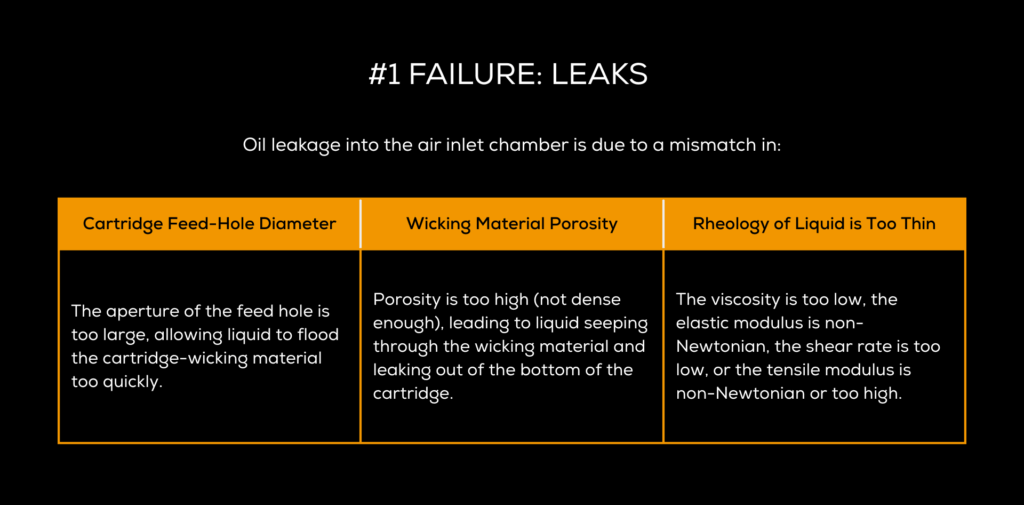
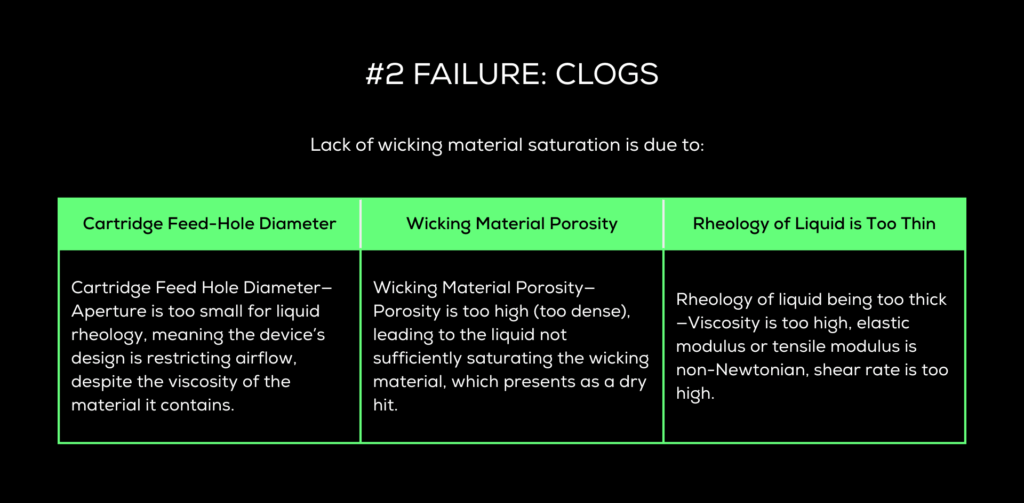
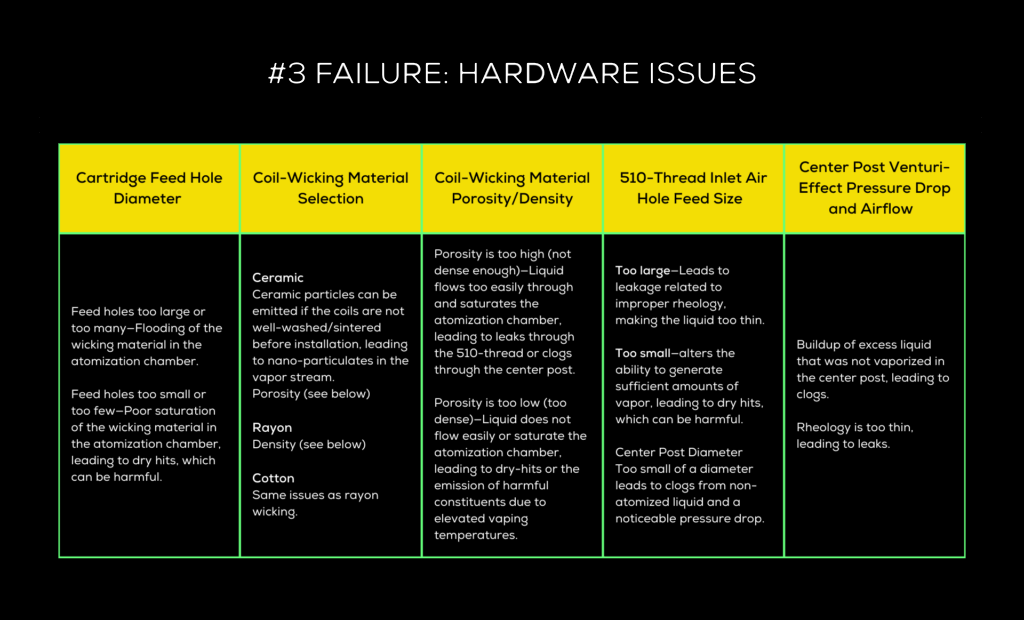
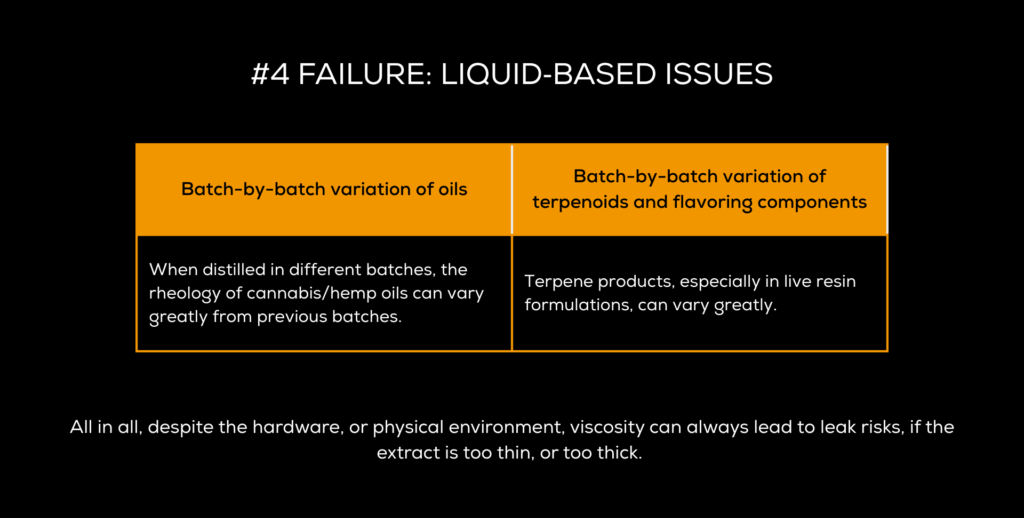
Most common vape cartridge failures are caused by improper hardware selection for that specific oil formulation, leading to poor performance within the hardware. For example, selecting hardware that’s not well-suited for the thicker nature of live rosin, or vice versa for less viscous distillate oils.   

So how do you measure performance?  

We measure key variables of the oil and cartridge combination. Proper performance of an oil and cartridge combination starts with a regulated oil feed rate into the coil atomizer, allowing for atomization of oil into the vapor phase at a constant and predictable rate, without leaks or dry, clogged hits.  

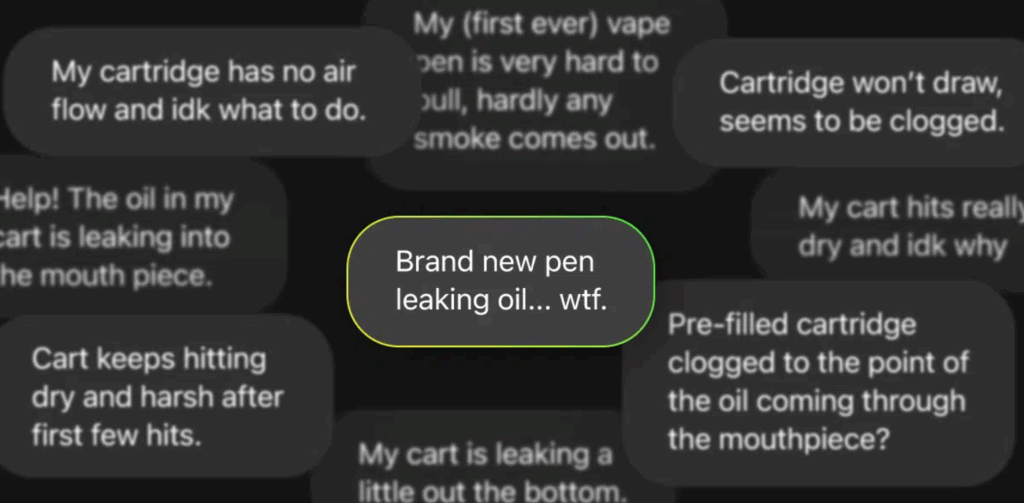
Of course, it’s also essential to understand the fundamental differences between leaks and clogs. A vape cartridge leak occurs when the material exits or oozes from the mouthpiece. A vape cartridge clog occurs when the oil thickens or solidifies and blocks airflow, preventing the hit altogether.

Now, let’s look at the reasons vape cartridges fail in a bit more depth.

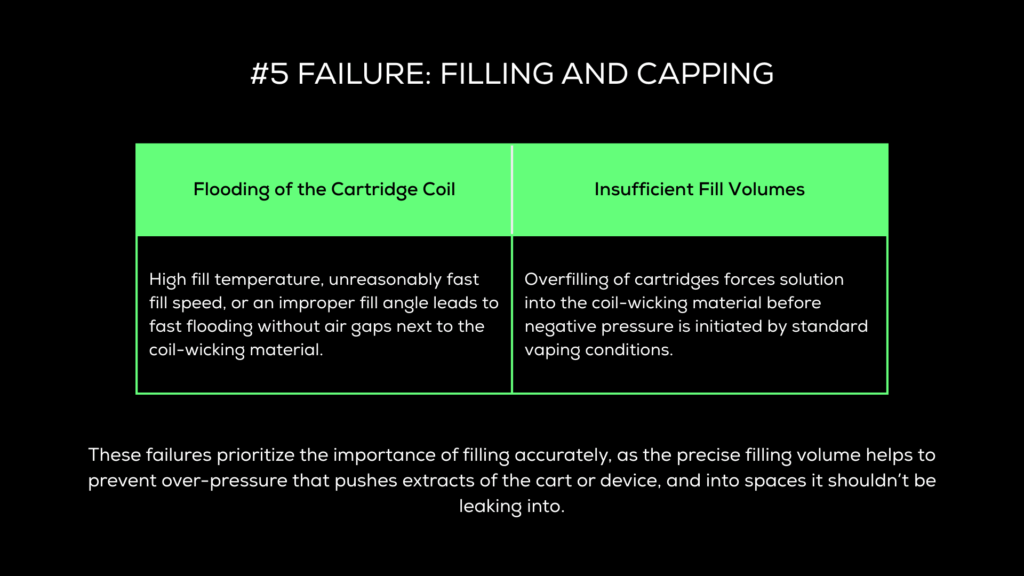
The Top 5 Reasons for Vape Cartridges Failures

First, Some Definitions  

Rheology—studies the deformation of the flow of material, and in this case, the liquid flowing through a vape cartridge reservoir into the vaporization chamber and out of the mouthpiece.  

Viscosity—a measure of a liquid’s thickness and ability to deform to a container/force when pressure or heat is applied.  

Shear-Rate—the stickiness of a liquid and how strong it clings to a container or surface.  

Elastic Modulus—a liquid’s ability to stretch when a force is applied, either by pressure or by heat.   

Tensile Modulus—a liquid’s ability to resist deformation when a force is applied, either by pressure or by heat. 

Diagnosing a Leaking Cartridge

When it comes to leaking cartridges, it’s not always apparent that a device is malfunctioning. If you’re ever unsure, here are a few telltale signs to diagnose a leaky device: 

  • Oil residue: The most apparent sign is finding (or feeling) that signature sticky extract residue, near the mouthpiece or battery
  • Gurgling: If you hear gurgling or can feel air bubbles working their way out as you hit the device, that’s a sign that leakage is occurring somewhere internally. 
  • Difficulty pulling: Any resistance when attempting to inhale, or difficulty in hits, is another sign that your device could be leaking. 

To inspect and verify the diagnosis, here are step-by-step instructions for inspecting your vape cart or all-in-one device for leaks: 

  1. Check its fill level to see if it’s overfilled.
  2. Inspect seals and threads for signs of misalignment or physical damage.
  3. Examine the cartridge for cracks or damage.
  4. Test different power settings and heats. 

If you’re experiencing any of the signs above or uncover signs of physical damage during your inspection, unfortunately, it’s best to replace the cartridge altogether. Continuing use can further damage the battery device. If you don’t want the material to go to waste, however, be aware of the risks you’re taking, and consider purchasing a new battery for the next vape cart you purchase.

How to Fix a Leaking Cartridge 

So…you’ve completed your inspection and confirmed, you’ve got a leaking cartridge. Now what? Let’s review a few DIY ways to fix the leaky cart, or device, next. 

  • Clean connections and airway: Remove cartridge and wipe excess concentrate.
  • Attach carefullly: Tighten, but don’t overtighten to ensure the cartridge is properly attached without stripping threads. Attaching it misligned, or forcing it, can crack the cartridge’s glass.
  • Store upright: Always keep cartridges vertical or upright when not in use, to avoid the extract from seeping into the mouthpiece, or leaking out the bottom. 
  • Replace damaged parts: Swap worn o‑rings or seals on your battery device, or replace the cartridge if leaks persist.
  • Adjust usage & battery settings: Use the recommended voltage to avoid overheating and take slower draws to prevent flooding.
  • Never leave carts in a hot car: Heat thins oil which can increase the chance for leaks, so avoid leaving your cartridge or all-in-one device in a hot vehicle or space. 

How to Fix a Clogged Cartridge 

If you’re experiencing a cartridge that’s clogging, rather than leaking, there are a few DIY tips and tricks you can employ to help. First, start with preheating the battery to soften or thin out the concentrate. Simply press the power button a few times without inhaling, or for auto-draw devices, inhale to start heating without drawing. 

Another method involves an everyday tool you likely have in your bathroom: a hairdryer. Simply apply high or low heat to the cart or device to heat it from the outside. If you suspect your airway is clogged, try clearing it with a pointy tool like a paper clip or bobby pin. Lastly, if none of these work, replace the cartridge if clogging persists.

Keep in mind, there is some risk involved when clearing clogs, as oil can flood the airway, leading to leaks. So, no matter which method you choose, be sure to go low and slow, testing, adjusting, or troubleshooting as you go. 

How to Prevent Vape Cartridge Leaks

Before you go, and to conclude our complete guide to the science behind vape cartridge failures, let’s summarize the steps you can take to prevent them from happening in the first place. 

  • Quality matters: Only purchase quality cartridges from reputable brands, which are more likely to conduct lengthy R&D processes to fine-tune hardware and viscosities. 
  • Proper storage: Even with a quality device, storing your device upright in a cool, dry place and avoiding direct sunlight or leaving in hot cars is crucial to preventing leaks.
  • Check equipment: Before taking your first hit, do a thorough inspection of the vape cart or device, checking seals and threads. Then, don’t over-tighten for optimal use! 
  • Avoid overfills: Spot an overfilled cartridge? See if you can return for a more accurately filled cart to avoid damage to your battery device, and to prevent messy leaks. 
  • Smooth and steady: Vaping is no race to the finish line. Be sure you’re using the right voltage, or power for your material, and take slow steady draws for a gradual heat up. 
  • Switch it up: If you’re continually having issues with your battery device, and vape carts, consider disposables or all-in-one devices. These devices can be pre-programmed by the brand, to specifically avoid common malfunctions that cause clogs or leaks.

FAQs: Leaking Carts

Still have questions? We’ve got answers. Here are some of the most frequently asked questions about vape cartridge failures, along with solutions to support them. 

  1. Why is my cart leaking into my mouth?

Carts typically leak out the mouthpiece when an excess of extract seeps out of the cart. This is often due to various reasons, such as the room temperature thinning the oil, overheating or overpriming, or storing a cartridge on its side or upside down. 

  1. Are leaking vapes dangerous?

While not typically “hazardous” or dangerous, leaking vapes do expose you to unvaporized extracts. This could potentially irritate your skin, but it also creates a sticky mess and wastes product. To help avoid irritation, always clean your cart or device’s mouthpiece before use. 

  1. Can clogs cause leaks?


Yes. When airflow is blocked, pressure can build up in the cartridge and force oil out through seams or the mouthpiece. Following the tips in our guide here, for regular maintenance and proper storage help minimize both issues.

  1. Why do some vape cartridges clog more often than others?

Certain oils with thicker viscosity or higher terpene content are more prone to clogging, especially if stored in cooler environments. Cartridge design and hardware quality also play a major role.

  1. Can temperature changes cause leaks or clogs?

Yes. Extreme heat can thin oil and lead to leaks, while cold temperatures can thicken oil and cause clogs. Proper storage at room temperature helps prevent both issues.

Joining Forces: Vape‑Jet x N.N. Analytics 

Understanding the reasons vape cartridges fail is crucial to creating and producing a high-quality and reliable product. Whether it is due to hardware selection, leaks, clogs, hardware issues, or improper coil-wicking material selection, having the proper knowledge and resources can help prevent common vape cartridge failures.  

But where do we go from here?  

Stay tuned for our next article, where we discuss practical solutions to overcome these common vape cartridge failures and provide guidance for achieving enhanced product performance and a smoother vaping experience. If you’re looking to optimize your vape cartridge formulations, minimize returns, and achieve better results, you’re in the right spot. 

Browse N.N. Analytics’ Complete Services

Need some help taking your vape cartridge filling performance to the next level? Reach out to our crew and learn how Vape-Jet can provide next-level products for your customers.  

Some of our success stories:  

Don’t forget to sign up for our monthly Re:Fill newsletter to get early access to company updates, product releases, and other exciting announcements. Follow us on the essentials, too: Facebook, Instagram, LinkedIn, X.com, and YouTube.

Still unsure of which types of failures your vape cartridge or all-in-one device is experiencing? Explore our troubleshooting section, step by step, to pinpoint the precise malfunction, or get in touch with the Vape-Jet team to learn how we can help. 

Vape Cartridge Failures: The Bottom Line 

As you’ve learned here, often the most common vape cartridge failures aren’t due to user error, but rather from a mismatch between the material and hardware. Say it with us…leaks and clogs are preventable! It simply takes quality hardware, proper storage, and correct usage to avoid malfunctions that can steer customers away from your brand. 

Bookmark this guide to review the fixes and troubleshooting tips for your specific vape cartridge or all-in-one device. Need more help? Our Vape-Jet team is equipped and on-call to support. Contact Vape-Jet for expert help, or begin exploring our fleet of future-ready equipment designed to increase efficiency, without compromising quality: 

Categories
Vape-Jet

Vape-Jet Featured in MG Magazine’s 2025 Tech Issue

We couldn’t be more thrilled to announce that Vape-Jet is featured in the August 2025 Tech Issue of MG Magazine. This special edition highlights the tech side of the cannabis industry, recognizing the companies responsible for shaping its future with new technologies and forward-thinking approaches.

Earning Recognition From Industry Leaders 

As Vape-Jet continues to grow, our team is proud to be included alongside the industry’s top innovators in this special edition of one of the industry’s leading publications. The yearly Tech Issue, published by MG Magazine, is the annual “who’s who” of companies transforming cannabis operations through technology. 

In 2025’s edition, the publication shines a spotlight on the increasing role of automation, precision, and data-driven solutions for operators seeking to create consistent and scalable production environments. Why is this so important for operators across the US? Consumer demand continues to surge, with the article highlighting that the vape industry has grown from $146 million in tracked sales in 2016 to $1.73 billion nationwide in 2024.

Beyond the sales statistics, the article also highlights the increased savviness of today’s modern consumers, noting that technological innovation is a key factor in attracting them. A fact that requires operators to consider advanced all-in-one devices, specifically designed for cannabis extracts, which emphasizes the importance of automation and specialized engineering for the ongoing expansion of the industry.

Spotlight: Tech Behind the Trend

Featured in the “Spotlight: Tech Behind the Trend,” MG Magazine shares insights into consumer preferences regarding their consumption, revealing a surprising fact. Although all-in-one disposables or devices may seem popular, cartridge-based vape systems still hold a strong hold on consumers across the US. 

For single- and multi-state operators, the truth in sales numbers requires versatility in the number of SKUs they offer. Hence, the rise in popularity of embracing automation technology, which not only makes workflows more efficient for swapping device types but also allows companies to meet demand in both volume and quality, thereby increasing overall scalability. 

That’s where Vape-Jet enters the conversation, being recognized for transforming the filling process, turning what was once a manual operation into a more efficient and profitable one. Nationwide, leading extract companies turn to Vape-Jet to increase throughput while maintaining consistency and quality.

Inside the Vape-Jet 4.0 Top-Load Advantage

Not all fully automatic cartridge and device fillers can be treated equally, which writer Sue Denham explores by highlighting the specific advantages of the Vape-Jet 4.0. With intuitive features built to address key industry challenges, a few of the benefits the MG Magazine feature specifically touches upon include: 

  • Automation with accuracy: While reducing your labor force is beneficial for your bottom line, costly overfills can be more detrimental than helpful. The Vape-Jet 4.0 empowers operators to fill cartridges consistently and accurately, with a repeatability rate of ±0.25% and the lowest transfer loss on the market.
  • Process efficiency: Innovation is only as good as the uptime it provides, meaning that seeking out equipment that minimizes downtime is crucial for operators scaling in the competitive cannabis industry. This allows facilities to maintain delivery times (and retain trust amongst retailers!) while reducing material loss, which impacts margins. 
  • Scalability: It’s not just the trend of disposables and all-in-one devices that’s affecting SKU variability. The industry is ever-evolving, with consumers seeking out carts and disposables with higher volumes (1g, 2g, etc.) and extract variability, including distillate, live rosin, etc. To keep up, operators must be able to adapt quickly as demand grows, which Vape-Jet’s machine vision alignment and loading jig skipping capabilities support. 

Innovation at the Core

At Vape-Jet, our team is committed to innovative automation technology, especially processes and progress that support niche operational excellence. In cannabis, this means producing a fleet of equipment responsible for enhancing extract integrity and minimizing waste, while automating workflows to achieve maximum productivity.

As innovators to the core, being featured in MG Magazine’s 2025 Tech Issue, within “Spotlight: Tech Behind the Trend”, is not just an honor but also a validation of the Vape-Jet team’s work toward the future of the industry. Even more, the recognition serves as a sign of a broader industry shift toward applying engineering, software, and automation principles to cannabis operations.

A big thanks to MG Magazine for recognizing Vape-Jet as it celebrates ten years of chronicling cannabis innovation. The Vape-Jet team is proud to be part of this next chapter in the industry’s story. Keep learning and get insights from our CEO by reading the full MG Magazine feature here

Ready to make technology a part of your operation’s future? Get a closer look at the Vape-Jet 4.0, or Vape-Jet’s entire fleet of equipment, designed to support the ability to scale. 

Categories
Vape-Jet

Types of Cannabis Vape Cartridge Filling Machines

The Cannabis Industry’s Need for Vape Cartridge Filling Machines

As consumer behaviors continue to shift sales away from traditional categories such as flower and tinctures, and towards packaged products such as vapes, pre-rolls, and edibles, it’s clear that consumers are looking for more portable and convenient recreational products. Vapes in particular are popular for their portability and ease of use, reflected by sales reaching $4.3 billion in 2024, increasing from $2.8 billion in November 2022

To sustain this growth in popularity without sacrificing quality, many producers are investing in automated cart filling machines. If you are new to the world of vape cartridges and device-filling equipment, join us as we break down the different types of cannabis oil filling machines along with their advantages, disadvantages, and the best use cases for each.

Table of Contents

  • Manual Cannabis Vape Cartridge Filling Machines and Equipment
  • Semi-Automatic Cannabis Vape Cartridge Filling Machines
  • Fully-Automatic Cannabis Vape Cartridge Filling Machines 
  • What Else to Consider When Shopping for a Cartridge Filling Machine
  • Emerging Gaps & Trends 
  • What to Choose (2025 Recommendations)
  • Still not sure what type of filling machine is right for your operation?

Manual Cannabis Vape Cartridge Filling Machines and Equipment

Manual vape cartridge and device filling machines are the simplest type of vape cartridge filler machines. They are operated by hand with tools such as syringes and heaters, and the operator is responsible for the entire filling process – whether filling cartridges or all-in-one “disposable” type devices. 

These machines are inexpensive and easy to use, making them a good choice for small-scale operations. However, they are not suitable for large-scale production due to their slow production speed and reliance on manual labor. 

Examples of manual filling machines: 

  • Manual syringe 
  • Handheld repeater syringe 
  • Multi-shot style hand dispensers 

Advantages of using manual filling machines: 

  • Lowest equipment cost 
  • Easy to use 
  • Simple setup 
  • Small physical footprint 

Disadvantages of using manual filling machines: 

  • Highest labor cost 
  • Slowest production speed 
  • Inconsistent fill volume 
  • Operator-dependent 
  • Easy to damage oil with heat 
  • Susceptible to operator error 
  • Syringe lubricant can affect the cartridge 
  • Risk of operator injury from manual labor 
  • High maintenance requirements 

Best use cases for manual filling machines: 

  • Small-scale or micro-batch production 
  • Craft operations
  • Limited budget 
  • Non-technical operators
  • Pilot testing

Despite ergonomic improvements to manual vape cartridge filler systems, it’s essential to keep in mind that even modern manual tools yield ~85% dosing precision according to Cannabis Tech Quarterly (2023). This can increase a facility’s product loss and waste, ultimately affecting bottom lines. However, the machines remain relevant for specialized or low-budget operations. 

Semi-Automatic Cannabis Vape Cartridge Filling Machines

Semi-automatic vape filling machines, such as the Jet Fueler, are an intermediate between manual and fully automatic cartridge fillers that service carts and disposable all-in-one devices. They require some manual operation by lifting the cartridge or device to the needle for dispensation, but they automate the pumping portion of the filling process. 

These machines are suitable for mid-scale production and offer a good balance between cost and efficiency.

Example of semi-automatic filling machines: 

  • Automatic recharging repeater syringe systems 
  • Pneumatic systems 
  • Syringe pump systems 

Advantages of using semi-automatic filling machines: 

  • Faster production speed than manual filling machines 
  • More consistent fill volume 
  • More consistent heat application 
  • Lower labor cost than manual filling machines 

Disadvantages of using semi-automatic filling machines: 

  • Higher equipment cost than manual filling machines 
  • More complex than manual filling machines 
  • Not suitable for large-scale production 
  • Operator still has to cap cartridges separately 

Best use cases for semi-automatic filling machines: 

  • Mid-scale production 
  • Low to mid-range budget 
  • Entry-level technical operators 

Now, let’s take a closer look at one of the best vape cartridge filling machines that offers semi-automatic operation. The Jet Fueler, by Vape-Jet, offers operators not only increased throughput, but precision, with the ability to fill 4,000–14,000 carts per shift at a ±0.01 mL accuracy. 

Its features are intuitively designed, with a modular design that can easily fit in small or large operations, with interchangeable nozzles to allow for versatility in SKUs. From disposable all-in-one devices, to .5 grams, to 1 grams, and beyond, the Jet Fueler’s system allows for adjustable volumes with a short oil path to reduce oxidation. 

The cart filling machine also offers clean-in-place features that reduce downtime and keep your workflows moving. That means, when using this Vape-Jet cartridge filler, you can not only increase productivity and output, but also preserve the integrity of the original oil, for the utmost in quality. 

In today’s competitive world of cannabis, customer retention and loyalty are crucial to scaling, heightening the importance of operators balancing quality and efficiency for ultimate returns. Hence, the popularity and growing trend of extraction facilities investing in semi-automatic vape filling machines. 

Fully-Automatic Cannabis Vape Cartridge Filling Machines

Fully-automatic filling machines such as the Vape-Jet are the most advanced class of filling machines. They automate and control the pumping, dispensing, and heating processes. Some even automate the capping process, while others are designed to work with a separate capping machine. 

These machines offer the highest production capacity and consistency in fill volume. However, they are also the most expensive and may require specialized accessories such as hardware jigs or additional operator training. Despite the cost and additional expenses, in the long term, these machines result in the lowest total cost of ownership. 

Example of fully-automatic filling machines: 

  • Robotic-assisted recharging repeater syringe systems 
  • Robotic assisted pneumatic systems 
  • Robotic assisted syringe pump systems 

Advantages of using fully automatic cartridge filler machines: 

  • Lowest labor cost 
  • Highest production capacity 
  • Consistent and accurate fill volume 
  • Flexibility in handling a wide range of fill volumes and viscosities 
  • Increased reliability with minimal room for operator error 
  • Limited exposure to environmental contaminants 
  • Operator can multitask during the filling process 

Disadvantages of using fully-automatic cart-filling machines 

  • Highest equipment cost 
  • Largest physical footprint 
  • Requires additional operator training 

Best use cases for fully automatic vape cartridge filler machines: 

  • Large-scale production 
  • Mid to high-range budget 
  • Experienced technical operators

Automatic cartridge fillers, like the Vape-Jet, offer the highest level of throughput and precision of all the equipment covered today. Using machine-vision alignment, Vape-Jet increases throughput to 5,000–10,000 carts per shift, while also protecting terpenes and the extract’s natural integrity with low-temp heated vape filler technology. 

When investing in the cream of the crop, operations don’t just gain the advantage of efficiency and increased productivity; they gain the benefits necessary to scale in the competitive market, such as the ease of handling multiple cartridge and disposable type devices, for numerous SKUs, expanding market reach (and profits!). 

Even more, advanced equipment like the Vape-Jet offers add-ons that not only serve the vape category, but can be upgraded with modules such as the Fuel Injector, which is designed to infuse pre-rolls specifically. Lastly, automated clean-in-place procedures and remote support reduce downtime and allow operators to maintain retail deadlines and improve relationships with consistent delivery of quality products. 

What Else to Consider When Shopping for a Cartridge Filling Machine

Choosing the right cart-filling machine helps increase production efficiency, reduce waste, and 

ensure consistent and accurate fill volumes. Of course, it’s crucial to select the right machine for your operation, which will depend primarily on your production volume and available budget. Regardless of where your operation stands, here are the top key factors to consider: 

Adaptability & Hardware Compatibility

Some fully-automatic cart filling machines lock you into a limited number of cartridge and device styles you can fill without investing in physical retooling or additional custom hardware. Look for systems that can adapt to your hardware, not the other way around.

Product Support & Maintenance

Complicated filling machines may require more complex training and repairs. As you vet equipment manufacturers, be sure to ask how they provide product support, how long you can expect to wait on replacement parts, or how quickly they can get on-site support technicians to your facility should the need arise.

Data & Reporting Features

As states continue to pass additional regulations on the cannabis industry, it’s crucial to consider where you can implement data collection in your production process. Some fully-automatic filling machines have data reporting features built in, giving you insight into production trends as well as an additional quality management checkpoint. 

Cleaning Process 

A key part of the cartridge filling process is the cleaning procedure between strains or at the end of the day. Producers new to automated filling equipment often overlook the importance of this feature. Look for machines with an efficient and automated cleaning-in-place process to save on time and labor.

Accuracy & Compliance

A precise fill isn’t just a requirement for customer satisfaction and loyalty – it’s a requirement to avoid significant compliance risks. Manual methods often lead to inconsistent fill volumes, which can trigger costly product recalls or lost consumer trust. 

Automated or semi-automatic systems with built-in calibration and dosing verification help ensure every cartridge meets state weight and volume requirements, for compliance and customer purposes. 

Oil Integrity

The more the industry evolves, the more discerning consumers become regarding the quality and integrity of the oil they consume. That means, upgrading your processes wth the best vape cartridge filling machines for preserving the extract’s natural profile is crucial to attracting connoisseur-like consumers, and keeping them coming back for more. 

Poorly engineered fillers can expose extracts to excess heat, oxygen, or contamination, degrading potency and terpene content. So look for equipment that offers programmable heat zones for various consistencies (think live rosin, live resin, etc.) and minimal oxygen exposure, through nitrogen-assisted paths, too. 

Scalability & ROI

When evaluating equipment, it’s critical to look beyond immediate needs and consider the long-term return on investment. Machines that can scale with your growth, whether through modular upgrades, higher throughput, or multi-use functions, help future-proof your operation. 

Although fully-automated systems may require more upfront capital, they often deliver more substantial ROI by reducing labor costs, improving precision, and minimizing product waste over time. The right machine isn’t just an expense, it’s an investment in efficiency and profitability.

Emerging Gaps & Trends 

As the cannabis industry continues to evolve, so does the technology and equipment that’s designed to boost productivity, efficiency, and quality. In 2025, the latest upgrades to everyday workflows include: 

  • Pre-roll infusion automation: Infused pre-roll popularity is on the rise, and so is the upgrade of modules to current cannabis oil filling machines, to adapt to consumer demand. 
  • Heated vape fillers: Heated vape filler systems are solving viscosity challenges by keeping extracts at stable temperatures, ensuring smoother fills, fewer clogs, and higher throughput.
  • Nitrogen vape fill systems: Nitrogen vape fill systems are gaining ground for their ability to protect oil integrity, extend shelf life, and deliver a fresher consumer experience right out of the package.

Even more, as operations seek ways to gain a competitive advantage and scale, automatic cartridge filler adoption has never been more popular. From large-scale to mid-scale operations, operators are increasingly adopting automatic systems, including modular and multi-use machines that bridge cartridges and pre-rolls.

By doing so, companies can target the vaporizer market audiences and flower markets by expanding their SKUs to include both. 

What to Choose (2025 Recommendations)

With so many equipment options available today, it can be difficult for any single operator to decide which is right for them. To finish our complete guide to the types of cannabis vape cartridge filling machines, let’s finish with a summary of each, so that you can select the best option for your facility today, and for its brightest future: 

  • Manual vape cartridge fillers remain a go-to choice for small craft producers or R&D labs where batch sizes are low, and flexibility is key. As the lowest cost option, they’re also ideal for start-up brands, but operators should be mindful of higher labor inputs and variable precision.
  • Semi-automatic vape filling machines offer a balance between manual workflows and automatic systems that they might not yet be able to afford. For growing brands, they offer speed and consistency improvements without the investment required for full automation, making them ideal for those looking to expand into multiple SKUs.
  • Fully automatic cartridge filler equipment is the clear choice for high-volume producers. These machines deliver unmatched throughput, dosing precision, and compliance-friendly documentation, ultimately driving ROI by reducing labor costs and product waste.

When evaluating new equipment in 2025, consider not just today’s production needs but also tomorrow’s opportunities. Look for solutions that maximize ROI by improving accuracy, supporting smart operations with reliable data tracking, and optimizing workflow efficiency to keep teams focused on scaling the brand, rather than troubleshooting bottlenecks.

Still not sure what type of filling machine is right for your operation? 

Contact our crew to find out if a Jet Fueler, a semi-automatic vape filling machine, or Vape-Jet, an automatic cartridge filler, would be the right fit for you. Still growing? We offer an upgrade path from our semi-automatic to fully-automatic systems.

We use cookies to improve our user experience. By using our site, you consent to the use of cookies. Read More