In August of 2026, ASHE vapes were subject to one of the largest recalls by the California Department of Cannabis Control.
Unlike other recalls, this wasn’t due to unsafe pesticide levels or contaminated material. It resulted from improper testing and labeling.
This represents the importance of cannabis compliance beyond the product.
Something completely controllable was missed; as a result, ASHE not only lost profitable SKUs pulled from shelves but also faces irreparable brand damage.
But ASHE isn’t alone. So many operators don’t take compliance seriously until it costs them.
This guide helps break down the cost of cannabis product recalls for vape manufacturers to help you prioritize cannabis compliance from the filling station to shelves.
Why Cannabis Product Recall Risk Is Growing
As your volume grows, so does your risk for cannabis product recalls, especially when operating in more than one state.
Each state has its own testing and compliance requirements, making it even harder to navigate and follow individual rules and regulations.
Even more, stricter lab standards across the board and complex protocols to follow, like rapid retail quarantining, make cannabis manufacturing compliance that much more challenging.
Contaminant/pesticide failures: A batch fails safety testing for contaminants like heavy metals or pesticides above allowed thresholds.
Potency variance: When actual cannabinoid content falls outside permitted specifications or doesn’t match the label, a cannabis compliance red flag is raised.
Mislabeling: Mislabeling of dose, potency, ingredients, warnings, or other required information can trigger a cannabis product recall, as shown by the ASHE example from the introduction.
Unverified inputs: When a banned chemical was found to be present in a Michigan live rosin product in 2026, the brand was responsible for retrieving and disposing of all affected inventory. The same goes for other failed cannabis compliance testing when unverified inputs or ingredients are found without verification.
Incomplete batch records: If you can’t use your cannabis track and trace system to accurately pinpoint affected products, you could face further recalls and compliance issues.
Regardless of the cannabis recall trigger, each example highlights the importance of batch-level tracking to pull affected products.
A Recall Costs More Than the Inventory You Lose
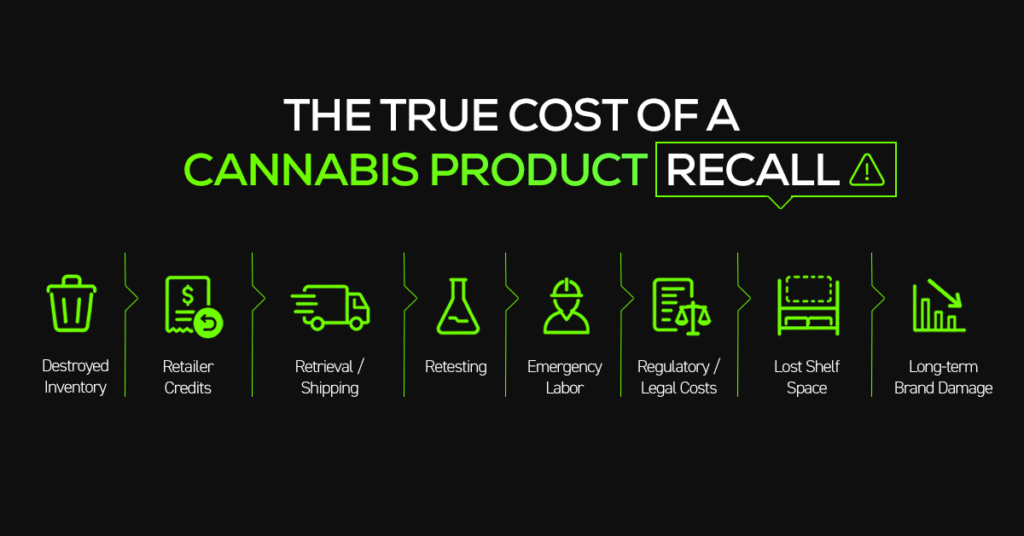
The product loss from recalls is only the start of what you’ll lose. You’ll lose time, labor, and effort collecting the recalled product on an emergency basis, and then you’re responsible for retesting, investigating the issue, and responding to regulators.
Beyond the products, your brand equity is negatively affected too, through:
Retailer/distributor disruption
Lost sales or shelf placement
Long-term damage to retailer and consumer confidence
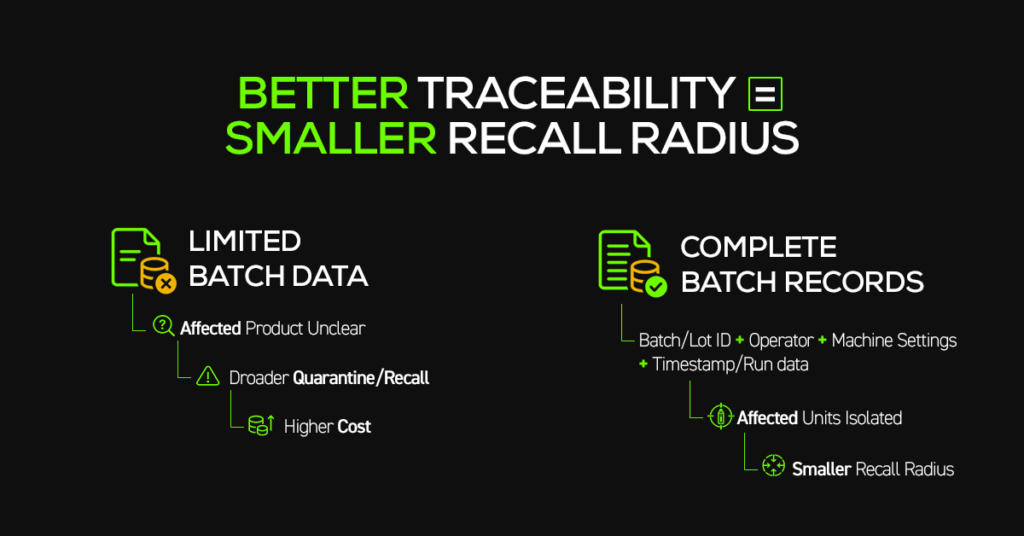
Tracking the affected product matters. If you can isolate the batch, the affected radius is smaller than if you can’t.
Vape cartridge filling machines help. Most machines that monitor fill accuracy to avoid labeling infractions and log batches for audits protect users better than those without.
What a Cannabis Product Recall Actually Costs, Line by Line
On the surface, a cannabis product recall may not seem that bad. But when you break down what each cost can include, it’s much more than it appears.
Recall Cost
What It Can Include
Destroyed inventory
Finished cartridges, oil, hardware, packaging, and other affected products that can no longer be sold. Think about this in terms of wholesale value to get the entire picture, not just raw-material cost.
Retailer chargebacks & credits
Refunds, credits, or reimbursements owed to retailers and distributors for recalled inventory already shipped or stocked.
Return shipping & retrieval
Freight, courier fees, handling, and labor required to locate and recover product across the distribution network.
Re-testing & investigation
Additional laboratory testing used to identify the source of the failure, confirm affected lots, or clear adjacent batches.
Emergency labor
Unplanned hours from QA, compliance, production, operations, and leadership teams working on quarantine, reconciliation, communication, and corrective action.
Regulatory response
Time and resources spent compiling records, responding to regulators, documenting corrective actions, and meeting recall or quarantine requirements.
Legal expenses
Outside counsel, product-liability review, contract disputes, or other legal support resulting from the recall.
Lost shelf placement
Sales lost while the SKU is unavailable, plus the risk that a retailer fills the space with another product and does not immediately restore the recalled SKU.
Long-term brand damage
Lost retailer confidence, consumer hesitation, and future sales impact that can continue after the immediate recall is resolved.
In real time, this can mean up to $3M in damage, as shown by Missouri Delta Extraction and their 2023 enforcement action, which included $2M in unusable inventory and $1M+ in stalled product from 4,500+ quarantined units.
Fill Accuracy Is a Compliance Control
Fill accuracy is one of the most vulnerable areas, not only for quality control but also for compliance.
Underfilling, even at .92 g in a 1.0 g cart, technically constitutes mislabeling. This can happen whether manually filling or using semi-automatic or automatic cart filling equipment, but know that the filling method you choose affects weight accuracy in different ways.
Volumetric systems dispense based on a set volume, while gravimetric verification checks the cartridge’s actual weight after filling. What complicates the decision and process is that extract behavior can shift when process or environmental conditions change.
For instance, thermal degradation during filling can alter the cannabinoid profiles as tested post-COA. So not only can the pump and nozzle system affect filling, but the extract fluid path can too.
Temperature changes can also affect viscosity, causing extracts to expand or contract and affecting filling accuracy and overall cannabis manufacturing compliance.
Controlling temperature throughout the fluid path helps maintain predictable flow without exposing the extract to unnecessary heat. For manufacturers, that makes fill accuracy a system-level issue, not simply a function of the pump or nozzle.
Your Audit Trail Decides How Wide the Recall Goes
The more you can prove there’s a limited batch affected, the shorter your audit trail will be. That’s another advantage of advanced vape cartridge filling equipment with integrated software and batch record-tracking tools, beyond just filling consistency.
Precise batch data helps operators isolate affected units. On the flip side, incomplete records or untrackable SKUs can force facility-wide product recalls, increasing risk and damage.
Equipment with cannabis track-and-trace tools maintains production records, linking batch or lot IDs to operator activity, machine settings, timestamps, and other run data.
The more complete the record, the easier it is to determine which units were produced under the same recallable conditions and which were not.
Cannabis Manufacturing Compliance: The Failures That Trigger Recalls
Many incidents that trigger a cannabis product recall can be traced back to controls that break down somewhere upstream. For instance, cross-contamination risks increase when equipment is hard to clean or doesn’t have automated cleaning procedures.
Potency variances can result from inaccurate dispensing, as can underfills, which can lead to mislabeling.
And finally, documentation gaps are the final layer of exposure for cannabis recall risk. Without automated logs that preserve production records, you expose your operation to the risk of a full facility audit or recall.
Altogether, each control throughout the vape filling process is just as much about hardware performance as it is cannabis manufacturing compliance.
The goal is not only to produce consistently and efficiently but also to create a traceable process that makes deviations easier to identify, document, and contain.
The Best Cannabis Recall Plan Starts at the Filling Station
In the end, it’s not just the material that matters when it comes to cannabis compliance. The vape cartridge filling equipment you use can support you during a cannabis product recall, too.
Advanced equipment delivers precise dosing to prevent mislabeling and potency issues, plus automated audit trails that can help contain recall damage.
In other words, investing in the right cart filling machine can turn a potentially enterprise-threatening event into an isolated batch correction.
Frequently Asked Questions: The Costs of a Cannabis Product Recall
To finish our ultimate guide, check out the most frequently asked questions on the costs of cannabis product recalls.
What causes most cannabis vape cartridge recalls?
Cannabis vape cartridge product recalls are often caused by failed or noncompliant testing, contaminants, potency or labeling discrepancies, unverified inputs, and incomplete track-and-trace records.
How much does a cannabis product recall cost?
There is no standard cost of a cannabis product recall. Expenses associated with product recalls include destroyed inventory, retailer credits, return shipping, re-testing, emergency labor, regulatory response, legal support, and lost shelf placement. The total cost will depend on how much product must be quarantined or recalled and whether records can isolate the affected batches.
How quickly do you have to notify the state after starting a cannabis recall?
Recall notification requirements vary by state. For instance, in California, a licensee must notify the Department of Cannabis Control within 24 hours of initiating a recall, and any cannabis goods intended for destruction must then remain quarantined for at least 72 hours. Other states have their own requirements or guidelines, so check with the regulatory agency of your operating state for more details.
Can a fill weight error trigger a recall?
Yes, a fill weight error can trigger a cannabis product recall when the amount actually dispensed causes the finished product to differ from its labeled quantity or potency requirements. State tolerances differ, so manufacturers should validate dispensing accuracy against applicable rules and testing results rather than relying solely on the machine’s programmed target.
What records do cannabis regulators ask for during a recall?
The records that cannabis regulators ask for during a recall will vary but usually include batch or lot identifiers, track-and-trace records, testing results, production and inventory records, disposition records, and documentation showing where recalled products were distributed. California also requires recalled goods intended for destruction to be identified, weighed, and tracked through its track-and-trace system and onsite records.
Does a recall in one state affect licenses in another?
No, a recall in one state does not automatically affect licenses in another state.Cannabis licenses and recall procedures are specific to each individual state, so a recall in one market does not by itself mean licenses in other states are recalled or suspended. Multi-state operators should still review each jurisdiction separately if the same product, ingredients, process, or compliance failure spans multiple licensed operations.
Without access to traditional financing and with inconsistent cash flow, operators quickly get frustrated trying to scale with cartridge-filling equipment.
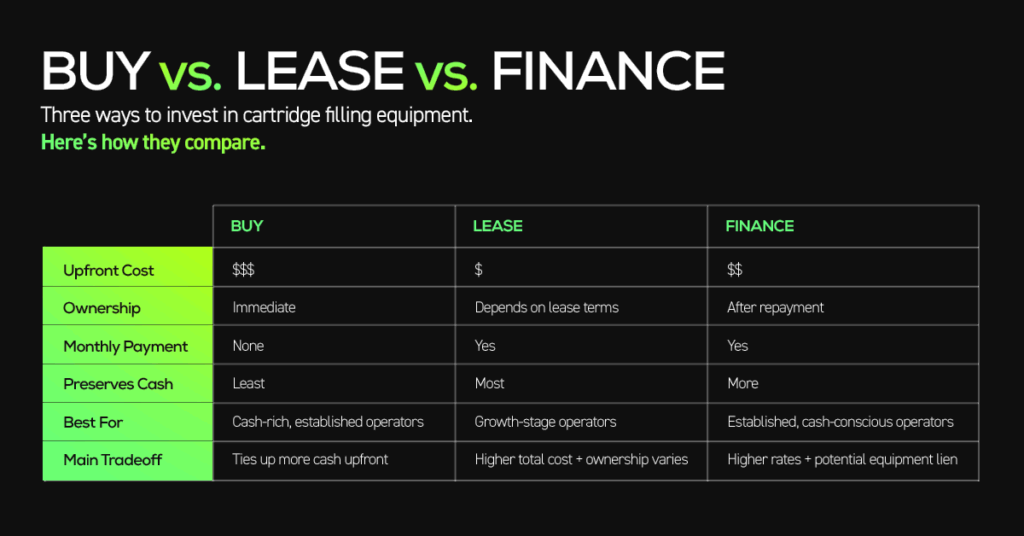
They often know it’s exactly what they need to grow, but all face the same question when purchasing: buy, lease, or finance?
When it comes to cannabis equipment leasing, not all companies are created equal. So, before you enter into a cannabis equipment loan or begin to explore cannabis equipment financing, there are a few things to know to navigate the industry successfully.
In this guide, we’ll cover the debate over whether to buy or lease cartridge filling equipment and how adding it to your fleet can support your operation.
Why Operators Turn to Cannabis Equipment Leasing
Despite operating in an industry responsible for producing $8 billion in vape sales from 2025 to 2026, thanks to regulatory challenges, many cannabis operators are cash poor. This makes executing capital expenditures like purchasing cannabis equipment that much more difficult.
Even 14 years after legalization in some states, operators are still subject to IRS code 280E. Because cannabis remains a Schedule I controlled substance, this federal code prevents cannabis businesses from deducting many ordinary and necessary operating expenses from their federal taxable income, significantly increasing their effective tax burden.
Making matters worse, without the opportunity to take advantage of SBA-backed loans, many operations feel hopeless when seeking cannabis equipment loans. Fortunately, as the industry matures, so does its availability of cannabis-specific lenders and cannabis equipment leasing companies filling that gap.
How to Choose Which is Right for Your Operation: Buy, Lease, or Finance
When a piece of equipment is a necessity for the growth and longevity of your company, there’s no question that you need it. The only question is whether you should buy, lease, or explore cannabis equipment financing.
Next, we’ll cover what’s right for individual operations, depending on cash flow, growth stage, and tax posture.
Paying Cash: When Buying Outright Makes Sense.
Paying cash makes the most sense for operators who can afford it. Purchasing outright is often the most cost-effective way to acquire equipment over its full life. The advantages of doing so are simple:
No interest or financing fees
Immediate ownership
No monthly payment competing with cash flow
Of course, not every operation can afford the cost outright. That means paying in cash for cannabis equipment is best for established operators with a healthy cash reserve and enough working capital that the purchase won’t constrain day-to-day operations.
Another consideration, even for established brands, is Section 179. While manufacturing equipment often falls within the type of machinery that can qualify for Section 179, Section 280E makes it complicated for cannabis businesses to take advantage of the tax benefit.
For eligible businesses, however, Section 179 can materially change the after-tax cost of equipment. Before buying equipment in cash, check with your CPA to see how the benefit applies under your specific 280E and accounting.
Leasing Your Cartridge Filling Line
Cannabis equipment leasing is another option to scale volume and lower the upfront barrier to entry. However, over time you will typically pay more in financing fees and interest rates in exchange for preserving cash and gaining flexibility today.
Leasing provides start-ups and early-stage companies with predictable monthly payments and preserves working capital for payroll, inventory, packaging, and other expenses. In many cases, the labor savings and additional production capacity equipment can generate will outweigh its monthly payment.
That means if you’re a growing operation with the sales to benefit from additional product capacity now but would rather preserve cash, leasing is a viable option to consider. It can also offer operators an easier upgrade path as production volume increases or when you need to scale up equipment.
When leasing cartridge filling equipment, keep a few things in mind. For instance, depending on the lease structure, you may not own the equipment at the end of the term, so it’s wise to compare lease terms from vendor to vendor.
Cannabis Equipment Financing and Loans: What’s Actually Available
Lastly, despite traditional loans being out of the question for most cannabis businesses, cannabis equipment financing does exist. However, operators generally have fewer options than in federally legal industries, and financing terms are typically much more expensive.
To fill the void left by SBA-backed loans and traditional lenders, specialty cannabis lenders, alternative commercial lenders, and equipment financing companies are helping operators finance the equipment they need to scale.
One important caveat: rates are typically much higher than conventional bank financing because lenders take on additional industry and regulatory risk. While requirements vary by lender, underwriting for cannabis equipment financing often considers:
Personal credit score
Time in business
Revenue and cash flow
Bank statements and financial records
Cannabis licensing/compliance
Value of the equipment being financed
Businesses with stronger credit and a longer operating history will get better financing options and rates than newer businesses. As general benchmarks, equipment lenders will consider operations with six months or more in operation and credit scores around 600, but the strongest terms go to businesses with two or more years of operation and stronger credit.
This means cannabis equipment financing is an acceptable middle ground for established operators who want to protect a healthy cash reserve while making predictable monthly payments and owning the equipment at the end.
Keep in mind, however, like leasing, the equipment itself is often used as collateral, meaning the lender may place a lien on the machine until the loan is repaid
A Quick Framework for Deciding
To help you weigh your options, take a quick look at our decision guide for your best fit.
Operator Profile
Best Fit
Why It Makes Sense
Main Tradeoff
Cash-rich / established
Buy outright
Lowest total acquisition cost, immediate ownership, no monthly payment
Uses the most cash upfront and can reduce working capital
Growth-stage / early-stage
Lease
Lower upfront cost, predictable payments, preserves cash for payroll, inventory, and growth
Typically costs more over time and ownership depends on lease terms
Established but cash-conscious
Finance
Preserves cash while still providing a path to ownership
Higher rates than conventional financing and may require a lien on the equipment
Rapidly scaling / multi-state
Lease or finance
Makes it easier to add capacity across facilities without tying up large amounts of capital at once
Multiple payments and financing costs can add up as the equipment fleet grows
Buy vs. Lease Equipment Cannabis: The Final Word
All in all, operators who take control of their capital expenditure strategy early in the game scale without giving up equity or flexibility later.
In this guide, you’ve learned more about cannabis equipment leasing and all the factors to consider to determine what’s right for you: buy vs. lease equipment in cannabis.
If you’ve made up your mind and are ready to move forward in scaling your operation, explore Vape-Jet’s fleet of cannabis cartridge filling equipment or get in touch with our team to learn more.
– Can cannabis businesses get SBA loans for equipment?
Cannabis businesses aren’t typically able to access SBA-backed loans for equipment due to marijuana remaining a Schedule I controlled substance. Because SBA lending programs follow federal requirements, state-licensed operators typically must seek cannabis equipment financing from private or alternative lenders.
– Is leasing cartridge filling equipment tax deductible?
Normally, leasing payments for business equipment may qualify as a tax-deductible expense; however, IRS code 280E complicates this for cannabis cartridge filling equipment. Tax treatment depends on how the equipment and payments are classified and allocated under applicable tax rules, so cannabis operators should confirm deductibility with a cannabis-experienced CPA or tax attorney.
– What credit score or time in business do lenders typically want for cannabis equipment financing?
Credit score and time in business requirements vary by lender for cannabis equipment financing. Some lenders may look at personal and business credit, revenue, cash flow/debt-service coverage, existing debt, time in business, the equipment being financed, and sometimes personal guarantees.
– Is it better to buy or lease a filling machine?
Whether buying or leasing a filling machine is better for your operation depends heavily on cash flow, expected equipment usage, financing terms, and how quickly the operation expects to scale. Buying makes sense for operators that want to own the asset outright, while leasing can make more sense when an operator wants to preserve cash.
– Do cannabis equipment lenders require a lien on the machine itself?
Cannabis equipment lenders often require a lien on the machine, since the purchased equipment serves as collateral for the loan. The lender may file a UCC-1 financing statement establishing its security interest in the equipment, so if the borrower defaults, that security interest can give the lender the right to repossess the financed equipment. However, collateral requirements vary by lender.
If you’re in the process of wondering whether your facility should stick with manual filling or upgrade to an automated vape cartridge filling machine, it’s likely you’ve noticed a common thread in content.
As you’re researching various machines and their ROI, almost every article or resource is written for operators filling 50,000+ carts per week.
So, if you’re producing less than that, you’re asked to take that math, scale it down, and by the time you’ve closed out the article, you’ll wonder if automation is really right for you or not.
Naturally, factors that affect larger operators differ from those that’ll drive costs at a smaller scale. But most information about manual vs. automated vape filling doesn’t delve deeply enough to uncover what truly makes a difference.
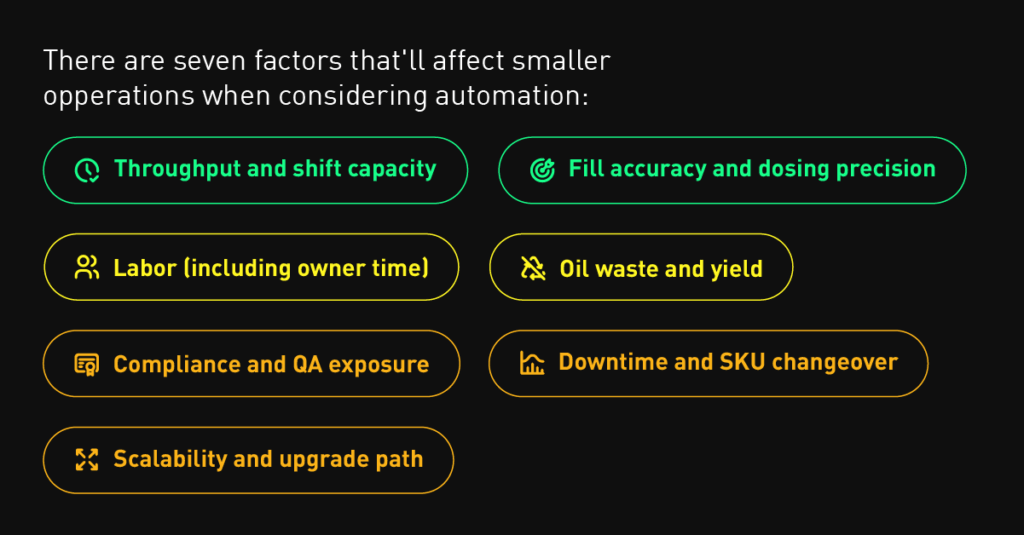
That’s what our guide here sets out to do! Here we’ll cover the seven-factor comparison for small operations to help you decide when manual still makes sense and when it pays off to automate.
Setting the Scope
First and foremost, let’s decide whether or not your operation is actually “small” or not to properly set the scope.
Smaller operations typically produce 500 to 3,000 vape carts per week, with one to four SKUs and just a handful of staff on the production line. The owner is usually heavily involved and even works on the line themselves to get orders out.
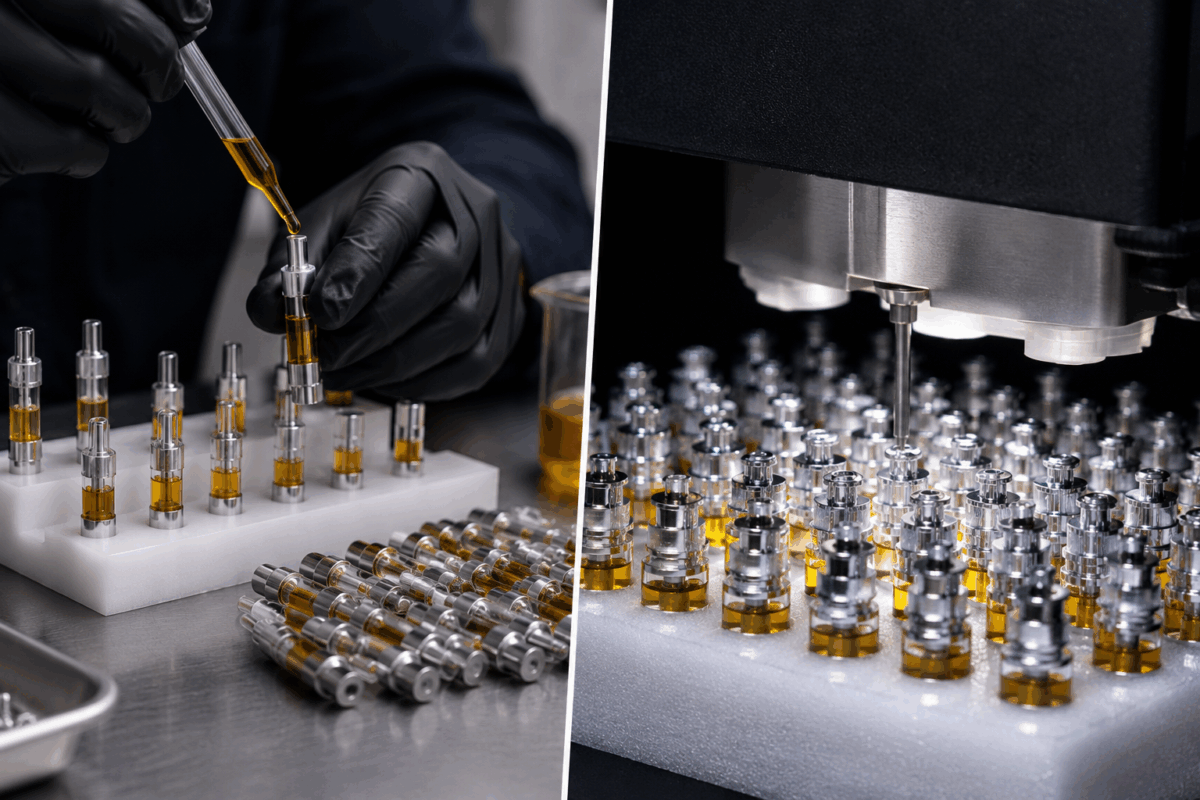
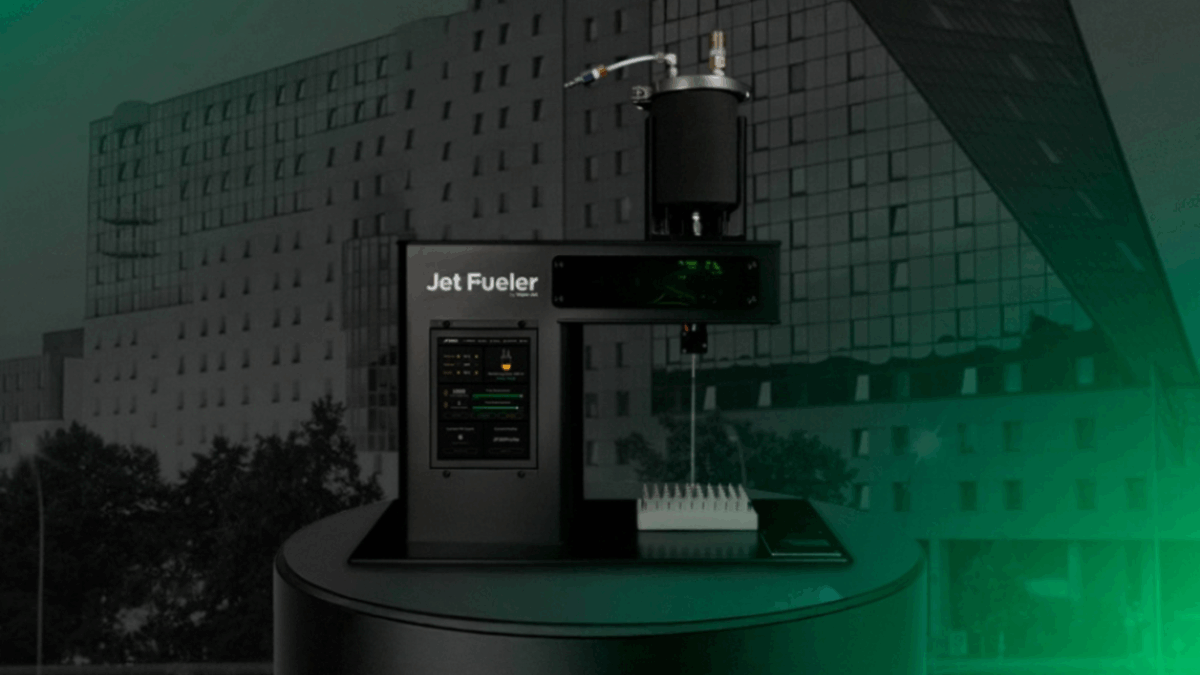
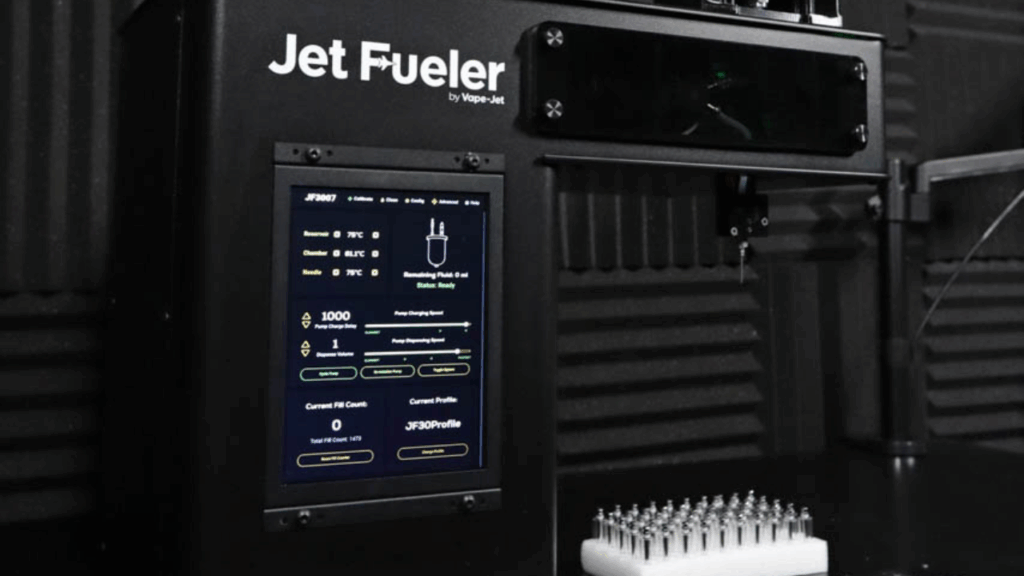
If this sounds like you, this article is designed for you. We’ll compare using a distillate gun and other handheld manual tools versus a semi-automatic vape cartridge filling machine, like the Jet Fueler.
Our next section will compare seven cost factors that affect smaller operations but differ from those affecting bigger operations to better help you understand the ROI and overall cost savings.
The Seven Cost Factors That Actually Differ
Side-by-Side at a Glance
To start, let’s compare each category side by side before we unpack each one in more depth.
Factor
Manual Filling
Semi-Automated (e.g. Jet Fueler)
Throughput per shift
300 to 1,000 carts
4,000 to 14,000 carts
Fill accuracy
±5% (≈85% precision)
±0.5% to ±1%
Labor per 1,000 carts
12 to 18 fill-hours
2 to 4 supervisor-hours
Oil waste
5 to 10% (overfill + rework)
Under 2%
Compliance exposure
High variance, high recall risk
Low variance, audit-friendly
SKU changeover time
45 to 90 minutes
5 to 15 minutes
Upgrade path
Replace entire workflow
Modular path to full automation
Factor 1, Throughput and Shift Capacity
The first factor operators have to consider is the throughput of each filling method. For manual filling on a small scale, you’ll typically top out at 300 to 1,000 carts per shift, depending on staffing levels, skill, and SKU complexity.
Another thing to consider when comparing manual and semi-automatic filling and throughput is operator fatigue. After a full morning of filling carts, this fatigue can reduce the volume of the second half of the shift by 20-30%.
Here the comparison is simple. A semi-automatic vape cartridge filling machine, such as the Jet Fueler, can fill 4,000 to 14,000 carts per shift, depending on several factors. This difference means you’ll be able to complete a full week’s output, or volume, in just part of one shift.
This increase in throughput means you’ll recover shift hours to convert into different products, new accounts, or less labor to run production. At a smaller scale, it’s less about hitting the ceiling of production and more about freeing the calendar to do more.
Factor 2, Fill Accuracy
Another cost factor that’s often overlooked is fill accuracy. Per Cannabis Tech Quarterly, manual filling has an 85% precision rate. That means most fills have a ±5 % variance, forcing operators to overfill defensively to stay above the label weight.
For semi-automated machines, accuracy is much higher. For instance, the Jet Fueler offers ±0.01 mL accuracy under normal operating conditions. This puts it into a whole separate category of precision.
Breaking down the math, a 5% overfill across 2,000 carts per week amounts to 100 grams of oil you’re losing per week. At $4/g wholesale, fill accuracy is affecting your operation by at least $400 a week.
Annually? That totals to more than $20,000. This math makes fill accuracy one of the largest single-line recoveries a small operation can make.
Factor 3, Labor (Including the Owner)
Next is a factor that you’re probably already thinking about but haven’t quantified accurately. Let’s do that now.
In general, manually filling 1,000 carts takes anywhere from 12 to 18 fill hours per week. But that’s not the entire job. After the carts are filled, they must be capped, inspected for quality control, and reworked if underfilled.
These hours add up fast, and you’re likely not tracking them.
The semi-automatic vape cartridge filling machine shifts the role from filling labor to supervising. One operator can run one machine that handles filling, capping, and in-line QC altogether in the same shift.
Here’s where another overlooked cost comes into play. While you might be calculating labor costs using the minimum wage for filling techs, what about the owner that’s involved in filling?
Instead of using $20-$22 an hour, you have to consider the highest-value alternative use of that owner’s time. If they weren’t filling, they could be working on marketing, branding, sales, etc., which would bump the figure up to $50-$150 an hour, depending on the owner’s skill set.
This turns labor cost savings from modest to substantial when framing it more accurately.
Factor 4, Oil Waste and Yield
It’s not just filling accuracy that affects oil waste, however. It’s also rework from carts that fail quality assurance, heating drift from degraded terpenes that fail at testing, or drips and stringy material during the filling and transfer process.
Closed-loop temperature controls protect the oil from degrading, machine-alignment filling closes the variance gap, and pharmaceutical-grade pumps eliminate waste from dripping or stringy material at the nozzle.
When doing the math, this translates to a 5-10% oil loss in manual workflows versus under 2% with semi-automatic vape cartridge filling machines. If you’re buying $30,000 to $50,000 worth of oil per year, this gap directly recovers $1,500 to $5,000.
For those extracting and producing oil in-house, vape cartridge filling machines help you preserve the most expensive input in your business.
Factor 5, Compliance and QA Exposure
Another less thought-about loss comes from quality assurance and compliance. In most states, underfilled carts on a retail shelf are treated as a labeling violation. Meaning, anyone that’s regularly filling at a 5% variance is at risk.
In this case, you’re not only subject to product recall costs but also to mandated retesting or retailer chargebacks. If you continue to make the mistake repeatedly, your entire license could be at risk.
Even one compliance risk can exceed the entire cost of the machine you’re considering purchasing. Semi-automatic vape cartridge filling machines not only fill more accurately to prevent underfills but also provide audit-friendly fill logs when needed.
Of course, this is an asymmetric factor. Most of the time, you’ll incur no compliance costs for manual filling. However, when a cost does hit you, it can be more than every other factor’s cost combined. Consider it an insurance cost that you have to pay for ultimate protection.
Factor 6, Downtime and SKU Changeover
Another part of the filling process that’s a cost for small operations to consider is the downtime associated with cleaning, tearing down, or SKU changeovers.
Switching between SKUs, cleaning the syringes or handheld tools, breaking down the station for refilling, or resetting temperature ranges can take 45 to 90 minutes per change, multiple times per week.
In comparison, semi-automated systems with clean-in-place cycles reduce the changeover time to just 5 to 15 minutes. In fact, advanced systems like the Jet Fueler can even store SKU profiles for repeatable setup, saving you even more valuable time.
For small operations running four or fewer SKUs and changing twice per week, this amounts to two to four hours of reclaimed production per week. As we touched upon earlier, when the calendar gets less crowded thanks to automation, you can make more while saving, too.
Factor 7, Scalability and Upgrade Path
Finally, it’s time to talk about ceilings. With manual filling, you’ll hit the threshold anywhere between 3,000 and 5,000 carts per week. Getting beyond this ceiling will require an entire workflow overhaul, retraining and retesting processes, and absorbing the downtime during the transition.
If you do enter with a semi-automated vape cartridge filling machine, you have a clearer upgrade path and seamless scalability. The semi-automated machine process will prepare your SOP and infrastructure for a move to fully automated equipment once your volume and profits allow.
Again, this is an often overlooked factor that many small operators undervalue. The decision to stay manual or go semi-automatic is not just about the next 12 months. It’s about the next three to five years and how to keep our operation producing the most consistently.
The Tally for a Typical Small Operation
Now that you have a better explanation of each cost factor, it’s time to see the numbers in real-time. Using numbers from smaller operations, here’s a look at the annual cost of manual filling at 1,500 carts per week.
Cost Factor
Annual Cost of Manual (1,500 carts/week op)
Labor (owner at $75/hr loaded, ~18 hrs/wk)
$67,500
Oil waste (7% on $40K oil spend)
$2,800
Rework (7% × 1,500 × 52 wks × $7 per cart)
$38,200
Downtime (3 hrs/wk × revenue/hr at $200)
$31,200
Compliance exposure (annualized, conservative)
$8,000
Total annual cost of staying manual
≈ $147,000
Indicative semi-automated machine cost (one-time)
$25,000 to $45,000
When Manual Still Wins
Of course, there is still a case for manual filling when it makes sense. If you’re producing less than 200 carts per week, with a single SKU and no plans to expand, manual workflows will suffice.
They’re also feasible for R&D-only environments when small-batch flexibility outweighs volume or throughput. Manual filling also makes sense for operators in their pre-revenue phase who are still waiting on final licensing.
Finally, operations with severely constrained capital may be unable to justify the investment until a specific profit bridge has been crossed. In this case, start with the breakeven calculator and revisit the consideration of semi-automated workflows, again, in 6 months.
When Semi-Automation Wins
Any operation producing over 500 carts per week with two or more active SKUs and any plan to grow, however, should consider semi-automation.
Especially if you’re an owner-operator who’s working the line often, when your valuable time could be spent elsewhere.
Another case where semi-automation is the clear winner is if your operation is launching something new or expanding within the next 12 months to multiply volume.
Beyond the obvious, semi-automation is also a smart shift for any operators who have had a compliance warning or scare, or even one rework event. This shows how thin the margin of error really is and how valuable the protection of semi-automatic equipment can be.
When Full Automation Enters the Picture
Lastly, as you grow, there will be a time to consider a fully automated vape cartridge filling machine. You’ll start to notice pressure with semi-automated machines when you’re reaching 5,000 carts per week.
At this time, fully automated systems like the Vape-Jet are worth considering. But don’t think by purchasing semi-automation, you’re locked out of moving to fully automated, eventually.
Most vendors (like Vape-Jet) will offer a semi-automated machine and fully automated equipment, allowing the same training base, workflow, and support infrastructure to grow with you.
In Closing: A True Cost Comparison for Small Cannabis Operations
As you’ve learned there, the true cost comparison of manual filling versus automation lies in seven factors: throughput and shift capacity, fill accuracy and dosing precision, labor (including owner time), oil waste and yield, compliance and QA exposure, downtime and SKU changeover, and scalability and upgrade path.
Depending on your exact numbers, manual filling might still be right for you if you’re producing low volumes or craft cartridge filling. However, for anyone producing over 500 carts per week, the proof is in the numbers when conducting a thorough cannabis filling automation comparison.
In the end, it’s not just about labor. It’s about every line item on your operation’s P&L. While the labor savings are real, it’s a small piece of the case for a small cannabis operation considering manual vs. automated cart filling.
Q: How does manual vape cartridge filling compare to automated for a small operation?
A: Across seven factors (throughput, accuracy, labor, oil waste, compliance, downtime, scalability), semi-automated systems outperform manual at almost every operating scale above 500 carts per week. The largest gaps appear in fill accuracy (±5% manual versus ±1% automated) and recovered owner time.
Q: What is the cheapest automated vape cartridge filling machine for a small operation?
A: Semi-automated systems for small operators start around $25,000 and reach roughly $45,000 depending on configuration and capping integration. That is a meaningful range, but most small operators recover the cost inside twelve months once labor, rework, oil waste, and compliance exposure are added together.
Q: Can a small craft brand justify an automated vape filling machine?
A: Yes for most small craft brands above 500 carts per week. The justification is rarely just labor savings. It is the combination of recovered owner time, eliminated overfill loss, reduced rework, lower compliance exposure, and a defined upgrade path that protects the operation as it grows.
Q: What is the difference between semi-automatic and fully automatic vape cartridge filling?
A: Semi-automatic systems automate the dispensing and pumping but still require an operator to load and unload cartridges. Fully automatic systems also automate alignment, loading, and capping. For most small operators, semi-automatic is the right entry point and full automation becomes warranted above roughly 5,000 carts per week.
As one of the first cannabis manufacturers in New Jersey, the Jersey Smooth team set out to find equipment not just to start up their business but to ease the workload on their small team.
Shortly into their search, they came across Vape-Jet, and, as they say, the rest is history. Jersey Smooth quickly went from operating four single tables to producing thousands of vapes each month, thanks to an early investment in an automatic vape filling machine
If you’re on the cusp of deciding, can I scale with traditional tabletop systems, or should I invest in automation? This is one cannabis brand’s story you’ll want to hear. Keep reading to learn how Vape-Jet helps Jersey Smooth scale production while maintaining flexible, efficient operations.
Meet Jersey Smooth
Jersey Smooth began as a small-craft operation in Ewing, New Jersey. The brand was founded to bring consistently exceptional vape products to market. To do so, the founders have aligned themselves with strong industry partners to source high-quality materials for premium natural terpenes and also use a production process they call “the Smooth Flow Path.”
The process incorporates numerous techniques and equipment to produce the most terpene-rich extracts as efficiently as possible, offering consumers access to high-quality material and maximizing their margins.
Together, the strategies have helped the locally family-owned company grow to be one of the most innovative, science-driven, and research-focused companies in the state.
Running a Small Cannabis Vape Operation With a Lean Team
But before it became one of the most advanced operations in the state, Jersey Smooth ran with a lean team. For approximately 7-8 months, a small team of three including the owner and his wife were filling, packaging, and delivering the entire operation off of just four stainless steel tables.
They attribute their rapid rise in success to investing in automation and a vape cart-filling machine from the start, especially one that helped multiply productivity, rather than systems that require additional or ongoing labor.
“What was so wonderful about us being so small and having a fully automatic Vape-Jet was that while the vapes were filling, we were doing calls, emails, you know, packaging, and other things that we could press go and walk away for 4 minutes while it was filling, or 3 minutes,” explains Aslan Zadeh, Founder and CEO at Jersey Smooth.
The Hidden Cost of Manual Vape Cartridge Filling
By adding automation from the start, as Aslan mentioned, the small operation was able to multitask through this important growth period. The team could seamlessly fill carts while managing packaging and sales by handling phone calls, emails, and more.
In the end, it wasn’t just about the cost of labor they’d have to pay but about hidden costs like lost flexibility, reduced throughput, and precious time that need to be considered when evaluating automation.
Why Jersey Smooth Looked Beyond Traditional Tabletop Filling Systems
Seeing others operate in the space and state, using smaller machines or manual filling, the pain points and the clear demand for automation were obvious to the founders of Jersey Smooth. What they saw was:
Observable bottlenecks
Labor-heavy workflows
Constant supervision
So, the decision to begin their operations with automation was simple from the start. They began with just a scale, a bead bath, a hot plate stirrer, and the Vape-Jet automated vape-filling system, taking it slowly at first and gaining momentum in production as sales grew.
“Soon, we were doing $500k/month in vape sales while the machine only ran 5–6 days/month. That was the point that I knew we made the right decision,” Aslan shares.
Implementing an Automated Vape Filling System
By implementing an automated vape-filling system from the start, Jersey Smooth avoided the traditional pain points of manual filling and the associated hidden costs through improving workflow efficiency, creating more consistent production, and allowing its small team to scale more efficiently.
Let’s break down more on each next.
Improving Workflow Efficiency
As Aslan’s example shows, it’s not just about handling important phone calls or emails that automatic vape filling machines give you time back to handle. It’s the overall workflow efficiency that they help improve.
Machine-enabled asynchronous work allows small teams to multitask during fills, reducing the downtime between operation tasks. As a machine is filling, your team can be capping, packaging, labeling, or delivering, getting more done with fewer hands and time.
Creating More Consistent Production
Automated vape cartridge filling machines also support more consistent production, a key component of getting repeat orders and nurturing customer loyalty.
By selecting a machine like Vape-Jet, with a proven repeatability rate and its configuration profiles for SKU settings, Jersey Smooth gained the ability to seamlessly fill one type of vape cartridge across many types, with the confidence that comes from accuracy and consistency.
Maximizing Uptime with Advanced Support
When relying on equipment and automation, support responsiveness matters as much as machine performance to maximize uptime. During installation and inspection, Jersey Smooth saw just how quickly Vape-Jet support works when an issue came up.
“We plug it in, we turn it on, it’s not working. So, immediately, we called Vape-Jet. We were on the phone, they diagnosed it, and found that it’s one cable that’s in the back, and they immediately overnighted it,” Aslan recalls.
With advanced support, the Vape-Jet tech team can access the machine and its operating system remotely to troubleshoot issues quickly, getting operations back on track and moving before delays occur.
Or, even, helping clients with important inspections for licensing. Like Vape-Jet’s team did, swooping in to save the day for Jersey Smooth when inspectors showed up and the machinery wasn’t operating yet.
Quick thinking by Aslan and a quick phone call enabled Vape-Jet technicians to remotely add an image of the normal operating screen. By doing so, they satisfied the inspector’s needs and passed the inspection again without delay.
“What’s really important is how the company backs it up. That support is really where I saw the value,” Aslan continues.
Allowing a Small Team to Scale More Efficiently
With higher volumes, improved efficiency, more time on your hands, and consistent production, it’s easy to see how small teams can scale more efficiently with automated vape filling machines.
For Jersey Smooth, the initial team scaled revenue substantially without large labor expansion. Meaning, automation supported growth before major hiring.
Despite the system capacity exceeding early production needs, the Vape-Jets’ efficiency gave their team the internal systems they needed before they grew, stabilizing operational foundations for rapid success.
How Automation Changed Daily Operations
For Aslan and Jersey Smooth, automation changed the game in daily operations. They were able to evolve from large single-day production runs to more flexible batching, which helped operations become smoother and less stressful.
Today, the brand easily produces 1,200–7,000 vape carts per shift or day. Beyond its operational efficiency and volume, the team applauds Vape-Jet for how naturally it integrated into day-to-day operations and for the support and service the company offers.
Why More Cannabis Brands Are Investing in Vape Cartridge Filling Machines
In the ever-evolving cannabis industry, automation is no longer just for MSOs. More and more brands and small craft producers are investing in vape cartridge filling machines than ever before. Why? Because:
Cannabis margins are tightening
Lean teams need to produce more without increasing labor costs
Manual filling can create bottlenecks as demand grows
Automated vape filling systems help improve production speed and consistency
Operators can multitask instead of being tied to a filling station all day
Consistent fill accuracy helps support product quality and customer experience
Faster production helps brands stay competitive in maturing markets
Scalable equipment allows brands to grow without constantly rebuilding operations
Reliable automation can reduce downtime and improve day-to-day efficiency
Final Thoughts
With such early success, Jersey Smooth is now expanding its operations by exploring new hardware and adding pre-rolls and rosin SKUs.
So, even though you might have begun this article wondering, “Is now the right time to automate? After hearing Jersey Smooth’s path to success, you may now be wondering, “Why didn’t I automate sooner?”
Fortunately, it’s never too late. Investing in automation, no matter which stage of growth you are in, helps reduce labor strain, create consistent production, and improve overall efficiency.
Just as Vape-Jet helped a small team achieve major production volumes, they can help your team achieve efficiency with the support and service the industry demands. “The VapeJet helped us do so much with so little. It’s worth the spend,”Aslan concludes.
In fact, you’ve likely already run the quick math to get to a rough break-even point. You’ve divided the cost of the machine by the hourly wage of your tech and, at $40,000 a machine and a $22/hour tech, figured out you’ll get back to zero after approximately 1,800 hours.
Of course, that equation only factors in one variable. It doesn’t factor in three silent variables that speed up your payback far more than just your labor line item.
In this guide, we’ll go beyond just labor and break down four variables that affect the breakeven point for investing in vape cartridge filing equipment. Keep reading to dive deeper and to learn from two real-world examples, producing both 500 and 2,000 carts per week.
The Four Variables in a Real Payback Calculation
Although labor costs might be hurting you the most, that’s only one variable in the payback calculation when considering cartridge filing machine costs. If you want to know your facility’s real payback point, you’ll need to consider four variables, including:
Variable 1, Labor cost: The most obvious variable we’ll cover; we’ll break down the number of hours you’ll save per week and multiply that by not just the hourly rate but the fully loaded hourly cost. That includes wage plus payroll tax plus benefits, which usually equals 1.25 to 1.35 times the tech’s base pay.
Variable 2, Rework and oil waste recovered: In your current operation, you’re likely losing X amount of oil and finished products to underfill, overfill, product leaks, and temperature-driven failures. With a vape cartridge filling machine, you’ll recoup the losses, making the recovery a viable variable to consider.
Variable 3, Throughput recovered: You’ll also recover time and money through increased throughput, transforming all the carts you normally couldn’t fill because you ran out of human hours into sellable inventory to include in your calculations.
Variable 4, Owner opportunity cost: Ever do the math on your own hours? Of course not; you’re the owner. But your time is valuable and takes you away from other profit-building skills, so it should be a part of the payback calculation. Here, we’ll quantify how much time you’re spending at the fill station instead of selling, building accounts, designing SKUs, or, let’s be honest, resting.
Variable 1, Labor (Including the Owner’s)
The first variable to consider for cartridge filling machine payback is labor. Your team’s labor and the labor of the owner or facility leads. Let’s walk through the simple math at a smaller scale first.
Manually filling 1,000 carts per week takes anywhere from 12 to 18 fill hours depending on operator speed and SKU mix. Multiply that by 50 weeks, and you’re looking at 600 to 900 hours per year.
When doing the math previously, you may have been multiplying that by a standard rate, for instance, by $22/hour, if that’s what you pay your techs. But that’s not exactly the full picture.
With payroll taxes and benefits, the “loaded” hourly rate you’re really paying each tech is more like $28. Multiply that by 600 to 900 hours, and you’re paying just one tech between $16,800 and $25,200 annually for labor cost manual filling.
Of course, if you, the owner, are the fill tech, $22/hour is not the rate to use for accurate calculations. You should enter the amount you’d otherwise earn per hour from running and managing the business.
For most small operators, that rate ranges from $50 to $150 per hour, suddenly bumping your labor cost line for manually filling to $30,000 to $135,000 per year.
This owner-operator opportunity cost of manual filling is much more than any normal, let alone small, operation can handle annually.
Variable 2, The Rework You Stop Paying For
Next, we have to address the loss that occurs during manual cart filling. According to industry benchmarks, manual workflows have an 85% dosing precision, meaning. At a small scale, that translates to a 5 to 10% rework rate.
Let’s put those numbers into a concrete example. Say you have a 1,000-week period, and we’ll assume an average rework rate of 7%. That’s 70 carts.
With an oil cost per gram of $4-$6 and hardware at $2-$4 a cart, multiply that by 70 carts or devices, and that’s $420-$700, not including labor. With hourly wages, you’re looking at an impact of $700-$1000 per week in rework alone.
Over a 50-week year, that weekly rework can total $35,000 to $50,000. But luckily, it’s a margin that automation can help recover.
A semi-automatic vape cartridge filling machine is typically equipped with a 0.5% to 1% accuracy rate (plus or minus), closing that gap and saving you from rework costs that compound over time.
Variable 3, The Throughput You Are Leaving on the Table
The next variable to consider when determining cartridge filling machine ROI is the vape cartridge filling machine throughput you’re leaving on the table. In the cannabis industry, most small operators aren’t constrained by demand. They’re constrained by your capacity to fill them.
The carts you could be selling but can’t fill are real revenue. They’re just invisible on the P&L because they never get invoiced.
The Jet Fueler can produce 4,000 to 14,000 carts per shift. So if you’re producing 2,000 carts per week, that means one operator could finish an entire week in one single shift.
Those remaining hours in the week are invested directly back into the operation. The tech now has time to devote to new SKU runs, new wholesale orders, or to taking on more co-packing work.
To turn that time into money, we’ll use $5 per cart as an example of wholesale margin. Leaving 500 carts per week unfilled at $5 per cart leaves $130,000 of unrealized margin on the table.
Any machine at or near this price pays for itself with revenue that does not yet exist, which is the hardest number to calculate and one that’s almost always missed by operators considering small cannabis operations scaling.
Variable 4, The Hours You Cannot Buy Back
Variable 4 definitely hits home. It’s a primary driver behind your research into cartridge-filling machine payback and one of the biggest game-changers for operators who have already made the switch.
It’s the extra time you, or any owner, spend on or off the clock to fulfill orders and fix orders. Time that could be used to gain new accounts, build your brand, handle regulatory matters, prepare for the next SKU launch, or spend time with your family is wasted at the fill station.
To quantify the time and cost, let’s say you spend 10 hours a week filling carts. If you were to take that time and put it towards a high-value alternative task, you’d be making around $75/hour.
That’s over $750 of your own time per week and nearly $37,500 per year in opportunity cost the labor-only math never captures. By filling manually, not only are you stressing and potentially missing friends, family, and loved ones… you’re losing money.
Just remember, the pilot of the plane doesn’t also pump the fuel. Your time and skills are more valuable used elsewhere.
The Calculator: Two Worked Scenarios
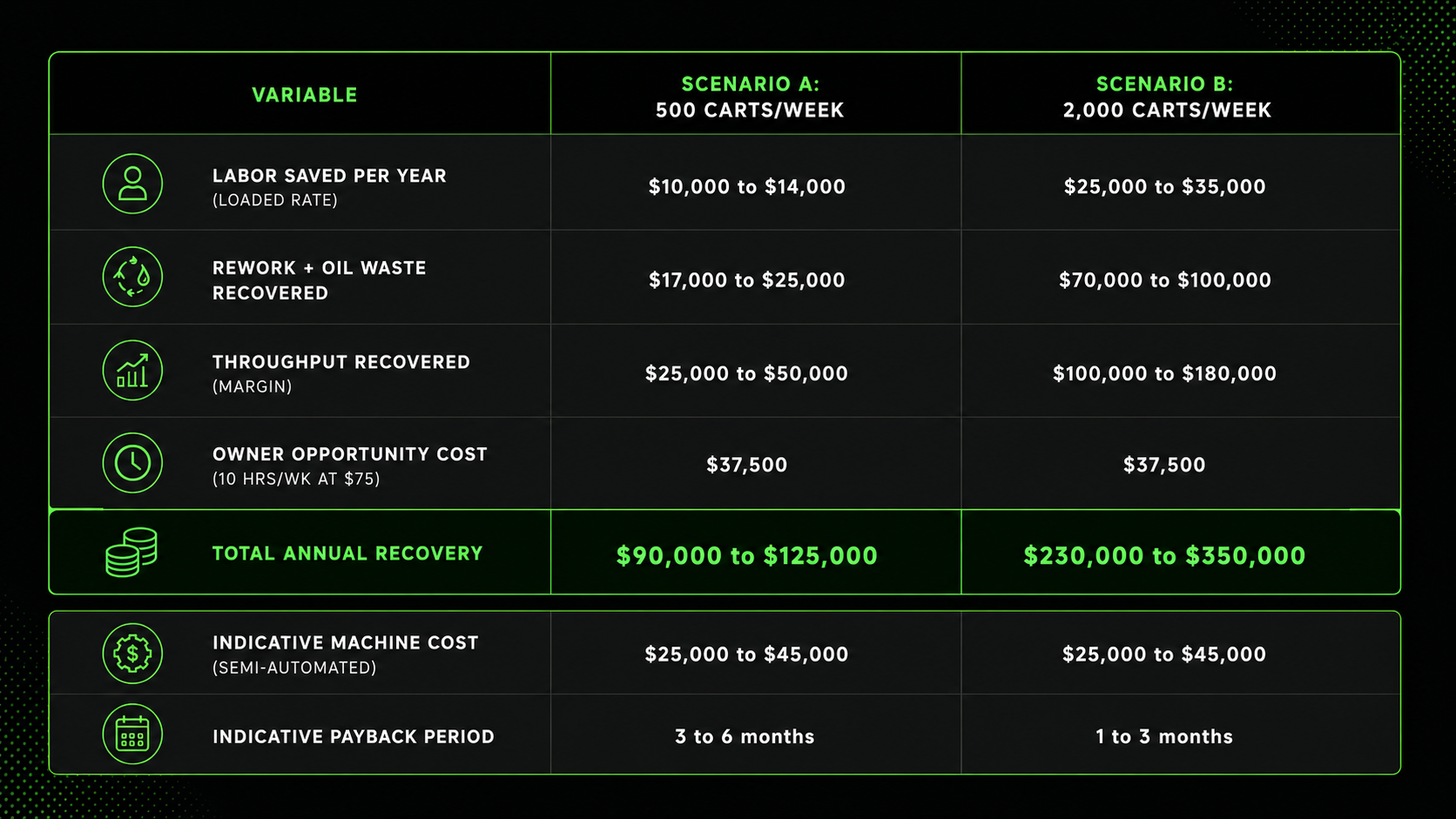
Here’s where the work gets real. Take a look at two real-life scenarios of small cannabis operations producing 500 carts per week and 2,000 carts per week to compare to your own.
This is the math an operator running these inputs would see. Plug your own numbers into the equations provided to get a real-life look at what you could save.
What Changes the Math Faster Than You Think
Of course, there are industry outliers that affect labor, costs, and payback. Here are three accelerators to keep in mind that could affect the equations we’re discussing today.
Adding a second or third SKU: When adding a SKU to manual workflows, it multiplies the time and costs of changeovers, whereas machines handle them with a change in profile configuration.
One compliance event: A single underfill recall can cost more than the machine. Add up the handling of recalls, retailer chargebacks, and testing re-runs, and you’re adding up money fast.
A staffing event: Manual workflows depend on your team, so if a fill tech leaves, gets sick, or relocates, your flows are suddenly disrupted. Automation helps keep your operation moving and products getting out the door.
When the Machine Does Not Yet Pay for Itself
Finally, it’s important to note that vape cartridge filling machines aren’t for every operation. If any of the following stick out as true for you, a vape cartridge filling machine might not be the right move:
If you produce fewer than 200 carts per week with a single SKU and no near-term plan to expand.
If you run R&D-only operations or pilot runs with frequent oil reformulation.
If you’re in pre-licensing and waiting on final paperwork. Capex before revenue is rarely the right move.
In all other cases, the math tends to favor automation earlier than operators expect, even in small cannabis operations.
The Vape Cartridge Filling Machine Equation: Looking Ahead
Our guide has taught you that there are actually three other variables to consider in addition to labor hours: the rework, the throughput, and the opportunity costs.
Now, you can run the calculations with your own numbers and see just how quickly you’ll achieve cartridge filling machine payback when using all four variables, not just one.
If the payback is shorter than you expected, and you’re ready to start seriously considering a vape cartridge filling machine, you’re in the right place. Take operational flight with Vape-Jet.
Talk with our crew about our fleet of machines and which would best fit your current workflow.
FAQ Section
Before you go, check out answers to the most frequently asked questions about cartridge filling machine costs.
Q: How long does it take a semi-automatic vape cartridge filling machine to pay for itself?
For small operators in the 500 to 2,000 carts per week range, payback typically lands between three and twelve months once labor, rework, recovered throughput, and owner opportunity cost are included. The single-variable labor-only math usually overestimates payback by a factor of two to four.
Q: What does a semi-automatic vape cartridge filling machine cost?
Semi-automated systems for small operators typically fall in the $25,000 to $45,000 range, depending on configuration, capping integration, and SKU flexibility. Fully automatic systems sit higher. The decision is less about price and more about volume, SKU complexity, and how the math works against your own production numbers.
Q: How do I calculate opportunity cost when I am the one doing the filling?
A: Use the hourly rate you would earn doing your next-best activity (sales calls, new account development, SKU design, regulatory work). For most owner-operators, that figure sits between $50 and $150 per hour. Multiply by hours spent filling per week and then by working weeks per year.
Q: Is a cartridge filling machine worth it for a small craft brand?
A: For craft brands above roughly 500 carts per week, the math usually works. Below 200 carts per week with no expansion plans, manual is still defensible. The honest answer requires running the four-variable calculation against your own production, rework, and time numbers.
For most operators, the conversation surrounding vape cartridge filling machines always starts with return on investment. You find out the cost of the machine and then, on the back of an envelope, start doing the math yourself on how you’ll be able to make up for the investment.
With two techs at $22 an hour, a 40-hour week, payroll tax, and benefits loaded in, the capex never seems to pencil out.
But what many operators don’t realize is that it’s not just the labor line of their P&L that is hurting their ability to scale. While it’s the easiest to see and quantify, there are three hidden costs of manual filling that also contribute to growth problems.
Rework, fill-weight variance, and unplanned downtime never show up on a timesheet or as a labor line item. Yet they all represent hidden costs of manual cartridge filling.
If this sounds familiar or you’re comparing cart-filling machine costs, this guide is for you. Here, we’ll cover costs beyond the labor line item, with real insights into cannabis automation ROI.
Why the Labor Line Item Is the Wrong Starting Point
We get it. It’s hard to look beyond the labor line item when it’s such a significant number in your grand scheme of costs or when it’s screaming at you from the spreadsheet. Regardless of what you’ll learn here today, that remains unchanged.
Labor has to be considered when it takes two manual operators making 2,000 carts per shift at $350 to $500 per shift. And that’s before taxes and benefits and, of course, varies depending on your region.
But labor isn’t the place you should start, only because it’s the most obvious on the primary financial doc or spreadsheet you review each month.
Instead, there are costs that span four or five different reports that you should consider just as much as labor when evaluating cart-filling machine costs, including the following:
Quality assurance logs
Inventory
Scrap or loss reports
Compliance filings
And even harder-to-track numbers, like production downtime, are definitely missed in the total cost of manual cartridge filling.
Next, we’ll cover the top three hidden costs that every operator should consider when searching for vape cartridge filling machines: rework, fill-weight variance, and unplanned downtime.
Hidden Cost #1, Rework, The Tax You Pay Twice
You might think… if the product hits the shelves, who cares how much work went into making it? But if you think of rework in terms of time and dollars spent, it’s much easier to see why exactly you should care.
Let’s dive deeper into the concept now.
What Counts as Rework
To quantify rework, we have to understand what counts as rework on a filling line. Rework costs will include:
Underfilled carts that fail QA
Overfilled carts that leak in packaging
Miscapped units
Batches that fail tests due to filling-temperature drift
Each one of these rework events doesn’t just cost you once. It costs you four things simultaneously, including:
The labor to redo it
The oil wasted in the first pass
The hardware that cannot always be recovered
The schedule slip, which pushes other SKUs back
The Math Operators Never Run
Per Cannabis Tech Quarterly, manual cartridge filling typically yields roughly 85% dosing precision. This is an industry benchmark you can use as a foundation for thinking about rework.
Now, consider this scenario. If a 2,000-cart shift is running at 5% rework, that amounts to 100 carts. At roughly $6 in oil cost per gram-equivalent fill plus $2 to $4 in hardware per cart, that is $800 to $1,000 per shift in rework costs alone. Multiply by 250 production days, and you are between $200,000 and $250,000 per year for cart-filling rework.
$200k to $250k per year for refilling carts falls within the same cost range as an automatic vape cartridge-filling machine, which will not only save you on labor but also reduce rework with improved filling accuracy. For operations with smaller volumes, semi-automated equipment can achieve the same goals, like our Jet Fueler.
Hidden Cost #2, Fill-Weight Variance, The Silent P&L Leak
Rework isn’t where the concern for fill weight accuracy ends, however. It’s not just overfilling that can hurt an operation’s margin. Underfilling can also lead to compliance risk. Let’s explore more silent profit leaks by diving deeper into the costs of fill-weight variance.
Overfill Is Oil You Are Giving Away for Free
It’s easy to think that a slight overfill here and there doesn’t add up to anything measurable. But when you look at the math and economics of overfilling, you quickly prove yourself wrong.
Here’s a way to quantify the costs of overfilling. When manually filling a 1g cart, at approximately a 5% variance, you’re potentially overfilling some units by 50mg above the labeled dose.
That 50 mg is wholesale oil at roughly $3 to $6 per gram for distillate and higher for live resin or rosin. Across 10,000 carts a week, a 3% average overfill is 300 grams of oil leaving the facility unbilled. At $4 per gram, that is $1,200 a week, or $62,000 a year.
Instead, automatic vape cartridge filling machines that dial in weight accuracy protect against a variance problem that automation solves at the source.
Underfill Is a Compliance Event Waiting to Happen
On the flip side, underfilling can negatively affect your operation’s vape cartridge compliance requirements. When underfilled carts hit retail shelves, under their label weight. In most states, regulators will treat underfills as a labeling violation, not a rounding error, which can cost you in fines and hurt your brand’s reputation.
Other underfilling exposures that can carry costs include the following:
Product recalls
Testing re-runs
Retailer chargebacks
And in repeat cases, license risk.
None of these sit on your weekly labor report or P&Ls. Rather than run the risk, operators who improve accuracy with an automatic vape cartridge filling machine gain a fill accuracy of plus or minus 0.25% (like that of our very own, Vape-Jet!) to plus or minus 1%, compared to the 85% ceiling on manual workflows.
Hidden Cost #3, Downtime, The One Nobody Budgets For
Another hidden cost that operators often overlook when comparing manual vs. automatic workflows is downtime. Next, we’ll cover how manual operations often lose time (and money) without even noticing.
SKU Changeovers, Cleaning, and Operator Fatigue
Filling carts manually may look flexible on paper, but it is expensive in practice. Each time a line has to change SKUs, that requires breaking down the station, cleaning syringes or handheld guns, and resetting the temperatures. With each changeover taking 45 minutes to 90 minutes, if you’re an operation running 8-9 SKUs, that time adds up when it occurs multiple times a week.
Beyond changeovers, operator fatigue is real. Like any repeatable task, by hour six of a manual-fill shift, fill times slow and rework rates climb. It’s common for fill techs’ morale to take a hit from fatigue, especially under production pressure, which raises turnover costs.
At Vape-Jet, our team has seen facilities reclaim 8 to 12 hours of production time per week once they adapt to automated processes. The Vape-Jet specifically prioritizes clean-in-place automation with pre-configured SKU profiles to reduce line downtime, delivering meaningful time and cost savings, even at conservative per-hour revenue levels.
The Revenue Downtime Math
Now, here’s a simple framework you can use on your own P&L to uncover the math behind your cartridge-filling downtime. First, find the average revenue per production hour for your facility.
Then, calculate the average number of hours lost per week to SKU changeover, cleaning (without clean-in-place!), and fatigue-driven slowdowns. Finally, use the following equation to calculate the weekly cost of downtime, then annualize the result.
Average revenue per production hour X Average number of hours lost per week = cost of downtime per week
This is yet another number that never shows up on a labor line.
Stacking the Real Cost
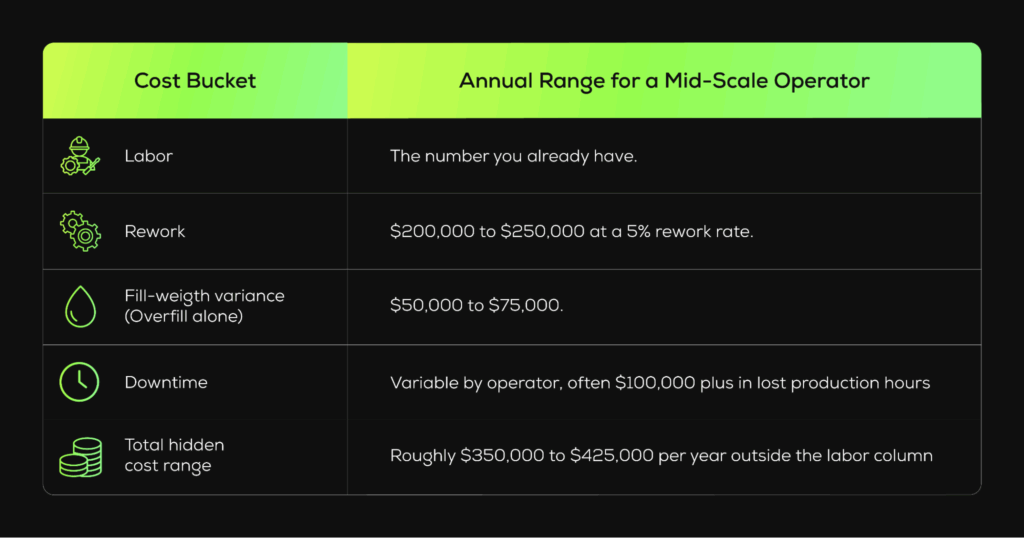
With the information you’ve learned today, you can now calculate your facility’s hidden costs. Find the costs below, to stack the real cost of manual cartridge filling, to compare with the capital expenditure investment of cart-filling machine costs.
As you can see here, vape cartridge filling machines are much more than an alternative to replacing labor or its costs. It’s an investment to protect margins and quality. The labor savings are just a byproduct, not the primary goal.
What to Actually Look For When the Capex Makes Sense
Once you’re equipped with the right equations and numbers, and the capital expenditure finally makes sense…you’re tasked with comparing machines and vendors. It’s important to know that not all automatic vape cartridge filling machines are created equal, so they won’t all provide the same value as the Vape-Jet.
To be sure you’re maximizing your capex, here’s a list of features or factors to look for:
Dosing repeatability tight enough to close the variance gap. Look for plus or minus 1% or better under load across a full shift, not just bench-test specs.
A clean-in-place cycle measured in minutes, not hours. If changeover requires a full teardown, you are trading one downtime problem for another.
Direct-to-tray filling rather than jig-loading. Jig systems add labor back into the workflow and are one of the places operators are surprised by hidden cost post-purchase.
Temperature control built around oil integrity. High-heat filling degrades terpenes, which shows up later as product returns and shelf complaints.
Machine-vision alignment or equivalent sensing. This is what gets a line from “mostly accurate” to “accurate under fatigue, changeover, and operator rotation.”
Real support response windows. Ask vendors for their median response time on a line-down ticket. Anything over 24 hours is a production risk. Here’s what our support looks like.
Before You Run the Numbers Again
To finish our guide and your research, pull six months of QA logs, scrap reports, and SKU-changeover records, and run the three calculations we walked through. That amount is what it’s costing you to continue running manual cartridge filling.
If that cost is close to the capex you’d put toward a vape cartridge filling machine, it’s worth the conversation moving past labor versus automation to the protection of margins and uptime.
Operators we work with who had these same conversations 18 months ago are now expanding into new states, formats, and SKUs. The ones still running the labor-only math are still running the labor-only math.
Q: How much does a vape cartridge filling machine cost to operate versus manual filling?
A: Operating cost comparisons should include labor, rework (from 5% manual variance versus 0.25 to 1% automated), oil overfill loss, and downtime from cleaning and SKU changeovers. For most mid-scale operators, the hidden costs of manual filling exceed direct labor, which is why automation ROI typically lands inside 18 months.
Q: What is a realistic rework rate on manual cart filling?
A: Industry data puts manual filling at roughly 85% dosing precision, which translates to rework rates of 5 to 10% on most lines. At 5% rework, a 2,000-cart shift loses $800 to $1,000 in labor, oil, and hardware costs per shift before any compliance exposure is priced in.
Q: How does fill-weight variance expose operators to compliance risk?
A: Underfilled cartridges that hit retail below label weight are treated as labeling violations in most legal cannabis states, with exposure that includes recalls, retailer chargebacks, and license review. Overfills are not a compliance event but give away margin on every unit shipped.
Q: When does it make sense to move from manual to automated cart filling?
A: The traditional answer is “at volume.” The more accurate answer is “when hidden costs (rework, variance, downtime) sum to more than the monthly payment on an automated vape cartridge filling machine.” For many operators, that threshold arrives earlier than the volume math suggests.
High-performance vapes are built at the intersection of oil quality, flavor chemistry, and production process. The oil does not exist in isolation once it’s inside a cartridge or disposable. It moves through intake ports, saturates a ceramic core, contacts a heating element, and aerosolizes through a defined airflow pathway before it reaches the consumer. This guide, developed by the terpene science team at Abstrax Tech, is written specifically for formulation teams and production managers who want to understand how terpene chemistry affects that entire path, starting at the filling machine. Terpene concentration is one of the primary variables driving viscosity, which means formulation decisions made at the bench directly determine how oil moves through a filling system at scale.
Terpenes sit at the center of that system. They influence oil viscosity, how quickly individual compounds volatilize under heat, and how a formulation’s aroma profile holds across repeated activation cycles. Monoterpenes like b-Myrcene and d-Limonene aerosolize rapidly at lower temperatures, while heavier sesquiterpenes like b-Caryophyllene tend to persist longer through the draw. The same blend can express differently in a narrow intake cartridge versus a wide-aperture design, or across a ceramic heater versus a metal coil. Oil base, terpene percentage, and hardware geometry all interact. When those decisions are made in isolation, issues like clogging, inconsistent vapor production, faded top notes, or off-flavor from thermal degradation are more likely to emerge at scale.
This guide is written for formulation teams, lab operators, and production managers. It explores how terpene chemistry translates inside real hardware, where instability tends to surface, and how to evaluate formulation decisions and their impact on filling and device performance. When cartridge design and terpene strategy are considered from the start, products are easier to reproduce, easier to scale, and more consistent from the shelf to the end user.
How to Choose Terpenes for Vape Cartridges and Disposables
Terpenes are the building blocks of flavor in a vape. They determine what the product tastes like, how complex it feels, and how clearly it presents from the first draw to the last. Before choosing a blend, brands need to decide what they want to be known for.
Are you leaning into cannabis authenticity and recognizable strain profiles? Or are you building fruit-forward, dessert-inspired, or trend-driven flavors meant to hit immediately? That choice drives your terpene composition, your dosing strategy, and the kind of supplier you need to work with.
Terpene inclusion rates also affect how oil behaves during filling and inside the device. Higher percentages generally lower viscosity, which changes how consistently oil feeds through a filling needle, how quickly it saturates a ceramic core, and how reliably it moves through intake ports once in use.
This is where your terpene supplier goes from vendor to formulation partner. A supplier built for inhalable applications provides regulatory documentation, consistent lot-to-lot composition, and genuine dosing guidance based on your oil base and device format.
Terpenes for vape formulations should allow you to hit flavor targets at controlled inclusion rates without pushing viscosity out of your hardware’s operating window. Efficient, well-constructed profiles that perform consistently across devices protect both your production consistency and your brand identity at scale.
Why Terpenes Matter in Vape Cartridges
Flavor and aroma are the primary drivers of the vape experience. A layered blend communicates depth and authenticity. A high-impact fruit profile communicates boldness and immediacy. Consumers associate that sensory signature with your brand.
Quality and dosing both matter. Lower-cost blends often lack the complexity needed for persistence and balance. Overloading terpenes in an attempt to increase intensity can shift viscosity and create harshness or oversaturation. Many formulators use neutral liquidizers to fine-tune flow once the flavor profile is set, which allows viscosity adjustments without changing taste.
Composition also influences how a product holds up over time. Monoterpenes like Terpinolene are highly volatile and can deplete faster under repeated heat cycles, which shifts the perceived aroma profile across a cart’s lifespan. Oxidation-prone compounds gradually alter flavor balance and can contribute to residue buildup on heating elements. Stable blends with appropriate inclusion rates help maintain concentration and complexity across batches.
Common Approaches to Terpenes in Vape Products
When building a vape brand, most manufacturers lean in one of two directions: plant-forward or flavor-forward. Brands with staying power usually weave both into their overall strategy, offering authentic strain profiles alongside high-impact fruit and dessert flavors so there’s something for everyone.
What matters is being intentional about which role each SKU plays in the lineup.
Plant-Forward Profiles
Plant-forward profiles are built around authenticity. These products are meant to reflect recognizable cultivars and the layered complexity people associate with cannabis. Consumers reaching for Garlic Cookies or GG4 expect something that feels true to the reference strain, not a simplified interpretation.
That requires terpene blends with real chemical depth. The dominant terpenes matter, but so do the supporting compounds that create persistence and nuance. When blends are overly simplified, the result can feel thin or one-dimensional even if the name on the package is familiar.
Consistency is just as important. If a strain is part of the core lineup, it needs to read the same across batches. That comes down to working with partners who prioritize repeatable composition and proper documentation.
These profiles also tend to involve more complex oil bases like live resin or rosin, which behave differently at the filling stage than distillate. Viscosity management during filling is more demanding, and terpene percentages that work beautifully in a distillate context may need recalibration when the base oil changes.
Flavor-Forward Profiles
Flavor-forward profiles focus on high impact experiences. Fruity releases, dessert-inspired flavors, beverage-style carts, and other viral or trend-based launches all fall into this category. These SKUs are built for recognition and immediate flavorful intensity.
The challenge is achieving that intensity while staying within your device’s operating window. Well-constructed flavor-forward blends solve this by delivering strong sensory output at percentages your hardware can actually handle.
This is also where formulation support becomes valuable. An experienced partner can help dial in flavor first, then adjust inclusion rates and flow characteristics so the product tastes bold while still filling reliably and functioning consistently inside the intended device.
Terpene Inclusion Rates and Production Variables: What to Lock In Before You Scale
Before selecting your terpene blend, a few decisions need to be made up front, long before you ever start testing or dosing. These choices shape what inclusion range makes sense, what kind of blend you actually need, and whether your product will translate cleanly through your filling process and into your hardware.
Flavor Direction and Intensity
Start with the experience you’re trying to create. Is this SKU meant to feel strain-authentic and sophisticated? Or is it built for immediate impact, like a bright fruit or dessert profile that hits hard on the first impression?
That choice sets the tone for both your terpene composition and inclusion rates. Strain-driven profiles often rely on chemical depth and balanced loading.
Flavor-forward launches may need more perceptual intensity, but that doesn’t automatically mean cranking percentages. Sometimes it means selecting more efficient compounds so you can stay within device specifications while still delivering strong flavor and aroma. This can all be done in concert with the right terpene provider.
Locking in the intensity target early will prevent constant reformulation. If you don’t define it, you’ll end up adjusting terpene levels later to fix problems that started with unclear goals. Don’t be afraid to ask your provider to partner with you on this. If you want a starting framework before those conversations happen, working through inclusion rates and hardware compatibility beforehand will sharpen what you’re asking for.
Oil Base and Product Format
Your oil base also matters. Distillate, live resin, and other bases all start at different viscosity baselines. That baseline determines how much terpene content you can realistically add before flow becomes an issue at the needle, in the core, and across repeated fill cycles.
Product format matters too. Different formats behave differently at the filling stage. A blend that fills cleanly into a one gram 510 ceramic cartridge may need viscosity adjustment for a disposable with smaller intake ports or a tighter heating core. Pod-based platforms introduce additional filling variables: atomizer material, pod volume, and fill viscosity windows can all differ significantly from 510 geometry, and terpene percentages that work well in a cartridge may need recalibration when moving to a pod format. Knowing your format’s filling tolerances before you finalize terpene percentages saves reformulation cycles later.
Formulating Terpenes With Hardware in Mind
Flavor may start the conversation, but the production process and the hardware it feeds into ultimately shape how that flavor reaches the consumer. The cartridge or disposable your operation runs defines how oil moves, how heat is applied, and how compounds are expressed during each draw. Terpene strategy has to live inside that framework.
The goal is to design your formulation with both the filling process and the cartridge in mind from the start. This is particularly important when production moves from benchtop testing to automated filling systems, where consistency across hundreds or thousands of units depends on those parameters holding across every run.
Your Device and Fill Parameters Define the Working Range
Every device has a working range built into its design, and every filling operation adds variables on top of that. Intake geometry, core material, fill temperature, airflow path, and heating element design all influence what viscosity window makes sense and how volatile compounds will present under heat.
A ceramic 510 cartridge with larger intake ports will behave differently at the fill stage than a compact disposable with tighter geometry, and terpene percentages that fill cleanly in one may need adjustment in the other. Knowing those boundaries for each format you run is what lets you set reliable fill parameters from the start.
When terpene levels are chosen with the device in mind, flavor and aroma tend to express more predictably. When they’re chosen in isolation, you find out at the filling stage, not before.
Validating Flavor in the Intended Device
The only way to know how a blend performs is to test it in the exact format your operation is filling. Hardware is not a neutral variable. It shapes what the consumer experiences, and your filling parameters shape what the hardware delivers.
A practical validation process usually includes:
Testing terpene inclusion rates in the final cartridge or disposable
Confirming that fill temperature settings preserve terpene concentration through the dispensing process
Running repeated activation cycles to observe consistency
Evaluating flavor stability after storage
Monitoring how the device handles flow over time
Fine-tuning viscosity with a neutral liquidizer once flavor targets are set
Small adjustments can make a noticeable difference. Before your first hardware test run, establishing a baseline inclusion range for your oil base gives you a meaningful reference point rather than starting from zero. Once that baseline is set, a modest shift in terpene percentages may change how evenly oil feeds into the core or how quickly top notes present. Validating in real hardware ensures the flavor strategy translates the way it was intended.
For brands building long-term portfolios, hardware and terpene formulation should evolve together. The strongest products are those where device design and flavor chemistry were considered part of the same system from the beginning.
How Terpene Formulation Decisions Affect Filling Operations
Terpene percentages and oil base choices don’t just determine how a product tastes. They determine how that product moves through a filling system. Viscosity, temperature sensitivity, and blend composition all have direct consequences at the machine level. Those consequences show up as fill weight inconsistency, needle clogging, terpene loss during dispensing, or product that performs differently across a production run than it did in development. At scale, these variables determine whether a filling operation runs predictably or requires constant adjustment between batches.
Viscosity Is a Filling Variable First
Every filling system operates within a viscosity window. Too thick and oil won’t feed consistently through the needle. Too thin and fill weights drift and product can leak before it ever reaches the shelf.
Terpene percentage is one of the primary levers that determines where your oil lands in that window. Higher inclusion rates lower viscosity. Lower inclusion rates raise it. That relationship is predictable when you’re working with well-documented blends from a supplier who can tell you exactly how a profile will behave in your oil base at your fill temperature.
When that documentation doesn’t exist, you find the limits of your viscosity window through failed production runs instead of formulation notes.
Fill Temperature and Terpene Preservation
Most filling systems apply heat to manage viscosity during dispensing. That heat is necessary for flow but it introduces a preservation challenge. Monoterpenes like b-Myrcene and d-Limonene are highly volatile and begin to volatilize at relatively low temperatures. If fill temperature is set higher than necessary to manage flow, the top notes that define a blend’s character can begin volatilizing before the oil ever reaches the cartridge.
The solution is not always to lower the fill temperature. Sometimes it means selecting blends with better thermal stability at the percentages your system requires, or working with a supplier who can tell you how a specific profile behaves across a realistic fill temperature range.
Filling systems with precise, independently controlled heat zones give operators more flexibility here. Tighter temperature control at each stage of the fluid path means less thermal exposure overall, which means more of the volatile fraction of a blend survives to the consumer.
Lot-to-Lot Consistency Starts With Your Supplier
A formulation that fills reliably in development can become a production problem if terpene composition shifts between supplier lots. Even modest changes in the ratio of volatile to stable compounds can shift viscosity enough to require fill parameter adjustment. That adjustment costs time, and at scale it costs significantly more.
This is why supplier documentation matters operationally, not just for compliance. Batch-level COAs, lot consistency protocols, and clear compositional data give your production team the information they need to anticipate how an incoming batch will behave before it goes on the machine. Without that data, every new lot is a variable you can’t control for.
How to Evaluate a Terpene Supplier for Inhalable Products
Once flavor direction and hardware goals are defined, choosing the right supplier becomes one of the most important decisions you’ll make. Terpenes aren’t a decorative ingredient in vape. They shape your brand, define flavor identity, influence viscosity and stability, and determine how reliably the product can be reproduced at scale.
Inhalable products carry a higher standard than most. The blends you choose will be heated and aerosolized, which means compositional transparency and analytical documentation aren’t optional. Most terpene suppliers are not built specifically for vape applications. They may lack batch-level COAs for inhalable use, dosing guidance based on hardware format and fill parameters, or the formulation depth needed to support iterative development. That gap shows up in your product eventually. Terpene suppliers built for inhalable applications operate differently from general flavor houses, and knowing what to ask for protects your brand.
The right supplier doesn’t just ship you blends. They understand formulation, hardware constraints, and regulatory complexity. They help you think through inclusion ranges, documentation requirements, and long-term portfolio planning before those issues become urgent.
A great terpene supplier is a great partner.
Abstrax Tech, for example, is one of the only terpene suppliers actively running toxicological evaluations modeled after FDA testing standards for inhalable products. They are actively invested in testing for genotoxicity, mutagenicity, and cytotoxicity that most general flavor suppliers never evaluate at all. Read more about that here.
Transparency and Documentation
If a supplier can’t clearly explain what’s in a blend and how it’s produced, that’s a red flag. There are key regulatory documents, spec sheets, and guidance data that should be readily available.
You should have access to:
Full compositional data
Batch-level COAs
Clear documentation of origin and production method
Analytical support appropriate for inhalable use
As brands expand across states, documentation quickly becomes operationally non-negotiable. Labeling rules vary. Testing panels change. Some markets require distinctions between botanical and cannabis-derived inputs. Having clean records in place simplifies audits and protects your launch timelines.
Reliability and Technical Partnership
Repeatability matters. If terpene composition shifts from lot to lot, viscosity can shift. Flavor intensity can drift. That often leads to unnecessary reformulation and preventable quality failures at scale. A strong supplier treats lot consistency as a core responsibility. They should also be able to support you beyond the initial purchase.
Insight into which profiles deliver strong flavor output without viscosity tradeoffs at the fill stage or in the device
Support when transitioning to new hardware platforms
Troubleshooting during scale-up
Vape formulation is iterative. Having a partner who understands flavor chemistry and how that chemistry behaves inside a cartridge can shorten development cycles and prevent avoidable setbacks. The suppliers worth working with will be able to point you to documentation on how their blends are produced, validated, and tested for inhalable use. Terpene research and documentation that covers composition methodology, lot consistency protocols, and analytical standards is a signal that a supplier understands the inhalable category specifically. If they can’t provide it, that’s your answer before you ever place an order.
Building a Terpene Strategy for a Vape Brand
The blends you choose today shape how easily you can expand your lineup later. They influence how smoothly you introduce new flavors and how consistent those products remain as production grows.
A vape brand without a clear terpene strategy ends up reformulating constantly. One SKU runs hot in a disposable. Another feels muted in a 510. A third tastes different six months later because sourcing changed. Those issues usually trace back to early decisions that weren’t made with enough intention.
A defined terpene strategy doesn’t mean locking yourself into a narrow range. It means setting standards around:
Inclusion ranges that work with your primary hardware
Core blends that define your brand identity
Documentation requirements for every supplier
Clear criteria for when a new profile makes sense
With that structure in place, new launches become easier. You’re building on something stable instead of reinventing the wheel every other quarter.
That means validating them across multiple production runs and hardware batches. It also means keeping terpene composition tight enough that inclusion rates don’t need to shift from lot to lot, which means your fill parameters stay stable and your machine doesn’t need to be recalibrated every time a new batch comes in.
When core products are stable, they create room for experimentation elsewhere.
Innovation Without Losing Control
Line extensions and limited releases are where brands can take risks. New flavor trends, seasonal drops, higher-impact blends – all of that can work when the guardrails are clear from the beginning.
If a new profile requires pushing terpene levels well beyond what your primary device supports, that’s a signal to rethink either the blend or the format (or both).
The strongest vape brands treat flavor development and production process as ongoing conversations, not one-time decisions. When those two evolve together, scaling becomes smoother and launches feel intentional instead of reactive.
Key Takeaway
Terpenes do more than shape flavor and aroma. They influence how your oil flows, how your device expresses that flavor, and how consistently your product holds up over time.
Start with intent. Decide whether a SKU is built around strain authenticity, bold flavor impact, or a mix of both. Know your hardware platform’s tolerances cold. Set realistic inclusion ranges that respect your device specifications.
Then choose a supplier who was built for inhalable applications, not one who adapted their catalog to fit the category. Clear documentation, repeatable composition, and genuine formulation guidance are the baseline for what a vape-focused terpene partner should provide.
Build flavor, hardware, and filling parameters together from the start, and you won’t be rebuilding later.
–
About the Authors
This guide was developed in collaboration with the Abstrax Tech research and flavor science team, a multidisciplinary group specializing in cannabis aroma chemistry, volatile organic compound (VOC) analysis, sensory science, and advanced terpene formulation. The team has published peer-reviewed research, including the discovery of the core “gas” aroma compounds in cannabis and the identification of terpene subclasses unique to modern cultivars. Their work supports many of the world’s most respected brands across cannabis, beverage, and flavor manufacturing.
About Abstrax Tech
Abstrax Tech is a flavor science company pioneering the future of cannabis-inspired terpene innovation. Founded in 2017, the company has become a global leader in advanced flavor discovery, product safety, and scalable solutions for the cannabis industry. At its core, Abstrax Tech combines rigorous research with bold creativity, operating under the philosophy of Flavor Intelligence™ – the idea that science and data can unlock extraordinary sensory experiences.
Disclaimer
The information in this guide is intended for educational purposes related to flavor and aroma chemistry. It does not describe physiological effects, therapeutic outcomes, health benefits, or legal advice. Regulatory requirements vary by state, and brands should always verify current city or county ordinances and consult legal counsel before making regulatory decisions around the use, distribution, or sale of cannabis.
Berlin Debut of Jet-Fueler & Strategic EU Collaboration with ACTIVE
As European cannabis markets continue to take shape, one thing is becoming clear: scaling production in regulated environments requires more than just demand. It requires precision, consistency, and systems built to perform under pressure.
At Vape-Jet, we’ve seen what it takes to scale. Across more than 100 million fills, operators in the U.S. have relied on automation to move from manual processes to repeatable, high-throughput production. Now, we’re bringing that same approach to Europe.
Our recent debut at the International Cannabis Business Conference (ICBC) in Berlin marked an important step forward. For the first time, European operators, brands, and manufacturing partners were able to see the Jet Fueler platform in action, an automation system designed to streamline cartridge filling and finishing while reducing variability and improving consistency.
But this expansion isn’t just about introducing equipment into a new market. It’s about helping operators build production systems that are ready for the realities of regulated cannabis manufacturing in Europe.
Built for Consistency from Day One
In emerging markets, early production decisions matter. The way systems are set up, from hardware selection to filling processes, can determine how efficiently a business scales over time.
Jet Fueler is designed to give operators a clear path forward:
High-accuracy filling to maintain product consistency
Lower dependence on manual labor.
Repeatable processes that support compliance and quality standards
As European markets mature, these factors become critical, not optional.
A More Integrated Approach to Production
To further support European operators, Vape-Jet is collaborating with ACTIVE, a globally recognized vape hardware manufacturer. By pairing proven hardware with precision filling and capping automation, we’re helping create a more complete production ecosystem.
For operators entering regulated markets, this means:
Reduced launch risk
Better alignment between hardware and filling systems
A more reliable path to scalable production
Preparing for Europe’s Next Phase
With CE certification in progress and targeted for mid-2026, Vape-Jet is actively aligning its technology with European regulatory requirements. At the same time, we’re working closely with partners and operators to support pilot programs, localized production strategies, and long-term growth plans.
The goal is simple: help manufacturers launch with confidence and scale with control.
More Than a Machine
Automation is only part of the equation. What matters just as much is the support behind it. From installation and training to remote diagnostics and ongoing optimization, Vape-Jet is built around a simple idea: operators shouldn’t have to figure it out alone. As we expand into Europe, that commitment remains the same.
From our inception, Vape-Jet has experienced tremendous growth, much of which was driven by unwavering support and word-of-mouth endorsements from our valued customers and machine operators. We are deeply humbled by the amount of positive feedback we have received about the work we do and the products we offer. And now we would like to give back by introducing our revamped three-tier partner program. This innovative program is designed to recognize and reward our brand advocates at every level of the industry. Let’s delve into what each tier offers.
Designed For: Current Vape-Jet, Jet Fueler, and Dab Dispenser machine operators and industry professionals with firsthand experience of our products.
Description: Our reps have the unique opportunity to contribute to Vape-Jet’s growth by sharing valuable leads, receiving a referral bonus for every lead that results in a closed deal.
What’s Included? Brand Reps will receive Vape-Jet branded merch and apparel to proudly represent our brand. Educational marketing materials will also be provided to assist them in understanding and promoting our products effectively. There will be special incentive offers for referred leads to motivate continued support, and a referral bonus for every deal closed to reward their hard work.
Tier 2: Brand Consultant
Designed For: Equipment manufacturers and independent consultants engaged in facility build-outs, networking, and industry events.
Description: These key players leverage their expertise to align with Vape-Jet’s mission of delivering efficient filling solutions, promoting growth and innovation within the industry.
What’s Included? Brand Consultants will receive introductory sales training to understand our products deeply. They will also have access to educational marketing materials to support their promotions. With personalized referral forms, a listing in our partner directory, and incentive offers for referred leads, consultants have all the tools they need for success. Furthermore, a commission rate for each deal closed adds a rewarding financial aspect to the partnership.
Tier 3: Brand Partner
Designed For: B2B or D2C brands with a shared customer base that has found success using both brands’ products and services. (Note: For hardware manufacturers, we require references for customers who are successfully filling your hardware with one of our filling machines.)
Description: This partnership fosters mutual growth and collaboration in the competitive cannabis market. It’s more than just a business relationship; it’s a shared journey to customer satisfaction.
What’s Included? Our brand partners will enjoy a feature on the Vape-Jet crew blog, where we will highlight our collaboration and success stories. In addition, shared social media content will enhance our online presence together, coupled with a special feature in our monthly newsletter. Partners will also be listed in our partner directory, have the option to develop a custom partner feature page on our website (example), and benefit from collaborative marketing opportunities. Co-branded sales collateral will strengthen our joint marketing efforts, and a commission rate for each deal closed will ensure mutual financial growth.
Ready to join the crew?
Our renewed partner program structure is more than just a reward system; it’s our way of building a community, fostering collaboration, and most importantly, showing our appreciation to those who have contributed to our success. If you believe in what we do, and you want to be a part of our growth story, we invite you to explore the tier that fits you best.
Your belief in Vape-Jet is what keeps us going, and we’re thrilled to offer these exciting opportunities to collaborate, grow, and celebrate our shared success.
Don’t forget to sign up for our monthly Re:Fill newsletter to get early access to company updates, product releases, and other exciting announcements. Follow us on the essentials, too: Facebook, Instagram, LinkedIn, Twitter, and YouTube.
Think Automation is a Thing of the Future?
This article was developed by an AI copywriter. The future is now, so join the revolution or risk getting stuck in the past. If you’re ready to integrate automation into your workflow reach out to our crew with your questions to see what Vape-Jet automation solutions can do for you.
Anyone close to or directly in the cannabis industry knows the excitement of croptober. For outdoor growers, it’s one of the year’s most bountiful and time-consuming months. Without maximum efficiency, you could miss out on maximizing the period.
So, from improving your yields for extraction purposes to increasing quality or fine-tuning output for desired ratios and streamlining post-harvest practices, it’s important to prepare for Croptober with a clear and concise strategy.
That’s why we’ve put together the ultimate guide to maximizing croptober to help. Keep reading to learn more about croptober weed, including how Vape-Jet can support preserving and protecting the precious fruits of the grower’s labor!
Use Effective Growing Season Strategies
In cannabis, like so many things in life, you reap what you sow. As a result, your croptober weed yields and success heavily depend on the in-season cultivation practices you implement. To ensure the success of your operation, consider the following best practices that leading cultivators rely on for achieving maximum yields, particularly in extraction:
Choose high-yield, resin-rich strains: It goes without saying that selecting resin-rich strains known for producing abundant trichomes is ideal for crops heading to extraction.
Living soils or medium choice: Utilizing living soil with beneficial microbes, fungi, and organic material is a technique often used to enhance plant health, which directly impacts resin production. No matter the medium, implementing compost teas and mycorrhizal fungi can also improve nutrient uptake, leading to healthier plants and more robust trichome production.
Optimize plant spacing: For grows focusing on extraction material, cultivators often space the plants more densely than when prioritizing big buds for flower production. This helps maximize yield per square foot.
Implement strategic defoliation: Schwayzing or removing excess fan leaves to improve light penetration and air circulation, especially in the weeks leading up to harvest, can help boost resin production.
Fine-tune nutrient regimen: To encourage resin production during the flowering stage, focus on phosphorus and potassium (found together in cannabis bloom booster products).
Manage temperature and humidity: During the final weeks of flowering, maintain slightly cooler temperatures and lower humidity levels to stress plants into producing more resin.
Conduct Pre-Harvest Preparations
Again, preparation is key to croptober cannabis harvesting success. So, before the plants come down, here are the best practices leading operations follow to maximize efficiency.
Weather preparation: Set up tarps or temporary structures to protect from rain if needed, and consider what to do for unexpected cold snaps or frost (have heaters on standby, etc.)
Equipment check: Ensure all harvesting tools (pruning shears, buckets, etc.) are clean and sharp. It also helps to prepare drying or freezing areas, making sure they’re clean and climate-controlled.
Labor planning: Schedule additional help if needed for harvest, and be sure to train helpers on proper harvesting techniques.
Plant monitoring: Begin daily checks of trichome color and development. Prepare jeweler’s loupes or digital microscopes for close inspection.
Compliance and testing: Schedule any required compliance testing. Prepare necessary paperwork for regulatory requirements.
Post-harvest planning: Arrange for trim crews if needed, and plan for proper storage of harvested material.
Extraction planning: Ensure your facility is equipped and up to speed to process the amount of incoming material and maximize the efficiency of your processes prior to the material landing. This helps fill, package, and sell products (and reach a profit!) faster.
Harvest Cannabis Plants Effectively
Now, here is where the magic happens. The plants have grown from clone to maturity and are ready to harvest. The harvest techniques and transportation methods are crucial for the most effective and efficient extraction. Next, let’s learn more about both.
Techniques
Timing and technique are crucial when harvesting cannabis plants for extraction purposes. While we’ve already covered how to time your harvest, here are some techniques to keep in mind for harvesting cannabis plants effectively.
Many facilities immediately freeze the material for live resin extraction and simply take down entire plants or large branches to save time. However, depending on your extractor’s preference or extraction type, wet trimming can reduce plant material, helping to save space and efficiency.
Wet trimming entails removing large fan leaves but keeping sugar leaves because they also have a light coating of valuable trichomes. Some cultivators harvest early in the morning when the concentration of terpenes is believed to be at its peak. Other growers harvest and hang entire plants to dry before processing, which can be more time-efficient for large operations.
Transporting and Handling Cannabis
Regardless of the harvesting technique, be sure to handle plants gently to minimize trichome loss and use clean, sharp tools to prevent contamination. From start to finish, it’s crucial to maintain a clean environment and wear gloves to preserve the integrity of the resin for extraction.
Transporting material from one facility to another requires careful planning and execution to maintain product quality and comply with regulations. If transporting between locations, use climate-controlled vehicles to maintain optimal temperature and humidity levels, typically around 60-70°F and 45-55% relative humidity.
Ensure all transportation complies with local and state regulations, including proper documentation and chain of custody records. This includes using tamper-evident seals and even considering GPS tracking for added security. When transporting dried product, it is recommended to use airtight, light-proof containers to preserve cannabinoids and terpenes. If you are keeping it frozen, using insulated containers with dry ice will help maintain freezing temperatures.
Lastly, always prioritize discretion during transport to minimize security risks, and train staff on proper handling and transportation protocols to ensure consistency and compliance throughout the harvest process.
Post-Harvest Processing
Next, we’ll highlight the post-harvest stages beyond the plant, from bud to oil.
Drying
If the flower material for live products isn’t freshly frozen, it’ll go through a drying stage to remove excess moisture. To maintain and protect the integrity of the plant’s natural expression of cannabinoids and terpenes, it’s crucial to monitor this phase carefully and closely.
Curing
Curing is a process that’s not required for extraction purposes (it helps shelf-stability for buds and smokable flowers) but can be beneficial in some ways. For instance, cured material can be easier to work with for traditional solvent-based extracts like BHO and CO2-extracted oils, producing higher yields with enhanced flavor profiles in some cases.
Trim and Use Excess Trim for Vapes
Utilizing excess cannabis trim for vape products is an effective way to maximize the value of harvest byproducts. Trim, consisting of sugar leaves and small buds, contains significant amounts of cannabinoids and terpenes, making it suitable for extraction.
To create vape products, processors typically use methods like CO2 or hydrocarbon extraction to isolate the desired compounds from the trim. After winterizing the resulting crude oil to eliminate waxes and lipids, distillation is performed to refine and concentrate the cannabinoids.
Some brands enhance distillate with strain-specific terpenes to create full-spectrum vape oils for more potent, flavor-neutral options. You could also process fresh frozen trim for live resin extraction, offering broader terpene profiles for a more robust flavor experience.
When using trim for vapes, it’s crucial to ensure proper testing for contaminants like pesticides and heavy metals, as these can become concentrated during the extraction process. While trim-derived vape products may not command the premium of flower-extracted options, they offer a cost-effective way to create high-quality vape oils. This allows cultivators and extract brands to monetize what might otherwise be considered waste material, maximizing total ROI.
Storage
Once dried and cured, storing the material in airtight, light-proof containers made of glass or food-grade stainless steel is best to minimize terpene and cannabinoid degradation from light and oxygen exposure.
Temperature and humidity control are crucial to preserving a flower or extract’s natural expression, as its cannabinoids and terpenes determine its quality and integrity. Proper storage techniques not only maintain the cannabinoid and terpene profiles but also contribute to the overall quality and yield of the extracted product.
Start Extraction and Filling Vapes
The faster you can begin extraction and fill vapes, the quicker your product will hit the shelves to turn a profit. Hence, the importance of making each stage of the process that much more efficient. To finish our guide, let’s talk about efficiency when preserving the integrity of the material to maximize profits and the equipment to do so.
Extract To Preserve The Integrity Of Outdoor Bud And Maximize Profits
Gaining a competitive edge is not just about efficiency but also quality. We built Vape-Jet with cannabis in mind, configuring it to protect and preserve the integrity of all the extracts it processes.
It goes without saying that extracting from mature, fully developed buds will produce a higher-quality extract. Operations should preserve this higher-quality extract to maximize product price, customer satisfaction, and retention or loyalty. However, the same is true for protecting the integrity of any trim extract you run.
With higher-quality equipment filling vape carts or all-in-one devices, you can maximize profits for all SKUs, regardless of their original quality or price point. When extracting buds or trim material, Vape-Jet offers the following equipment features to preserve the integrity of outdoor or croptober weed:
Three individual heat zones
Nitrogen-pressurized fluid path
Both help keep the natural profiles of distillate, rosin, CO2, and other extracts by minimizing degradation, evaporation, and oxidation.
Filling Vapes With Excess Trim & Buds With Vape-Jet
Across the US (and Canada, too!), leading extract brands for all-in-one vapes or 510 carts choose Vape-Jet for ultimate operational efficiency. Whether you’re a small lab looking to scale or a high-volume enterprise, Vape-Jet offers a machine that’ll fit your unique needs and boost your business’s profitability.
For instance, the Vape-Jet 4.0, a fully automatic filling machine, can fill between 5,000 and 10,000 vape cartridges and all-in-one devices per shift with the lowest labor inputs and lowest operating temperatures of any machine on the market.
Vape-Jet’s configuration profiles and flexible automation allow your operation to change hardware types (now supporting over 1,000 different devices) and oil formulations quickly, resulting in faster fill times that help expand your brand’s overall SKUs (like swapping between bud extract and trim extract).
How To Use Vape-Jet’s Automatic Vape Filling Machines
Now that you’ve learned how to maximize Croptober from cultivation to filling vapes, equip your facility with the leading automatic vape-filling machine. Take the time today to learn more about the industry-leading Vape-Jet collection designed to maximize filling and operational efficiency.
Whether you’re just building your facility or seeking to improve efficiency, Vape-Jet is the choice for leading extractors. So, choose the automatic vape filling machine built to reduce costs and fill variability while preserving product quality for your operation, too.
Get ahead of the competition by maximizing croptober weed and year-round crops. Contact the Vape-Jet team to get started now.