
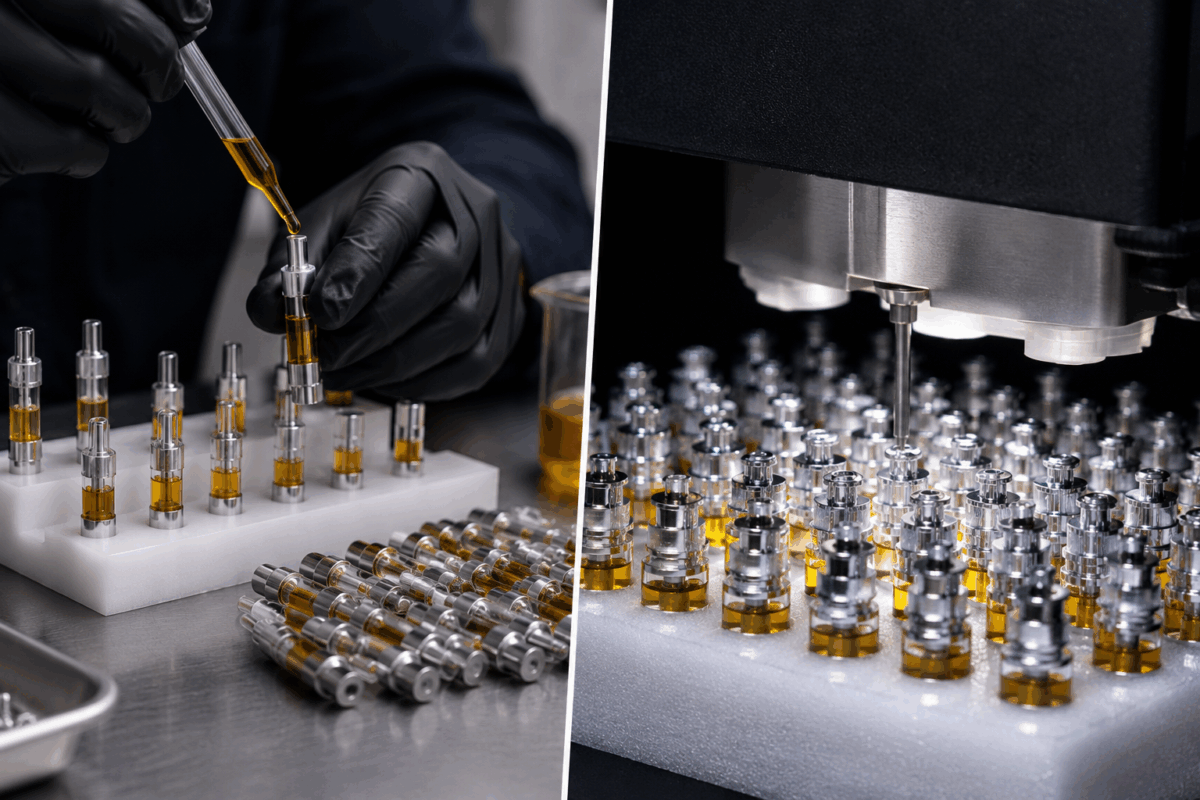
If you’re in the process of wondering whether your facility should stick with manual filling or upgrade to an automated vape cartridge filling machine, it’s likely you’ve noticed a common thread in content.
As you’re researching various machines and their ROI, almost every article or resource is written for operators filling 50,000+ carts per week.
So, if you’re producing less than that, you’re asked to take that math, scale it down, and by the time you’ve closed out the article, you’ll wonder if automation is really right for you or not.
Naturally, factors that affect larger operators differ from those that’ll drive costs at a smaller scale. But most information about manual vs. automated vape filling doesn’t delve deeply enough to uncover what truly makes a difference.
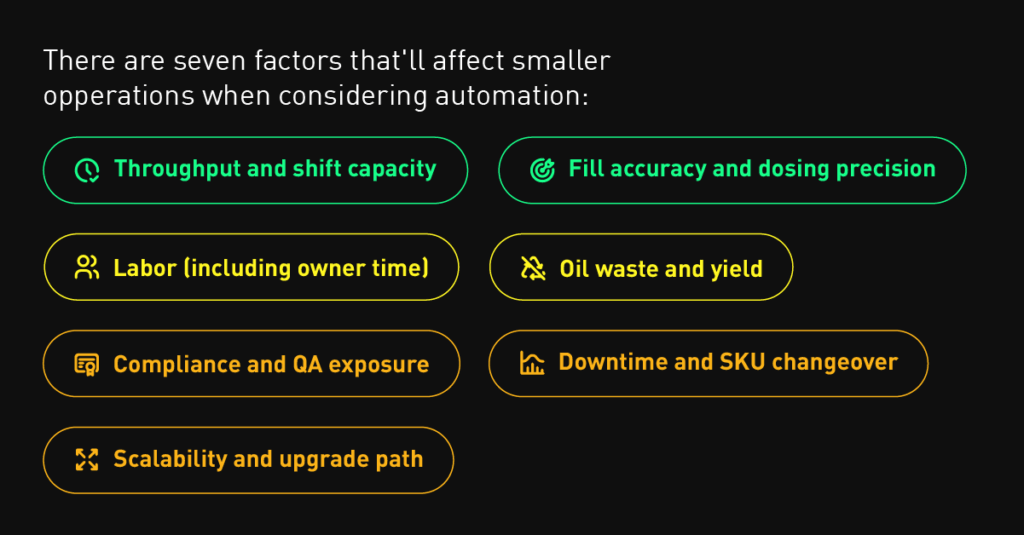
That’s what our guide here sets out to do! Here we’ll cover the seven-factor comparison for small operations to help you decide when manual still makes sense and when it pays off to automate.
Setting the Scope
First and foremost, let’s decide whether or not your operation is actually “small” or not to properly set the scope.
Smaller operations typically produce 500 to 3,000 vape carts per week, with one to four SKUs and just a handful of staff on the production line. The owner is usually heavily involved and even works on the line themselves to get orders out.
If this sounds like you, this article is designed for you. We’ll compare using a distillate gun and other handheld manual tools versus a semi-automatic vape cartridge filling machine, like the Jet Fueler.
Our next section will compare seven cost factors that affect smaller operations but differ from those affecting bigger operations to better help you understand the ROI and overall cost savings.
The Seven Cost Factors That Actually Differ
Side-by-Side at a Glance
To start, let’s compare each category side by side before we unpack each one in more depth.
| Factor | Manual Filling | Semi-Automated (e.g. Jet Fueler) |
| Throughput per shift | 300 to 1,000 carts | 4,000 to 14,000 carts |
| Fill accuracy | ±5% (≈85% precision) | ±0.5% to ±1% |
| Labor per 1,000 carts | 12 to 18 fill-hours | 2 to 4 supervisor-hours |
| Oil waste | 5 to 10% (overfill + rework) | Under 2% |
| Compliance exposure | High variance, high recall risk | Low variance, audit-friendly |
| SKU changeover time | 45 to 90 minutes | 5 to 15 minutes |
| Upgrade path | Replace entire workflow | Modular path to full automation |
Factor 1, Throughput and Shift Capacity
The first factor operators have to consider is the throughput of each filling method. For manual filling on a small scale, you’ll typically top out at 300 to 1,000 carts per shift, depending on staffing levels, skill, and SKU complexity.
Another thing to consider when comparing manual and semi-automatic filling and throughput is operator fatigue. After a full morning of filling carts, this fatigue can reduce the volume of the second half of the shift by 20-30%.
Here the comparison is simple. A semi-automatic vape cartridge filling machine, such as the Jet Fueler, can fill 4,000 to 14,000 carts per shift, depending on several factors. This difference means you’ll be able to complete a full week’s output, or volume, in just part of one shift.
This increase in throughput means you’ll recover shift hours to convert into different products, new accounts, or less labor to run production. At a smaller scale, it’s less about hitting the ceiling of production and more about freeing the calendar to do more.
Factor 2, Fill Accuracy
Another cost factor that’s often overlooked is fill accuracy. Per Cannabis Tech Quarterly, manual filling has an 85% precision rate. That means most fills have a ±5 % variance, forcing operators to overfill defensively to stay above the label weight.
For semi-automated machines, accuracy is much higher. For instance, the Jet Fueler offers ±0.01 mL accuracy under normal operating conditions. This puts it into a whole separate category of precision.
Breaking down the math, a 5% overfill across 2,000 carts per week amounts to 100 grams of oil you’re losing per week. At $4/g wholesale, fill accuracy is affecting your operation by at least $400 a week.
Annually? That totals to more than $20,000. This math makes fill accuracy one of the largest single-line recoveries a small operation can make.
Factor 3, Labor (Including the Owner)
Next is a factor that you’re probably already thinking about but haven’t quantified accurately. Let’s do that now.
In general, manually filling 1,000 carts takes anywhere from 12 to 18 fill hours per week. But that’s not the entire job. After the carts are filled, they must be capped, inspected for quality control, and reworked if underfilled.
These hours add up fast, and you’re likely not tracking them.
The semi-automatic vape cartridge filling machine shifts the role from filling labor to supervising. One operator can run one machine that handles filling, capping, and in-line QC altogether in the same shift.
Here’s where another overlooked cost comes into play. While you might be calculating labor costs using the minimum wage for filling techs, what about the owner that’s involved in filling?
Instead of using $20-$22 an hour, you have to consider the highest-value alternative use of that owner’s time. If they weren’t filling, they could be working on marketing, branding, sales, etc., which would bump the figure up to $50-$150 an hour, depending on the owner’s skill set.
This turns labor cost savings from modest to substantial when framing it more accurately.
Factor 4, Oil Waste and Yield
It’s not just filling accuracy that affects oil waste, however. It’s also rework from carts that fail quality assurance, heating drift from degraded terpenes that fail at testing, or drips and stringy material during the filling and transfer process.
The best vape cartridge filling machines, whether semi-automated or fully automated, will eliminate these leaks all at once.
Closed-loop temperature controls protect the oil from degrading, machine-alignment filling closes the variance gap, and pharmaceutical-grade pumps eliminate waste from dripping or stringy material at the nozzle.
When doing the math, this translates to a 5-10% oil loss in manual workflows versus under 2% with semi-automatic vape cartridge filling machines. If you’re buying $30,000 to $50,000 worth of oil per year, this gap directly recovers $1,500 to $5,000.
For those extracting and producing oil in-house, vape cartridge filling machines help you preserve the most expensive input in your business.
Factor 5, Compliance and QA Exposure
Another less thought-about loss comes from quality assurance and compliance. In most states, underfilled carts on a retail shelf are treated as a labeling violation. Meaning, anyone that’s regularly filling at a 5% variance is at risk.
In this case, you’re not only subject to product recall costs but also to mandated retesting or retailer chargebacks. If you continue to make the mistake repeatedly, your entire license could be at risk.
Even one compliance risk can exceed the entire cost of the machine you’re considering purchasing. Semi-automatic vape cartridge filling machines not only fill more accurately to prevent underfills but also provide audit-friendly fill logs when needed.
Of course, this is an asymmetric factor. Most of the time, you’ll incur no compliance costs for manual filling. However, when a cost does hit you, it can be more than every other factor’s cost combined. Consider it an insurance cost that you have to pay for ultimate protection.
Factor 6, Downtime and SKU Changeover
Another part of the filling process that’s a cost for small operations to consider is the downtime associated with cleaning, tearing down, or SKU changeovers.
Switching between SKUs, cleaning the syringes or handheld tools, breaking down the station for refilling, or resetting temperature ranges can take 45 to 90 minutes per change, multiple times per week.
In comparison, semi-automated systems with clean-in-place cycles reduce the changeover time to just 5 to 15 minutes. In fact, advanced systems like the Jet Fueler can even store SKU profiles for repeatable setup, saving you even more valuable time.
For small operations running four or fewer SKUs and changing twice per week, this amounts to two to four hours of reclaimed production per week. As we touched upon earlier, when the calendar gets less crowded thanks to automation, you can make more while saving, too.
Factor 7, Scalability and Upgrade Path
Finally, it’s time to talk about ceilings. With manual filling, you’ll hit the threshold anywhere between 3,000 and 5,000 carts per week. Getting beyond this ceiling will require an entire workflow overhaul, retraining and retesting processes, and absorbing the downtime during the transition.
If you do enter with a semi-automated vape cartridge filling machine, you have a clearer upgrade path and seamless scalability. The semi-automated machine process will prepare your SOP and infrastructure for a move to fully automated equipment once your volume and profits allow.
Again, this is an often overlooked factor that many small operators undervalue. The decision to stay manual or go semi-automatic is not just about the next 12 months. It’s about the next three to five years and how to keep our operation producing the most consistently.
The Tally for a Typical Small Operation
Now that you have a better explanation of each cost factor, it’s time to see the numbers in real-time. Using numbers from smaller operations, here’s a look at the annual cost of manual filling at 1,500 carts per week.
| Cost Factor | Annual Cost of Manual (1,500 carts/week op) |
| Labor (owner at $75/hr loaded, ~18 hrs/wk) | $67,500 |
| Oil waste (7% on $40K oil spend) | $2,800 |
| Rework (7% × 1,500 × 52 wks × $7 per cart) | $38,200 |
| Downtime (3 hrs/wk × revenue/hr at $200) | $31,200 |
| Compliance exposure (annualized, conservative) | $8,000 |
| Total annual cost of staying manual | ≈ $147,000 |
| Indicative semi-automated machine cost (one-time) | $25,000 to $45,000 |
When Manual Still Wins
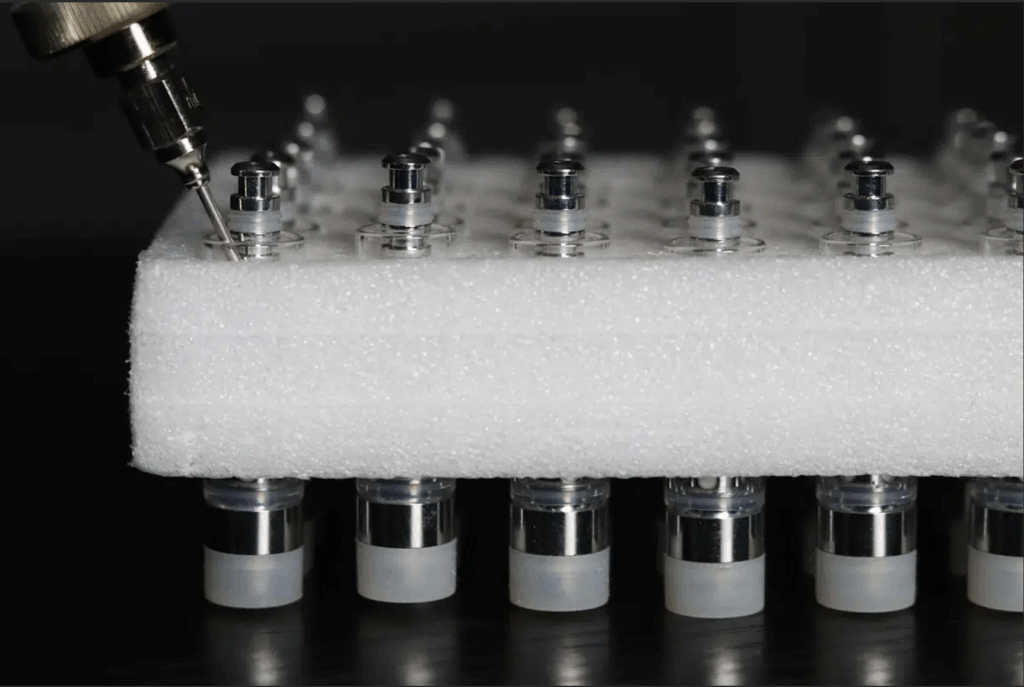
Of course, there is still a case for manual filling when it makes sense. If you’re producing less than 200 carts per week, with a single SKU and no plans to expand, manual workflows will suffice.
They’re also feasible for R&D-only environments when small-batch flexibility outweighs volume or throughput. Manual filling also makes sense for operators in their pre-revenue phase who are still waiting on final licensing.
Finally, operations with severely constrained capital may be unable to justify the investment until a specific profit bridge has been crossed. In this case, start with the breakeven calculator and revisit the consideration of semi-automated workflows, again, in 6 months.
When Semi-Automation Wins
Any operation producing over 500 carts per week with two or more active SKUs and any plan to grow, however, should consider semi-automation.
Especially if you’re an owner-operator who’s working the line often, when your valuable time could be spent elsewhere.
Another case where semi-automation is the clear winner is if your operation is launching something new or expanding within the next 12 months to multiply volume.
Beyond the obvious, semi-automation is also a smart shift for any operators who have had a compliance warning or scare, or even one rework event. This shows how thin the margin of error really is and how valuable the protection of semi-automatic equipment can be.
When Full Automation Enters the Picture
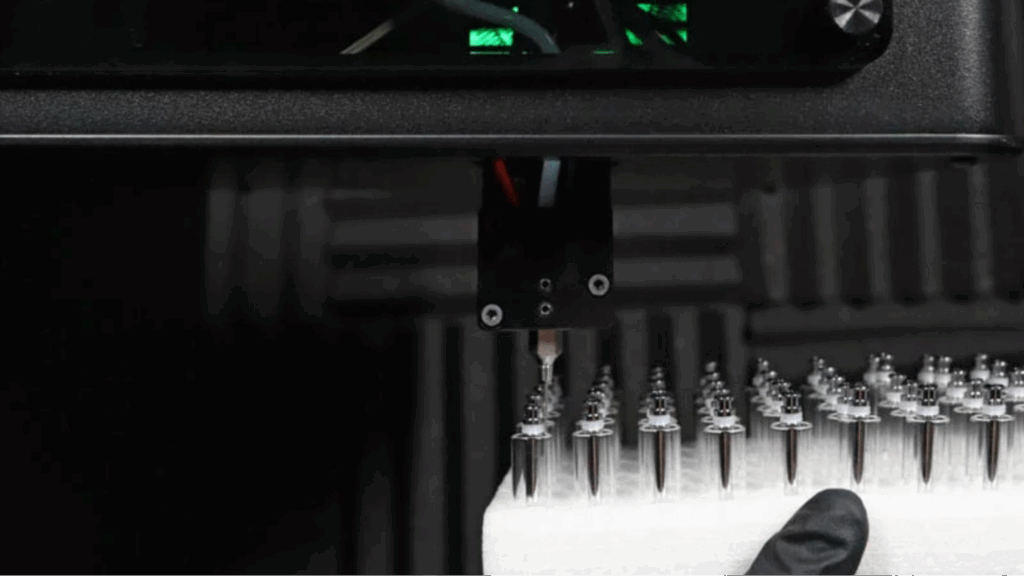
Lastly, as you grow, there will be a time to consider a fully automated vape cartridge filling machine. You’ll start to notice pressure with semi-automated machines when you’re reaching 5,000 carts per week.
At this time, fully automated systems like the Vape-Jet are worth considering. But don’t think by purchasing semi-automation, you’re locked out of moving to fully automated, eventually.
Most vendors (like Vape-Jet) will offer a semi-automated machine and fully automated equipment, allowing the same training base, workflow, and support infrastructure to grow with you.
In Closing: A True Cost Comparison for Small Cannabis Operations
As you’ve learned there, the true cost comparison of manual filling versus automation lies in seven factors: throughput and shift capacity, fill accuracy and dosing precision, labor (including owner time), oil waste and yield, compliance and QA exposure, downtime and SKU changeover, and scalability and upgrade path.
Depending on your exact numbers, manual filling might still be right for you if you’re producing low volumes or craft cartridge filling. However, for anyone producing over 500 carts per week, the proof is in the numbers when conducting a thorough cannabis filling automation comparison.
In the end, it’s not just about labor. It’s about every line item on your operation’s P&L. While the labor savings are real, it’s a small piece of the case for a small cannabis operation considering manual vs. automated cart filling.
Ready to run the true comparison of your operation’s costs? Pop your numbers into our breakeven calculator to learn more, or talk with our crew.
FAQ Section
Q: How does manual vape cartridge filling compare to automated for a small operation?
A: Across seven factors (throughput, accuracy, labor, oil waste, compliance, downtime, scalability), semi-automated systems outperform manual at almost every operating scale above 500 carts per week. The largest gaps appear in fill accuracy (±5% manual versus ±1% automated) and recovered owner time.
Q: What is the cheapest automated vape cartridge filling machine for a small operation?
A: Semi-automated systems for small operators start around $25,000 and reach roughly $45,000 depending on configuration and capping integration. That is a meaningful range, but most small operators recover the cost inside twelve months once labor, rework, oil waste, and compliance exposure are added together.
Q: Can a small craft brand justify an automated vape filling machine?
A: Yes for most small craft brands above 500 carts per week. The justification is rarely just labor savings. It is the combination of recovered owner time, eliminated overfill loss, reduced rework, lower compliance exposure, and a defined upgrade path that protects the operation as it grows.
Q: What is the difference between semi-automatic and fully automatic vape cartridge filling?
A: Semi-automatic systems automate the dispensing and pumping but still require an operator to load and unload cartridges. Fully automatic systems also automate alignment, loading, and capping. For most small operators, semi-automatic is the right entry point and full automation becomes warranted above roughly 5,000 carts per week.