
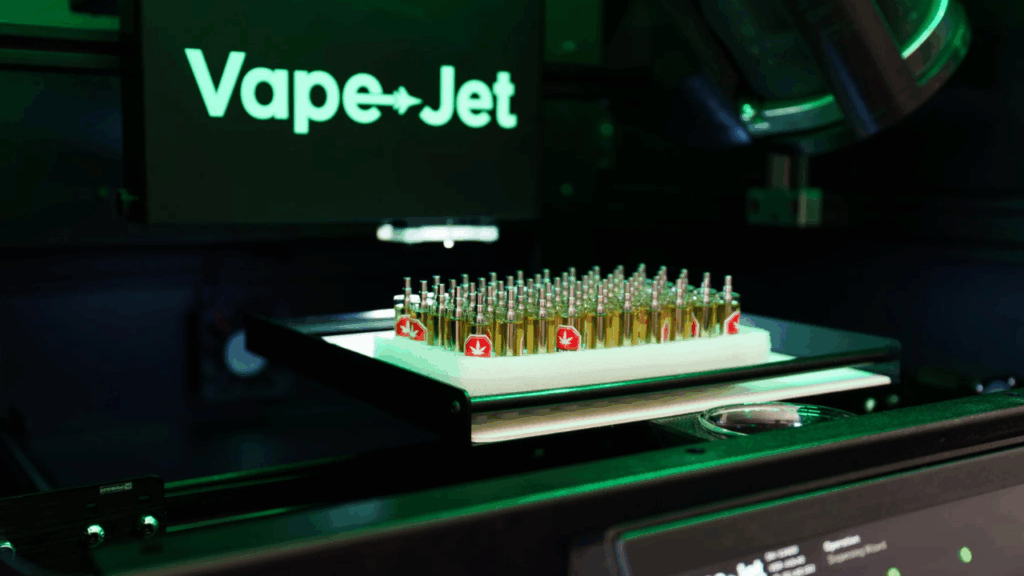
If you’re a small operator, it’s likely you’ve already begun exploring semi-automatic vape cartridge filling machines or even fully automatic machines, as a way to beat labor costs.
In fact, you’ve likely already run the quick math to get to a rough break-even point. You’ve divided the cost of the machine by the hourly wage of your tech and, at $40,000 a machine and a $22/hour tech, figured out you’ll get back to zero after approximately 1,800 hours.
Of course, that equation only factors in one variable. It doesn’t factor in three silent variables that speed up your payback far more than just your labor line item.
In this guide, we’ll go beyond just labor and break down four variables that affect the breakeven point for investing in vape cartridge filing equipment. Keep reading to dive deeper and to learn from two real-world examples, producing both 500 and 2,000 carts per week.
The Four Variables in a Real Payback Calculation
Although labor costs might be hurting you the most, that’s only one variable in the payback calculation when considering cartridge filing machine costs. If you want to know your facility’s real payback point, you’ll need to consider four variables, including:
- Variable 1, Labor cost: The most obvious variable we’ll cover; we’ll break down the number of hours you’ll save per week and multiply that by not just the hourly rate but the fully loaded hourly cost. That includes wage plus payroll tax plus benefits, which usually equals 1.25 to 1.35 times the tech’s base pay.
- Variable 2, Rework and oil waste recovered: In your current operation, you’re likely losing X amount of oil and finished products to underfill, overfill, product leaks, and temperature-driven failures. With a vape cartridge filling machine, you’ll recoup the losses, making the recovery a viable variable to consider.
- Variable 3, Throughput recovered: You’ll also recover time and money through increased throughput, transforming all the carts you normally couldn’t fill because you ran out of human hours into sellable inventory to include in your calculations.
- Variable 4, Owner opportunity cost: Ever do the math on your own hours? Of course not; you’re the owner. But your time is valuable and takes you away from other profit-building skills, so it should be a part of the payback calculation. Here, we’ll quantify how much time you’re spending at the fill station instead of selling, building accounts, designing SKUs, or, let’s be honest, resting.
Variable 1, Labor (Including the Owner’s)
The first variable to consider for cartridge filling machine payback is labor. Your team’s labor and the labor of the owner or facility leads. Let’s walk through the simple math at a smaller scale first.
Manually filling 1,000 carts per week takes anywhere from 12 to 18 fill hours depending on operator speed and SKU mix. Multiply that by 50 weeks, and you’re looking at 600 to 900 hours per year.
When doing the math previously, you may have been multiplying that by a standard rate, for instance, by $22/hour, if that’s what you pay your techs. But that’s not exactly the full picture.
With payroll taxes and benefits, the “loaded” hourly rate you’re really paying each tech is more like $28. Multiply that by 600 to 900 hours, and you’re paying just one tech between $16,800 and $25,200 annually for labor cost manual filling.
Of course, if you, the owner, are the fill tech, $22/hour is not the rate to use for accurate calculations. You should enter the amount you’d otherwise earn per hour from running and managing the business.
For most small operators, that rate ranges from $50 to $150 per hour, suddenly bumping your labor cost line for manually filling to $30,000 to $135,000 per year.
This owner-operator opportunity cost of manual filling is much more than any normal, let alone small, operation can handle annually.
Variable 2, The Rework You Stop Paying For
Next, we have to address the loss that occurs during manual cart filling. According to industry benchmarks, manual workflows have an 85% dosing precision, meaning. At a small scale, that translates to a 5 to 10% rework rate.
Let’s put those numbers into a concrete example. Say you have a 1,000-week period, and we’ll assume an average rework rate of 7%. That’s 70 carts.
With an oil cost per gram of $4-$6 and hardware at $2-$4 a cart, multiply that by 70 carts or devices, and that’s $420-$700, not including labor. With hourly wages, you’re looking at an impact of $700-$1000 per week in rework alone.
Over a 50-week year, that weekly rework can total $35,000 to $50,000. But luckily, it’s a margin that automation can help recover.
A semi-automatic vape cartridge filling machine is typically equipped with a 0.5% to 1% accuracy rate (plus or minus), closing that gap and saving you from rework costs that compound over time.
Variable 3, The Throughput You Are Leaving on the Table
The next variable to consider when determining cartridge filling machine ROI is the vape cartridge filling machine throughput you’re leaving on the table. In the cannabis industry, most small operators aren’t constrained by demand. They’re constrained by your capacity to fill them.
The carts you could be selling but can’t fill are real revenue. They’re just invisible on the P&L because they never get invoiced.
Here’s what the equation will look like to calculate how much revenue you’re leaving on the floor, using the Jet Fueler, Vape-Jet’s semi-automatic vape cartridge filling machine, as an example.
The Jet Fueler can produce 4,000 to 14,000 carts per shift. So if you’re producing 2,000 carts per week, that means one operator could finish an entire week in one single shift.
Those remaining hours in the week are invested directly back into the operation. The tech now has time to devote to new SKU runs, new wholesale orders, or to taking on more co-packing work.
To turn that time into money, we’ll use $5 per cart as an example of wholesale margin. Leaving 500 carts per week unfilled at $5 per cart leaves $130,000 of unrealized margin on the table.
Any machine at or near this price pays for itself with revenue that does not yet exist, which is the hardest number to calculate and one that’s almost always missed by operators considering small cannabis operations scaling.
Variable 4, The Hours You Cannot Buy Back
Variable 4 definitely hits home. It’s a primary driver behind your research into cartridge-filling machine payback and one of the biggest game-changers for operators who have already made the switch.
It’s the extra time you, or any owner, spend on or off the clock to fulfill orders and fix orders. Time that could be used to gain new accounts, build your brand, handle regulatory matters, prepare for the next SKU launch, or spend time with your family is wasted at the fill station.
To quantify the time and cost, let’s say you spend 10 hours a week filling carts. If you were to take that time and put it towards a high-value alternative task, you’d be making around $75/hour.
That’s over $750 of your own time per week and nearly $37,500 per year in opportunity cost the labor-only math never captures. By filling manually, not only are you stressing and potentially missing friends, family, and loved ones… you’re losing money.
Just remember, the pilot of the plane doesn’t also pump the fuel. Your time and skills are more valuable used elsewhere.
The Calculator: Two Worked Scenarios
Here’s where the work gets real. Take a look at two real-life scenarios of small cannabis operations producing 500 carts per week and 2,000 carts per week to compare to your own.
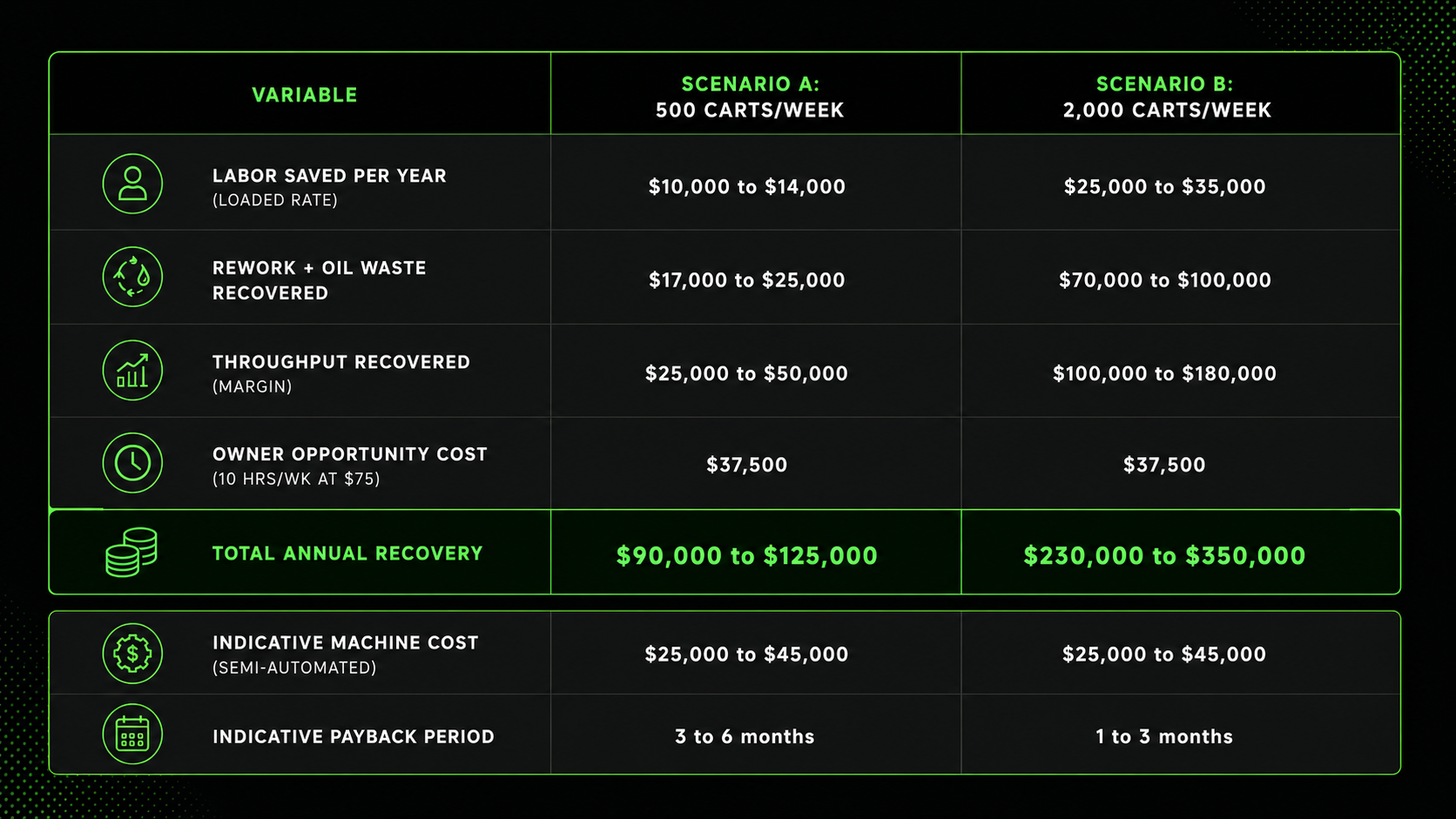
This is the math an operator running these inputs would see. Plug your own numbers into the equations provided to get a real-life look at what you could save.
What Changes the Math Faster Than You Think
Of course, there are industry outliers that affect labor, costs, and payback. Here are three accelerators to keep in mind that could affect the equations we’re discussing today.
- Adding a second or third SKU: When adding a SKU to manual workflows, it multiplies the time and costs of changeovers, whereas machines handle them with a change in profile configuration.
- One compliance event: A single underfill recall can cost more than the machine. Add up the handling of recalls, retailer chargebacks, and testing re-runs, and you’re adding up money fast.
- A staffing event: Manual workflows depend on your team, so if a fill tech leaves, gets sick, or relocates, your flows are suddenly disrupted. Automation helps keep your operation moving and products getting out the door.
When the Machine Does Not Yet Pay for Itself
Finally, it’s important to note that vape cartridge filling machines aren’t for every operation. If any of the following stick out as true for you, a vape cartridge filling machine might not be the right move:
- If you produce fewer than 200 carts per week with a single SKU and no near-term plan to expand.
- If you run R&D-only operations or pilot runs with frequent oil reformulation.
- If you’re in pre-licensing and waiting on final paperwork. Capex before revenue is rarely the right move.
In all other cases, the math tends to favor automation earlier than operators expect, even in small cannabis operations.
The Vape Cartridge Filling Machine Equation: Looking Ahead
As you’ve learned here today, when considering a semi-automatic or fully automatic vape cartridge filling machine, it’s not just labor costs you’ll be recouping; it’s more.
Our guide has taught you that there are actually three other variables to consider in addition to labor hours: the rework, the throughput, and the opportunity costs.
Now, you can run the calculations with your own numbers and see just how quickly you’ll achieve cartridge filling machine payback when using all four variables, not just one.
If the payback is shorter than you expected, and you’re ready to start seriously considering a vape cartridge filling machine, you’re in the right place. Take operational flight with Vape-Jet.
Talk with our crew about our fleet of machines and which would best fit your current workflow.
FAQ Section
Before you go, check out answers to the most frequently asked questions about cartridge filling machine costs.
Q: How long does it take a semi-automatic vape cartridge filling machine to pay for itself?
For small operators in the 500 to 2,000 carts per week range, payback typically lands between three and twelve months once labor, rework, recovered throughput, and owner opportunity cost are included. The single-variable labor-only math usually overestimates payback by a factor of two to four.
Q: What does a semi-automatic vape cartridge filling machine cost?
Semi-automated systems for small operators typically fall in the $25,000 to $45,000 range, depending on configuration, capping integration, and SKU flexibility. Fully automatic systems sit higher. The decision is less about price and more about volume, SKU complexity, and how the math works against your own production numbers.
Q: How do I calculate opportunity cost when I am the one doing the filling?
A: Use the hourly rate you would earn doing your next-best activity (sales calls, new account development, SKU design, regulatory work). For most owner-operators, that figure sits between $50 and $150 per hour. Multiply by hours spent filling per week and then by working weeks per year.
Q: Is a cartridge filling machine worth it for a small craft brand?
A: For craft brands above roughly 500 carts per week, the math usually works. Below 200 carts per week with no expansion plans, manual is still defensible. The honest answer requires running the four-variable calculation against your own production, rework, and time numbers.