

Manual vs Automated Filling: A Crucial Production Choice
When it comes to scaling your vape cart operation or entering the vape cartridge space, every operator faces a crossroads: should I automate my workflow or continue using manual labor to fill each device or cart?
It’s only natural, at this intersection, to start wondering about the differences between distillate guns vs. cart-filling machines. While distillate guns are the preferred choice for emerging brands or beginners, automated vape cartridge filling equipment is the inevitable choice as volume grows.
So, whether you’re just exploring new workflows or thinking about adding high-volume cart filling to your operations, this is the guide for you. Here, we’ll dive deep into all the pros and cons of manual vs automated cart filling to help you decide which is right for you.
What Is a Distillate Gun?
To start, let’s cover the definitions and basics of both devices. A distillate gun is exactly what it sounds like. It’s a handheld “gun”- type device with a heated syringe-like filling tool that fills vape carts or all-in-one devices when its trigger is activated.
This method is entirely manual, so it’s best for smaller labs looking to add vape carts or all-in-one devices to their product SKUs, or for early-stage brands without the volume or capital to purchase fully automated equipment.
In general, depending on the operator, distillate guns can fill 300-1,000 units per day. However, this can often come at a cost. Not only can operators become fatigued quickly from repetitive strain, negatively affecting morale, but fatigue can also lead to inconsistent fill volumes.
Another factor that affects filling with distillate guns is the need to maintain temperature stability manually. Without advanced equipment to heat the extract material for you, you’ll be responsible for heating it yourself, increasing the risk of high product loss from drips, stringing, and reloads.
Obviously, with the manual labor required to operate a distillate gun, this method has higher labor costs, which should be considered as part of the overall cost during initial conversations about which method to choose.
What Is a Cart Filling Machine?
For automated distillate filling, operators turn to vape cartridge filling equipment to alleviate labor costs and to increase daily output. These high-volume cart-filling solutions can produce 2,000- 100,000+ units per day, depending on the exact type you select.
Beyond throughput, one of the most notable benefits of vape manufacturing automation is its ability to maintain stable temperatures. Most advanced equipment features advanced temperature controls, allowing you to fill with distillate and other thicker materials.
No matter the type of extract you’re using, vape cartridge filling equipment is also more accurate, with fills typically within ±1–2% per fill for tight tolerances. They’re also designed to minimize drip, helping reduce waste overall.
For maximum efficiency, it’s best to seek out equipment that offers repeatable, SOP-driven performance or configuration profiles within its interface. This allows you to seamlessly switch between SKUs, including various extracts or fill sizes.
All in all, automated solutions reduce operator labor to a supervisory role only, alleviating your team from manual labor and increasing consistency and quality. Machines like Vape-Jet also offer add-ons that integrate with cappers to automate your workflows further.
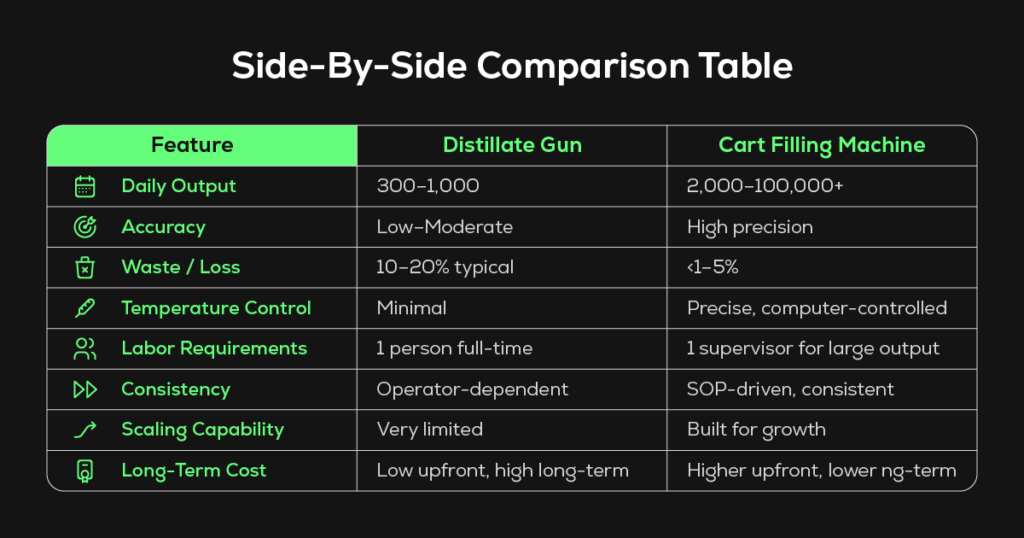
Side-By-Side Comparison Table
When deciding on a distillate gun vs a cart-filling machine for your operation, there’s nothing like a side-by-side comparison table to help. To summarize the main differences you need to know for scaling, take a look at the comparison of the major factors below.
Key Factors to Consider When Choosing
So, how do you know which is right for your operation when considering manual vs automated cart filling? There are a few key factors you’ll want to review and consider when making the decision, including:
- Batch size & daily output goals: Even if you’re starting small, if you plan to expand, or if retailer demand for higher output, you’ll want to consider long-term profitability. While distillate guns may suffice today, as output increases, you’ll need to consider automated solutions for optimal efficiency.
- Compliance & QA consistency requirements: If accuracy is a concern for compliance and quality assurance, automated solutions are also the way to go, as they are much more accurate fill-wise and less prone to human error.
- Budget vs long-term ROI: Manual tools may be cheaper upfront, but automated systems often deliver more substantial long-term ROI by reducing waste, labor hours, and rework. The more volume you run, the faster automation pays for itself.
- Oil type (distillate, live resin, rosin, HTE blends): If you plan to expand into more viscous materials, such as live resin or rosin, you’ll want to consider selecting automated equipment with temperature controls and support.
Lastly, consider your labor availability. If you’re running a lean operation with minimum staff, the need for hands-free operation will be greater than those that have the team size to support the bandwidth of manual filling.
If labor costs are an ongoing concern for you, it’s definitely wise to consider automated solutions. Manual workflows require consistent staffing and skill to maintain quality, and quality can decline toward the end of shifts due to operator strain.
Cost Comparison: True ROI of Automation
As we already mentioned, it’s not just the initial cost you’ll want to consider when deciding between distillate guns vs cart-filling machines. You’ll also want to consider long-term profitability and the ROI of automation in the long run.
With that said, distillate guns are far less expensive up-front than vape manufacturing automation equipment. But they do produce higher levels of waste and require more labor, which drives up costs overall.
Automation, on the other hand, reduces waste and manpower to just one or two operators while filling more carts or devices per hour. Since scaling requires efficiency and consistent product quality, operators have no problem justifying the cart-filling machine cost when seeing the value they’ll get in return.
To summarize, even though vape cartridge filling equipment costs more initially, it provides long-term savings with:
- Labor reduction
- Higher throughput
- Reduced oil waste
- Fewer failed QA checks and less rework
When a Distillate Gun Might Still Make Sense
Of course, high-volume cart filling equipment isn’t for everyone. A distillate gun is sufficient for micro-batch production or for facilities and labs conducting R&D. They’re also well-suited for those who want to start small or have a lower budget.
With a trustworthy team and the proper protocols in place, distillate guns can fill small-batch orders with accuracy, allowing operators to scale to larger equipment later as profits and capital build over time.
When a Cart Filling Machine Is the Superior Choice
If you’re already producing small- to mid-sized volumes and seeking to scale to the next level, it’s wise to consider a cart-filling machine. But keep in mind, not all vape cartridge filling equipment can be treated equally.
When searching for the superior choice, there are a few features that’ll support the streamlining of workflows and help improve product quality, including:
- Data-driven precision
- Pharmaceutical-grade engineering
- Cleanroom compatibility
- Reduced human error
- Future scalability
- Support + software updates
Why Choose Vape-Jet Machines Over Generic Automation
There’s a good reason the top vape cart brands choose Vape-Jet for their automated vape cartridge-filling equipment. The Vape-Jet is designed to address the industry and manufacturing challenges we’ve discussed here today.
The company’s fleet of equipment is designed and manufactured in the USA, and hand-made using American-made parts. It offers every facility the complete training and ongoing support that come with its equipment, with customized SOP guidance for a smooth onboarding.
As for equipment features, the Vape-Jet delivers efficiency, quality, and accuracy through machine-vision alignment, pharmaceutical-grade pumps, and a nitrogen-pressurized fluid path that protects the integrity of the precious materials used in its filling processes.
To further assist the vape filling process, Vape-Jet’s clean-in-place procedures allow seamless SKU switchovers, closed-loop temperature control to maintain optimal temperatures for various viscosities, and a repeatability rate of ±0.25% with the lowest transfer loss on the market.
Finally, the manufacturers of Vape-Jet are constantly working to improve the Vape-Jet based on direct customer feedback. They routinely add new features, can customize and modify the machines to your workflows, and continually apply software updates to improve processes.
Final Takeaway
As you’ve learned here today, when deciding between distillate guns vs cart-filling machines, there’s a time for distillate guns, and there’s a time for vape cartridge-filling equipment. For operators, it’s all about defining your facility’s long-term goals and overall product demand.
While distillate guns are sufficient for small-batch, entry-level needs, vape manufacturing automation is essential once volume and consistency matter. When it is time to get serious about scaling, there’s one high-volume cart-filling machine to consider over the rest: Vape-Jet.
Ready to Upgrade Your Filling Line? Get a Demo or Quote from Vape-Jet.